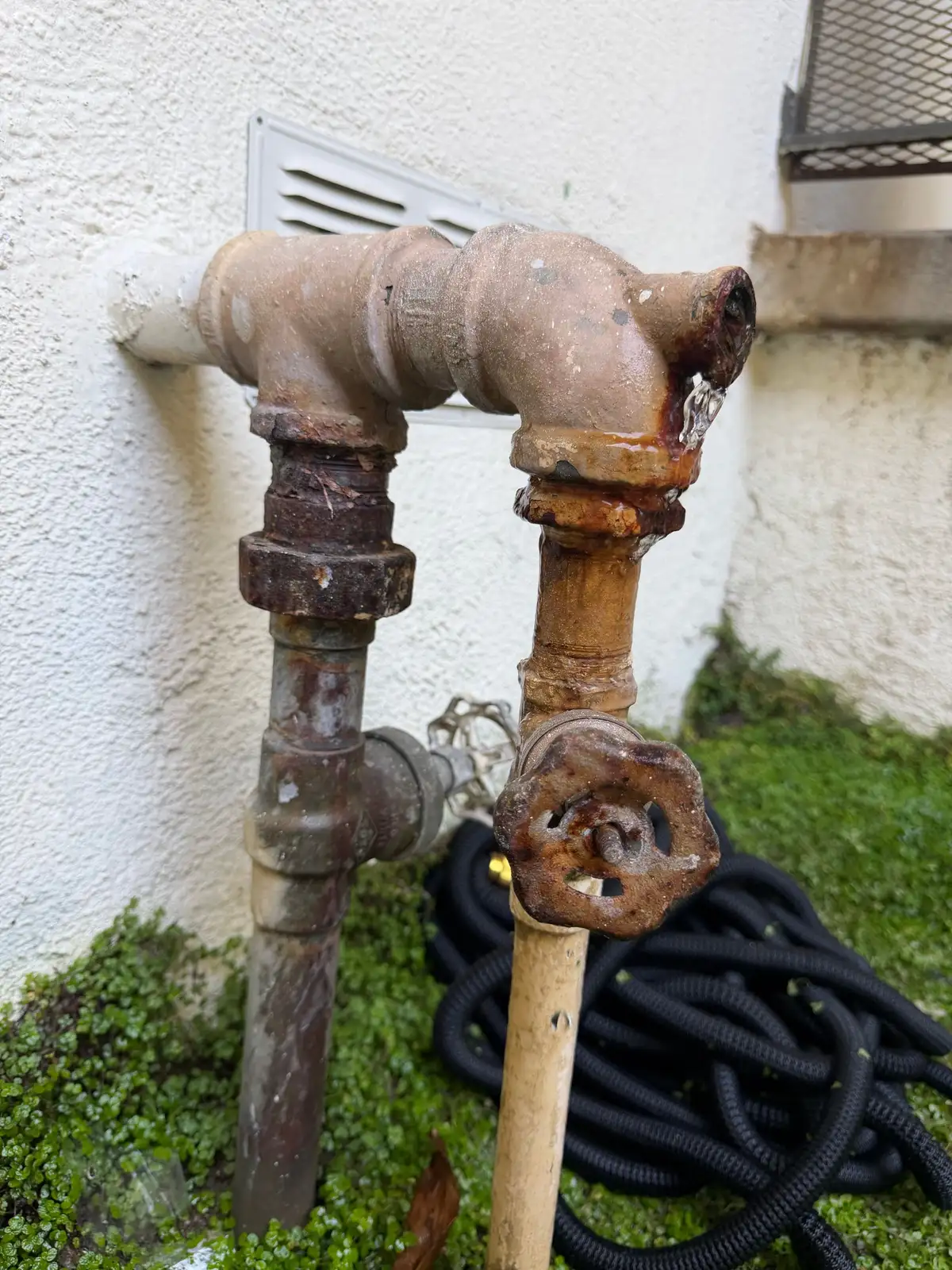
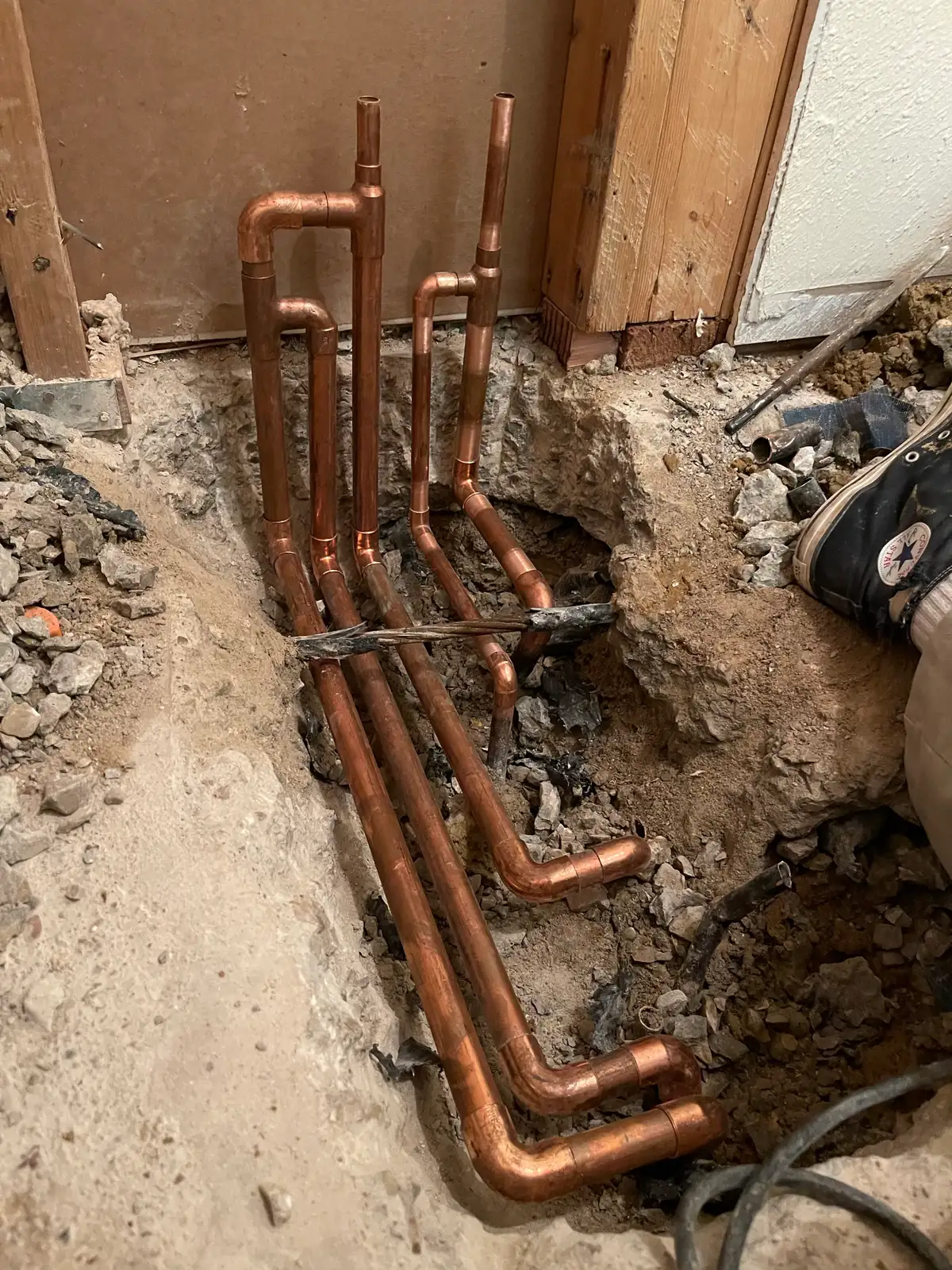
A slab leak is exactly what it sounds like — a pressurized supply line or drain line that's leaking beneath the concrete foundation of your home. Water escapes, saturates the subgrade, and either works its way up through the slab or migrates outward under your landscaping. Left alone, it warps hardwood, feeds mold colonies inside walls, undermines the slab itself, and eventually surfaces in a way that's much more expensive than catching it early would have been.
Most South Bay homes with slabs were built between 1948 and 1975. That era's standard was copper supply lines embedded directly in the concrete — sometimes with minimal or no protective sleeve. Fifty-plus years of soil movement, thermal cycling, and electrochemical corrosion have put those lines at or past their design life. In areas like Old Torrance, Hawthorne's Hollyglen neighborhood, and the post-war tracts in Gardena and Lawndale, we see multiple slab leaks per block on older streets.
The good news is that slab leaks rarely appear without warning. There are seven patterns that show up consistently before the damage becomes serious. Knowing what to look for can save you the difference between a $2,800 electronic detection and targeted reroute versus a $25,000 slab excavation and remodel.
Signal 1: Hot or warm spots on the floor
Walk your floors barefoot in the morning when the slab is coolest. If you feel a warm patch — especially in a hallway, near a bathroom, or along a kitchen wall — that's heat transferring up from a hot-water line leaking below the concrete. The water isn't necessarily standing on the surface yet; it's saturating the slab and conducting warmth upward.
This is one of the earliest and most reliable indicators. It means the leak is on the hot-side supply, which is the more common failure point. Hot water is more corrosive to copper than cold water, and it runs at higher pressure. The temperature differential also puts the pipe through more expansion and contraction cycles over its lifetime.
Don't dismiss a warm spot as radiant heat from the sun or a slab that just runs warmer. Test it at 6 a.m. before any sunlight has hit the floor. If it's still warm, call for a detection.
Signal 2: Your water meter is spinning when nothing is running
Turn off every fixture, appliance, and valve inside the house. Go to your meter box at the curb and watch the flow indicator — usually a small dial or triangle on the meter face. If it's moving, water is leaving the meter and going somewhere other than a fixture. That somewhere is almost always a leak.
For a more conclusive test, take a meter reading, wait 30 minutes without using any water, and take a second reading. Any change confirms an active leak in the supply system. This works for slab leaks as well as line leaks between the meter and the house.
This test costs nothing and takes 30 minutes. It's the first thing we recommend when a homeowner suspects a problem but hasn't seen visible water yet.
Signal 3: A water bill that jumps without explanation
A residential household in the South Bay that uses 8–12 CCF per month and suddenly shows 18–22 CCF without any change in usage patterns has lost water somewhere. A small slab leak — even a pinhole — can waste 250 to 400 gallons per day depending on line pressure. At current LADWP or California Water Service rates, that translates to a $60–$120 monthly spike that compounds every billing cycle you wait.
Compare three to four months of bills, not just the most recent one. A slab leak often starts small and grows. A bill that has been creeping up over two or three cycles is more telling than a single anomalous month, which could be a running toilet or an irrigation controller malfunction.
If your bill jumped and your meter test (Signal 2) confirms active flow with everything off, you have a leak somewhere in the pressurized supply system. The next step is determining whether it's above or below the slab.
Signal 4: Audible running water with everything off
Put your ear to the floor in a quiet room. Some homeowners describe it as a faint hiss, a low trickling sound, or a rushing noise that seems to come from inside the walls near the baseboard. This is pressurized water escaping through a breach in the line and moving through voids in the subgrade or along the underside of the slab.
It's easiest to hear in single-story homes and in rooms over the center of the slab, away from HVAC equipment. If you can hear it at the floor but not at the wall, the source is likely below rather than inside the wall cavity — which points to the slab.
Audible running water is a signal that the leak is active and likely not small. At this stage, the subgrade beneath that section of floor is already saturated.
Signal 5: Warped, buckled, or damp flooring
Water migrating upward through a slab concentrates at cracks and expansion joints. When it reaches the surface, it saturates whatever floor covering sits on top. Hardwood and engineered wood buckle and cup. Laminate swells at the seams. Even tile can develop efflorescence — white mineral deposits — at grout lines as moisture wicks through.
In carpet, the first sign is a damp or musty smell at floor level before you see any visible moisture. If you pull back a corner of carpet near a wall and the tack strip or pad is wet, the moisture is coming from below, not from a spill or surface source.
Warped flooring is a later-stage signal. By the time you can see floor damage, the subgrade below has been saturated for days to weeks. If you're at this stage, fast detection and repair is no longer optional.
Signal 6: Mold or mildew smell with no visible source
A musty smell at floor level — particularly in a hallway, along a bathroom wall, or under kitchen cabinets — that you can't trace to a visible leak under fixtures is a slab leak indicator until proven otherwise. Chronic moisture from below the slab creates exactly the damp, dark, low-airflow environment that mold needs. The mold colony itself is often inside the wall cavity at the base, not visible without opening drywall.
This signal frequently shows up in Redondo Beach homes near The Avenues and in San Pedro's older hillside blocks, where original copper supply under the slab has been dealing with decades of soil movement and salt-air humidity. The smell appears long before any staining or visible growth reaches the surface.
If you smell it and can't find the source, a [leak detection inspection](/services/trenchless/leak-detection) is the right first call — not a mold remediation company. Remediating without finding and stopping the source is money spent twice.
Signal 7: Low hot-water pressure at one or more fixtures
If your cold-water pressure is normal at a fixture but the hot side runs noticeably weak, that pressure drop is telling you something about the hot-side supply line. A breach in the line allows water to escape before it reaches the fixture, reducing flow at the tap. The effect is most pronounced at fixtures farthest from the water heater — back bathrooms, secondary kitchen sinks.
This is distinct from a water heater performance issue (which affects temperature, not pressure) and from a whole-house pressure problem (which affects both hot and cold equally). Isolated low pressure on the hot side, specifically, is a supply-line problem — and in a slab-built home, that line almost certainly runs under the floor.
Test it by comparing hot and cold flow at two or three different fixtures. If the cold-to-hot pressure discrepancy is consistent across multiple locations, you likely have a hot-side leak somewhere in the [underground supply line](/services/trenchless/leak-detection) between the water heater and those fixtures.
What electronic detection actually involves
When we get a call with two or more of these signals, the standard process is electronic leak detection before any cutting or excavation. We use acoustic amplification equipment that listens for the specific frequency of pressurized water escaping through a pipe breach. Combined with thermal imaging where the floor type allows it, we can typically locate the leak within 12 inches without opening anything.
The detection process on a standard single-story slab home takes two to four hours. The output is a marked location on the floor, a depth estimate, and an assessment of the surrounding pipe condition. That last part matters: if we find one pinhole in a 55-year-old copper line, the rest of the line is the same age. A targeted spot repair may solve today's problem but leave you with another leak in 18 months.
For homes in areas like [Lomita and the surrounding South Bay](/services/trenchless/leak-detection) where post-war tract construction dominates, we often find that the detection scope reveals broader pipe deterioration that makes a full copper-to-PEX reroute the more cost-effective decision over a 5–10 year horizon. We'll present both options with honest numbers — the reroute cost, the spot repair cost, and the realistic probability of recurrence based on pipe age and condition.
Reroute versus repipe: how to think about the decision
A targeted reroute runs the new line through wall cavities and/or attic space, bypassing the slab entirely. It avoids jackhammering but requires access points in drywall. Cost typically runs $1,800 to $4,500 for a single line reroute, depending on length and routing complexity. It's the right call when the rest of the supply system is in reasonable condition and the leak is isolated.
A full repipe replaces all hot and cold supply lines from the meter to every fixture, running new PEX through the walls and attic. In most South Bay tract homes built before 1970, this runs $6,500 to $14,000 depending on square footage and fixture count. If you've had two or more slab leaks in five years, or if detection reveals that your remaining copper is showing pitting and wall thinning throughout, a full [whole-house repipe](/services/repipes) is the last slab-leak repair you'll ever need.
The detection results drive the recommendation. We don't push toward the larger scope without the data to back it up. If a reroute solves the problem cleanly, that's what we'll propose.
What to do if you're seeing these signs
Run the meter test first — it's free and takes 30 minutes. If the meter is spinning with everything off, you have an active supply leak somewhere. If you're seeing two or more of the signals above, don't wait for the floor to warp or the mold to surface. The cost of detection is a small fraction of the remediation cost at the damage stage.
Mainline No-Dig Trenchless Plumbing holds C-36 license #901735 and has been running leak detection and slab repair work across 16 South Bay cities for 18+ years. We dispatch 24/7 with a 60-minute target response for emergencies, and we don't charge overtime rates for after-hours calls.
If you're noticing any of the signals above, call us at (310) 808-7343 or use the contact form on this page. We'll tell you honestly what the detection scope involves, what it costs, and what your options are once we know where the leak is.
Frequently Asked Questions
What are the warning signs of a slab leak?
The most common signs are an unexplained jump in your water bill, the sound of running water when everything is off, warm spots on the floor, cracks in flooring or walls, low water pressure, and mildew or moisture under carpet. Catching these early prevents foundation damage.
Is a slab leak an emergency?
A slab leak should be addressed quickly. Even a slow leak under the foundation can erode soil, crack the slab, and cause mold and structural damage over time. If you see warm floor spots, hear running water, or have a sudden water-bill spike, schedule electronic leak detection right away.
How do plumbers find a slab leak without breaking the floor?
Electronic leak detection uses acoustic listening equipment and pressure testing to pinpoint the leak location under the slab before any concrete is opened. This lets the repair be targeted — or rerouted above-slab — instead of excavating the entire foundation.
Tags
Related Services