An annual sewer line inspection on a pre-1970 South Bay home is a $250 camera-only appointment — free when it's paired with any service call or a trenchless or repair quote — and takes roughly 45 minutes. A raw sewage backup — the thing it prevents — typically runs $3,000–$8,000 in emergency plumbing alone, plus cleanup, possible drywall, and flooring. The math isn't subtle. For homes with clay tile, Orangeburg, or cast iron laterals, once a year is the right interval.
The South Bay is dense with exactly that housing stock. Old Torrance bungalows from the 1920s, post-war tract homes in Gardena and Lawndale, pre-war blocks in Vinegar Hill and Old San Pedro — these neighborhoods collectively have tens of thousands of sewer laterals that are 50 to 100 years old and have never been looked at. Most of them are fine. Some of them are not, and those homeowners don't find out until a Saturday night backup.
What the camera actually shows
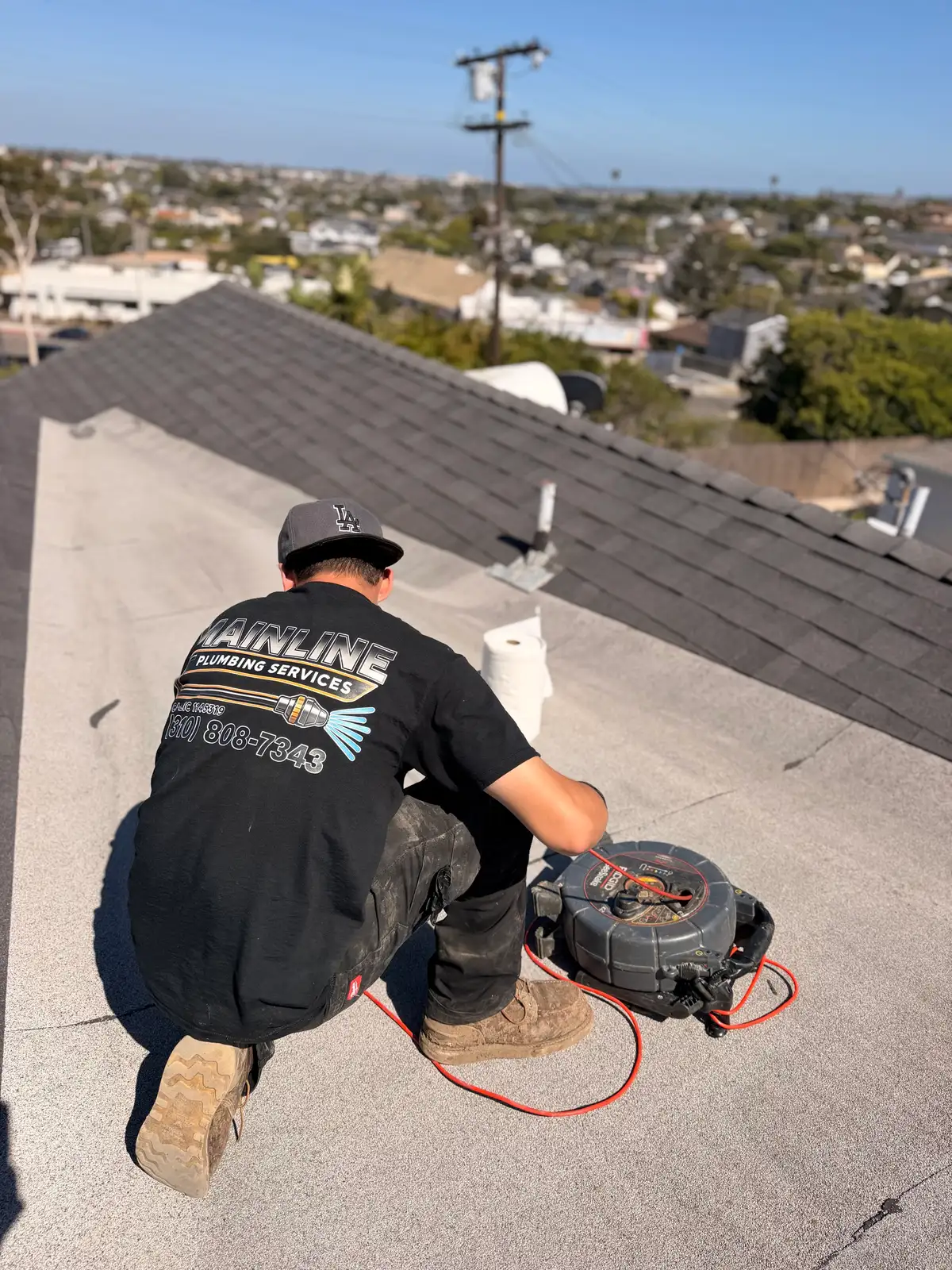
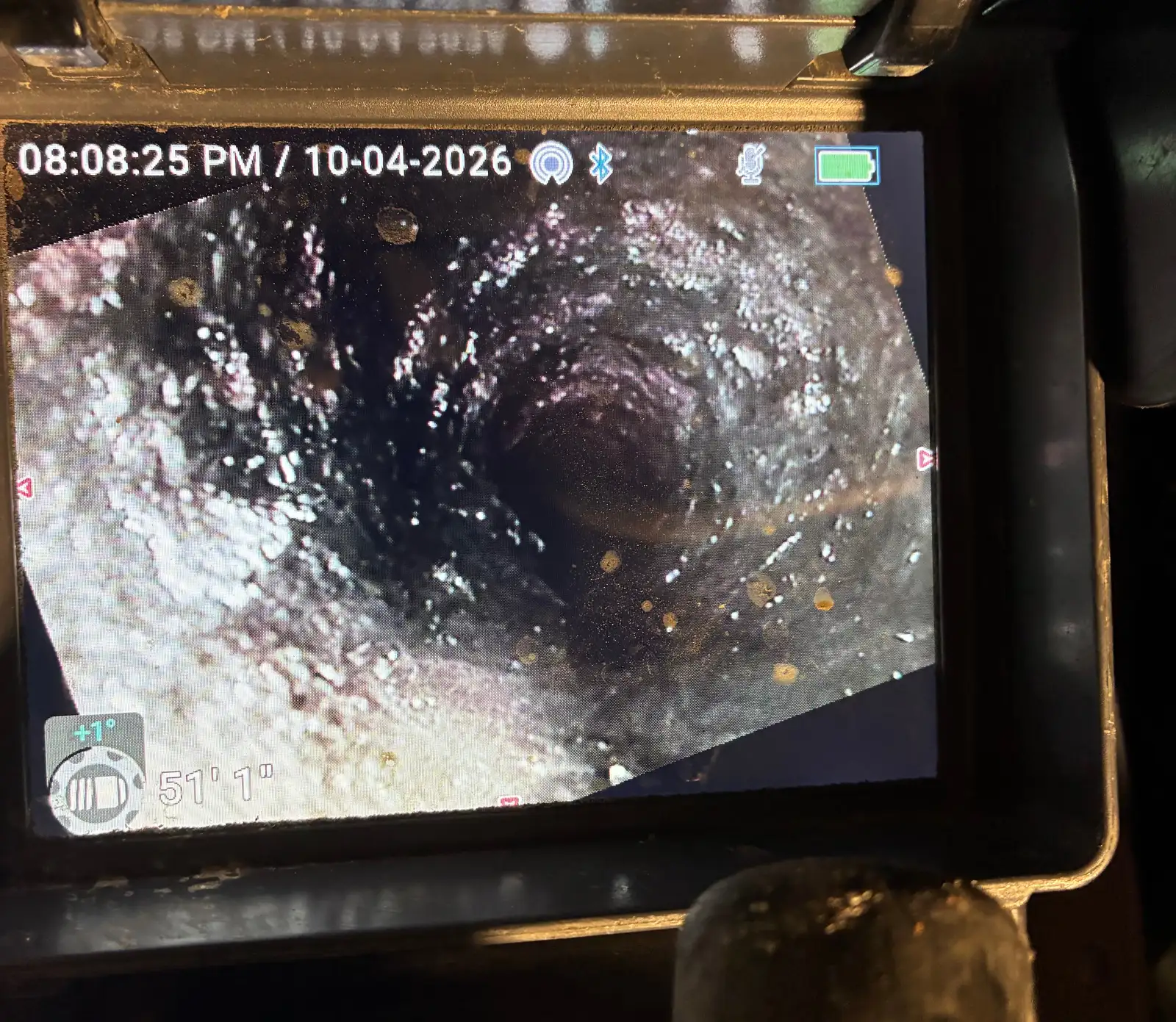
A push-rod camera runs from your cleanout access point — typically in the yard or near the foundation — through the lateral to the city main connection. The technician watches live video on a monitor and notes what the pipe looks like at every foot. The camera records to a file you can keep.
Common findings on older laterals: root intrusion from street trees and private landscaping, offset joints where sections have shifted, cracks from soil movement or traffic loading, and corrosion-thinning in cast iron or Orangeburg that looks like wet cardboard. It also shows grease buildup in kitchen-drain-adjacent lines — especially in homes where a kitchen drain ties into the main lateral close to the house.
What it cannot show: pipe wall thickness (that requires sonar or pressure testing), conditions inside the city-owned main beyond the connection point, or problems upstream of where the camera starts. That matters if you skip the cleanout and try to run from a toilet — you'll get a shorter view and less useful data.
Why roots are the most urgent thing to catch early
Tree roots enter through cracked bell joints — the socket-and-spigot connections on clay tile pipe — and through longitudinal cracks caused by soil settlement. At first the intrusion is a hairline feeder root. Within one to three years, without intervention, it becomes a mass that catches toilet paper and grease and begins to restrict flow.
Root intrusion found at the hairline stage can be addressed with a sewer snake or [hydro-jetting](/services/hydro-jetting) that clears the line and buys time. The same intrusion found after it has caused a partial collapse requires pipe repair or full replacement. The difference in cost is substantial — hundreds of dollars versus several thousand.
The neighborhoods most affected are those with mature street trees and older parkway plantings: the tree-lined blocks of Old Torrance, the established landscaping in Walteria and Hollywood Riviera in Torrance and Redondo Beach, the older sections of Bixby Knolls in Long Beach. If a 40-year-old liquid amber or fig stands within 20 feet of your lateral, annual inspection is not optional — it's basic maintenance.
Pipe material determines inspection frequency
Clay tile (vitrified clay pipe, or VCP) was the dominant material in South Bay laterals built before roughly 1960. It is brittle, joint-dependent, and does not flex. Ground movement — even the minor settling common in coastal soil — shifts the joints and creates entry points for roots. Clay tile in good condition can last well beyond 100 years. Clay tile with offset joints and active root intrusion can fail within a season of wet weather.
Orangeburg pipe — a tar-and-cellulose composite used from the 1940s through the early 1970s — has a design life that has already expired for most installations. It softens, deforms, and eventually collapses. If your home was built between 1945 and 1972 and has never had a sewer camera inspection, there is a real probability you have Orangeburg. The camera will tell you definitively. [Trenchless sewer repair](/services/trenchless) is the standard fix when Orangeburg is confirmed.
Cast iron laterals, common in older San Pedro and Lomita homes, corrode from the inside. Grease, sulfuric acid from hydrogen sulfide, and microbial activity thin the pipe wall from within. A camera inspection can identify the heavy tuberculation and pitting that precedes failure — but the camera alone can't tell you how much wall thickness remains. If the camera shows advanced interior corrosion, the next step is typically a localized repair or full replacement assessment.
The cost comparison is not close
A standard [sewer camera inspection](/services/trenchless/camera-inspection) on a residential lateral is $250 as a camera-only appointment, and free when it's paired with any service call or a trenchless or repair quote. If there's no cleanout to work from, setting an access point is quoted separately before we start. If an annual inspection identifies root intrusion early enough to clear it with a snake, you're looking at an additional $150–$350. Total annual maintenance cost: $400–$800.
A sewage backup that reaches finished flooring or subfloor is a different order of magnitude. Emergency dispatch, drain clearing, and line repair commonly run $3,000–$6,000. Add water and sewage damage remediation — drywall, flooring, contents — and the number climbs to $8,000–$20,000 depending on how long the backup went undetected. Homeowner's insurance coverage for sewer backup is inconsistent and often requires a separate rider.
There is also the disruption factor. An emergency backup on a weekend means a 24/7 dispatch call, a house that may be uninhabitable until the line is cleared, and repair work that may not begin until the following week. An annual inspection scheduled at a convenient time means none of that.
When once a year is not enough
Annual inspection is a baseline for homes with known risk factors. Some properties warrant inspection every six months: those with confirmed active root intrusion that was treated but not repaired, Orangeburg pipe in marginal condition, or laterals serving large households with heavy usage. If the prior year's camera run showed roots at the joint line, inspect again before the following winter — roots grow faster when the ground is wet and the main is flowing hard.
Homeowners in [Torrance](/service-areas/torrance) have a specific reason to stay current. Torrance puts the entire lateral on the property owner — including the connection to the public main in the street, which some neighboring cities keep on their own side of the ledger. There is no point-of-sale inspection mandate in Torrance, so nothing forces the issue until the line actually fails. When it does, the whole run is yours, and the portion under the street requires a Construction and Excavation permit on top of the standard building sewer permit.
Similarly, if you've had any significant landscaping work — new tree plantings near the lateral corridor, grading, retaining wall installation — run a camera inspection within six months. Ground disturbance affects pipe joints and can accelerate root intrusion or crack propagation in brittle pipe.
South Bay sewer inspection questions we hear most
How long does a camera inspection take? On most residential laterals in the South Bay — typically 40 to 80 feet from cleanout to city main — a camera run takes 30 to 50 minutes. If we need to set a cleanout first because there isn't one at the curb, add another 30 to 45 minutes for that work.
Do I need to be home for the inspection? You need to provide access to the cleanout and, in some cases, a hose bib for water if we're flushing the line first. After that you don't need to be present at the pipe, but we recommend being there when we review the footage so we can point out what we're seeing in real time.
What if the camera finds something serious — am I committed to a repair that day? No. The camera inspection is diagnostic. We'll give you the footage and a written assessment. You decide whether and when to proceed with any recommended repair. We don't use findings to pressure same-day decisions.
My house was built in 1958 — should I assume it has Orangeburg? Not necessarily. Orangeburg was widely used but not universal. Clay tile was also common in that era. A camera inspection will identify the material definitively, which matters because the repair approach and urgency differ. Orangeburg that has deformed or is showing collapse needs to move faster than clay tile with minor joint offset.
Is Mainline licensed for this work? Yes. We hold California C-36 Plumbing Contractor license #901735, which you can verify on the CSLB website at cslb.ca.gov. All camera inspection and sewer repair work is performed under that license.
Does the city own part of my sewer lateral? In most South Bay cities, the homeowner owns and is responsible for the entire lateral from the house connection to the point of connection at the city main — including the portion under the public right-of-way. Some cities have adopted shared-maintenance programs, but in the majority of cases the full repair cost falls on the property owner. Check with your city's public works department if you're unsure about the boundary.
What to do next
If your home predates 1975 and you haven't had a sewer camera inspection in the last two years, schedule one. It takes less than an hour, produces footage you can keep and reference, and gives you an accurate picture of what's actually happening in your lateral. Catching root intrusion or joint offset now costs a fraction of what it costs after a backup.
Call Mainline No-Dig Trenchless Plumbing at (310) 808-7343 to schedule an inspection or ask about our current camera inspection offer. We serve 16 cities across the South Bay, dispatch 24/7 for emergencies, and carry C-36 license #901735.
Tags