
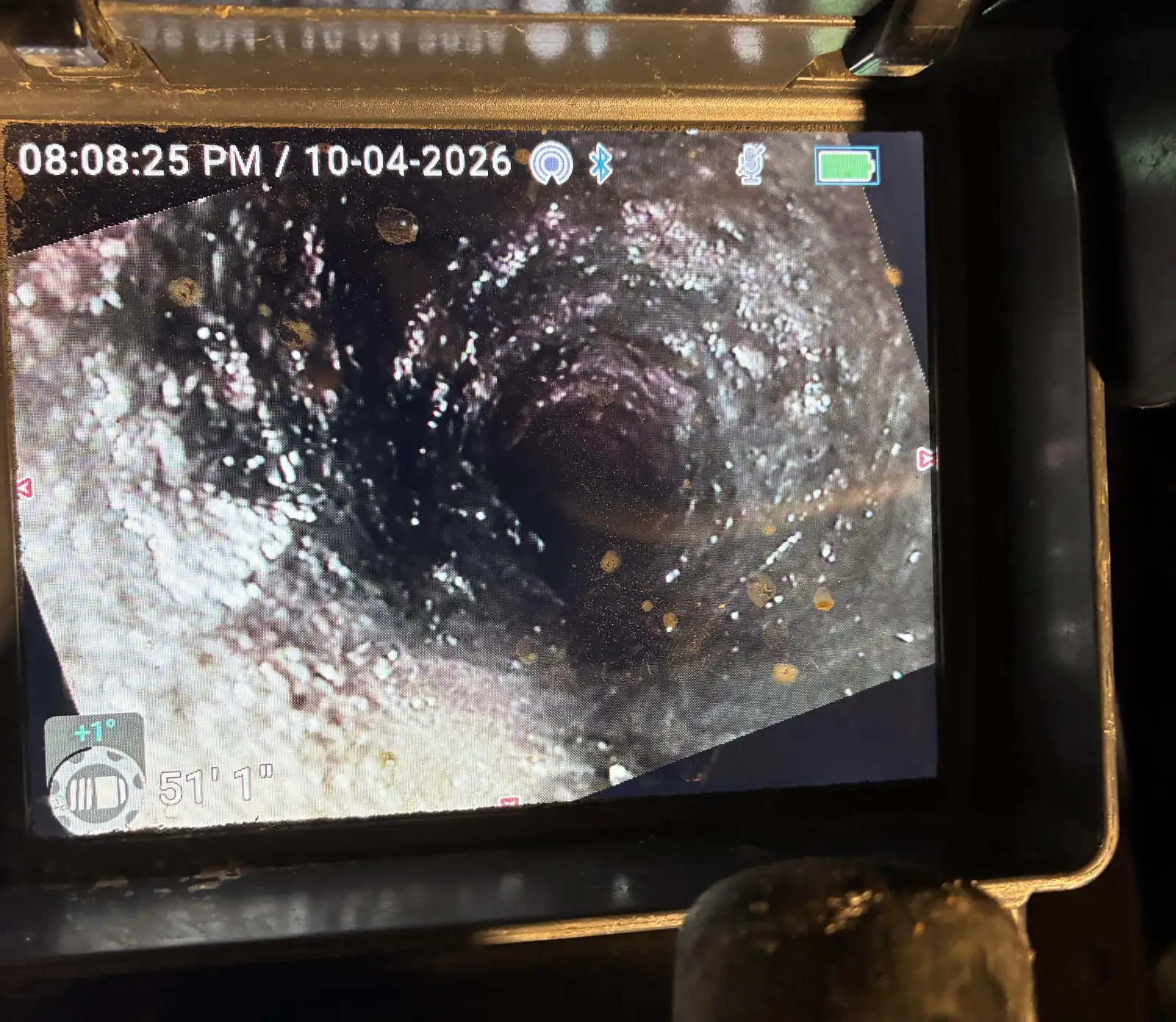
Yes, get the sewer scope. A pre-purchase [camera inspection](/services/trenchless) costs $250 and takes under two hours. The problems it can catch — root intrusion, offset joints, collapsed pipe, or deteriorating Orangeburg — routinely run $4,000 to $20,000 to repair. That math argues for the inspection on every purchase, not just older homes.
South Bay housing stock makes this especially relevant. Torrance, Gardena, Carson, San Pedro, and Lawndale have dense concentrations of 1950s and 1960s slab-tract homes where the original sewer laterals have never been replaced. Clay tile and Orangeburg were standard materials in that era. Both are at or past end-of-life. A general home inspection rarely covers the sewer line — that's a separate scope, literally and professionally.
What a sewer camera actually shows
A lateral camera inspection runs a video probe from the cleanout — or the toilet if there's no accessible cleanout — out to the city main connection, typically 50 to 100 linear feet. The footage is recorded and time-stamped, so every defect has a distance marker from the cleanout. You're not getting a verbal summary. You get video.
The camera will show root intrusion, which is the most common finding in older neighborhoods with mature street trees. It will show pipe bellies — low sections where the line has settled and water pools instead of draining. It will show offset joints where sections have shifted out of alignment. And it will show material condition: cracked clay tile, collapsed Orangeburg, or corroded cast iron.
What it won't show is flow rate under load. A static camera tells you about structural condition, not performance under a full household's demand. If the inspector does a flow test — running multiple fixtures simultaneously while the camera is in the line — that adds useful data. Ask whether that's part of the process before booking.
The pipe materials you'll find in South Bay laterals
Clay tile was the standard sewer pipe through the 1960s. It's brittle, the joints are sealed with oakum or cement, and root intrusion is essentially inevitable in any yard with large trees. Clay isn't always failing — many well-maintained clay laterals still function — but the camera will tell you how close to failure it is.
Orangeburg is the higher-risk material. It's a compressed tar-paper pipe installed from roughly 1945 through the mid-1970s as a wartime metal substitute that never stopped being used. It delaminates from the inside out as it absorbs water. By now, most Orangeburg laterals in South Bay cities are either already collapsed or collapsing. Finding Orangeburg on a camera inspection is not a negotiation point — it's a replacement item.
In Vinegar Hill and Old San Pedro, pre-1940 homes may have cast iron laterals. Cast iron lasts longer than Orangeburg or clay but corrodes internally. A camera will show scale buildup, pitting, and any sections where the bottom of the pipe has corroded through — a condition called channeling. ABS plastic, installed on homes built or repiped after the mid-1970s, is what you want to see. It's dimensionally stable and root-resistant at the joints.
Why general home inspections miss this
A licensed general home inspector evaluates the structure, roof, electrical panel, HVAC, and visible plumbing. They're not running a camera. Most inspection agreements explicitly exclude sewer lines from scope. When they note 'sewer lines not inspected,' that's not a hedge — it's a hard exclusion.
The result is that buyers routinely close on homes with laterals that are months from a sewage backup, with no knowledge of the condition. The first sign of the problem comes when the toilet won't flush or the cleanout backs up into the yard. At that point you own the problem and you're buying a repair without any seller contribution.
Torrance is worth calling out specifically. The city assigns the owner responsibility for the entire lateral including the tie-in at the public main, so a buyer who skips the scope inherits the street portion too. No city inspection is going to catch it for you — Torrance has no point-of-sale sewer requirement — which means the scope during your inspection contingency is the only thing standing between you and a repair that needs a right-of-way permit.
How to use the inspection findings in negotiation
If the camera shows root intrusion that's manageable — roots entering at joints but the pipe structure intact — that's a hydro-jetting and root-foaming situation. Cost is roughly $400–$800. That's a reasonable request for a seller credit, not a reason to walk.
If the camera shows Orangeburg, a collapsed section, or a pipe belly that's holding water and solids, you're looking at a sewer lateral replacement. [Trenchless pipe bursting](/services/trenchless) on a standard South Bay lateral runs $4,000–$8,000 for an average-length run without difficult access. That's a number you can put into the negotiation with a repair estimate attached — either as a price reduction, a seller credit at close, or a seller-funded repair before transfer.
The leverage is real only when you have documentation. A verbal summary from someone who 'glanced down the cleanout' carries no weight with a seller's agent. A timestamped video with a written report from a licensed C-36 contractor does. Make sure whoever scopes the line provides a written report, not just a link to a video file.
Timing, access, and what to ask your agent
The inspection contingency window is your window for the sewer scope. In most Southern California purchase agreements, you have 17 days default (sometimes negotiated shorter in competitive markets). Book the sewer scope in the first five days, not the last two. Getting a plumber scheduled, reviewing footage, and obtaining a written repair estimate takes time, especially if the findings require a follow-up assessment.
Access is sometimes the friction point. The camera goes in through the sewer cleanout, which is usually a 4-inch capped pipe at ground level near the house foundation. If the cleanout is buried, corroded shut, or there isn't one, the plumber will need to pull a toilet. That's standard — it adds maybe 20 minutes — but it needs to happen during the inspection period, with seller permission for access. Your agent handles the access coordination. Your job is to have the plumber scheduled.
For homes in Hermosa Beach and Manhattan Beach — where lots average 30 feet wide and the cleanout is often behind a gate or under a deck — factor in access complexity when scheduling. The inspection itself doesn't take longer, but getting to the cleanout sometimes does. Our [camera inspection](/services/trenchless/camera-inspection) work in Torrance runs into similar access constraints on older Walteria and Hollywood Riviera properties where cleanouts were paved over during driveway work.
South Bay home buyers: sewer scope questions we hear most
How much does a pre-purchase sewer camera inspection cost? In the South Bay, our price for a standard residential lateral inspection with video and a written report is $250 — and it's free if you're already having us out on a service call or pricing a repair. If the plumber needs to pull a toilet because there's no accessible cleanout, add $75–$150. That's the full cost.
Does the seller have to allow it? Under a standard California Residential Purchase Agreement, the buyer has the right to inspect during the contingency period. The seller can refuse specific access requests, but doing so typically triggers a right to cancel for the buyer. Most sellers allow it.
What if the inspection finds something serious — do I have to walk away? No. A major finding gives you a documented basis to renegotiate. You can request a price reduction, a credit toward repair at close, or a seller-funded repair before transfer. Walking away is one option, not the only one.
Does Torrance require a sewer inspection before I can buy? No. Torrance has no point-of-sale sewer lateral inspection requirement, and neither do the other South Bay cities we work in. What Torrance does have is a policy putting the full lateral — including the connection to the public main — on the property owner. That makes a voluntary scope more important, not less, because no city process will surface the defect for you. Repairs do require permits: an "Alter Building Sewer" plumbing permit for work on private property, and a Construction and Excavation permit for anything in the public right-of-way. Verify current requirements with Torrance Community Development at (310) 618-5910.
How do I verify the plumber is licensed? Look up the contractor on the CSLB license lookup tool at cslb.ca.gov. Mainline No-Dig Trenchless Plumbing holds C-36 license #901735. Any contractor you hire for this work should hold a current, active C-36 plumbing license in California.
Is the scope different for a condo versus a single-family home? Yes. In a condo, the sewer lateral responsibility typically begins at the stack or the unit connection inside the building — the lateral from building to main is usually HOA responsibility. Confirm with the HOA CC&Rs before deciding what to scope. For a single-family home, the lateral from foundation to city main is the owner's responsibility, and that's what the camera inspection covers.
What to do next
If you're in escrow on a South Bay property — or preparing to make an offer — call us at (310) 808-7343 to schedule a pre-purchase sewer camera inspection. We serve 16 South Bay cities, dispatch 24/7, and provide a written report you can hand directly to your agent or use in negotiations.
If the inspection reveals a problem, we can produce a repair estimate on the same visit or within 24 hours. Trenchless options — pipe bursting or CIPP lining — mean most South Bay laterals can be repaired or replaced without digging up the yard. That matters when you're negotiating on a landscaped property in Walteria, a narrow lot in the Avenues in Redondo Beach, or a hillside home in Rolling Hills Estates where excavation costs escalate quickly.
Tags