Most tank water heaters fail long before they should. Not because of the heating element, the thermostat, or the tank itself — but because a sacrificial magnesium or aluminum rod suspended inside the tank quietly dissolved away, went unnoticed, and left bare steel exposed to corrosive water for years. By the time a homeowner notices rust-colored hot water or a rotten-egg smell, the damage is already done. A new anode rod at that point won't save a tank that's already pitting.
The rod itself costs $20–$40 at any plumbing supply house. Installation takes a licensed plumber about 90 minutes. Done on schedule, that maintenance interval can add 5 or more years to a tank that costs $900–$2,200 to replace. The math is not subtle.
What makes this particularly important in the South Bay is water hardness. Municipal water across this region — from Redondo Beach to Carson, from Lomita to Long Beach — typically runs 9–12 grains per gallon. That's in the hard-to-very-hard range, and it accelerates anode depletion well past what manufacturers assume when they print a six-year warranty in their installation manual.
What an anode rod actually does
Steel tanks corrode. That's physics. Water contains dissolved oxygen, chlorides, and minerals that attack metal surfaces over time. Left unprotected, a standard glass-lined steel tank would start pitting and rusting within a few years of installation.
An anode rod works through electrochemical sacrifice. Magnesium or aluminum — both more electrochemically active than steel — are suspended in the water column inside the tank. When corrosive water attacks, it attacks the rod instead of the tank walls. The rod oxidizes. The tank survives. That's it. The rod is doing exactly what it's designed to do by dissolving.
Most tanks ship with one anode rod threaded into the top of the tank, occasionally two on larger units. Some manufacturers run a combination anode through the hot outlet port. A new rod is roughly 40–44 inches long and about 1 inch in diameter. A depleted rod — one that's done its job — looks like a thin wire core coated in calcium deposits, sometimes reduced to less than half its original diameter.
Why South Bay hard water shortens the service window
Manufacturer replacement intervals typically assume water hardness around 3–5 grains per gallon — roughly what you'd find in parts of Northern California or the Pacific Northwest. At that hardness, an anode rod can realistically last 5–6 years before it needs replacement.
South Bay municipal water doesn't cooperate with that assumption. Water delivered across most of the 16 cities we serve runs 9–12 grains per gallon, sourced heavily from the Colorado River and State Water Project, both of which carry significant mineral loads. At 10 grains per gallon, the same anode rod that lasts six years in soft water is often depleted in 3–4 years.
Salt-air proximity compounds this in the beach cities. In Redondo Beach neighborhoods like The Avenues and South Redondo — or along the Hermosa Beach Strand — salt air infiltrates water heater enclosures and accelerates oxidation on fittings, connectors, and anode rod threads. We inspect anode rods on a 3-year cycle in those areas, not 5. Waiting for the manufacturer interval in a coastal South Bay home is a reliable way to find a rod that's been gone for two years by the time you pull it.
Signs the rod needs replacement now
The most reliable sign is time: if it's been more than 3 years since your last replacement — or if you've never replaced it on a tank older than 4 years — it's worth pulling the rod and inspecting it directly. Visual inspection is the only real answer. There's no sensor or indicator light for anode depletion.
Secondary signs point in the same direction but have other possible causes. A sulfur or rotten-egg smell in hot water often means a depleted magnesium anode has allowed sulfate-reducing bacteria to colonize the tank. Switching to an aluminum-zinc rod and flushing the tank typically resolves it. Rust-colored or brown hot water suggests the tank itself is already corroding — the rod has been gone long enough for the steel to start oxidizing.
Popping or rumbling sounds during heating cycles usually indicate sediment buildup from hard water minerals, not the anode rod directly — but the same mineral-heavy water that layers the tank bottom in calcium carbonate is the same water burning through your rod ahead of schedule. Both problems tend to arrive together in South Bay homes with tanks older than 5–6 years.
What the replacement job actually involves
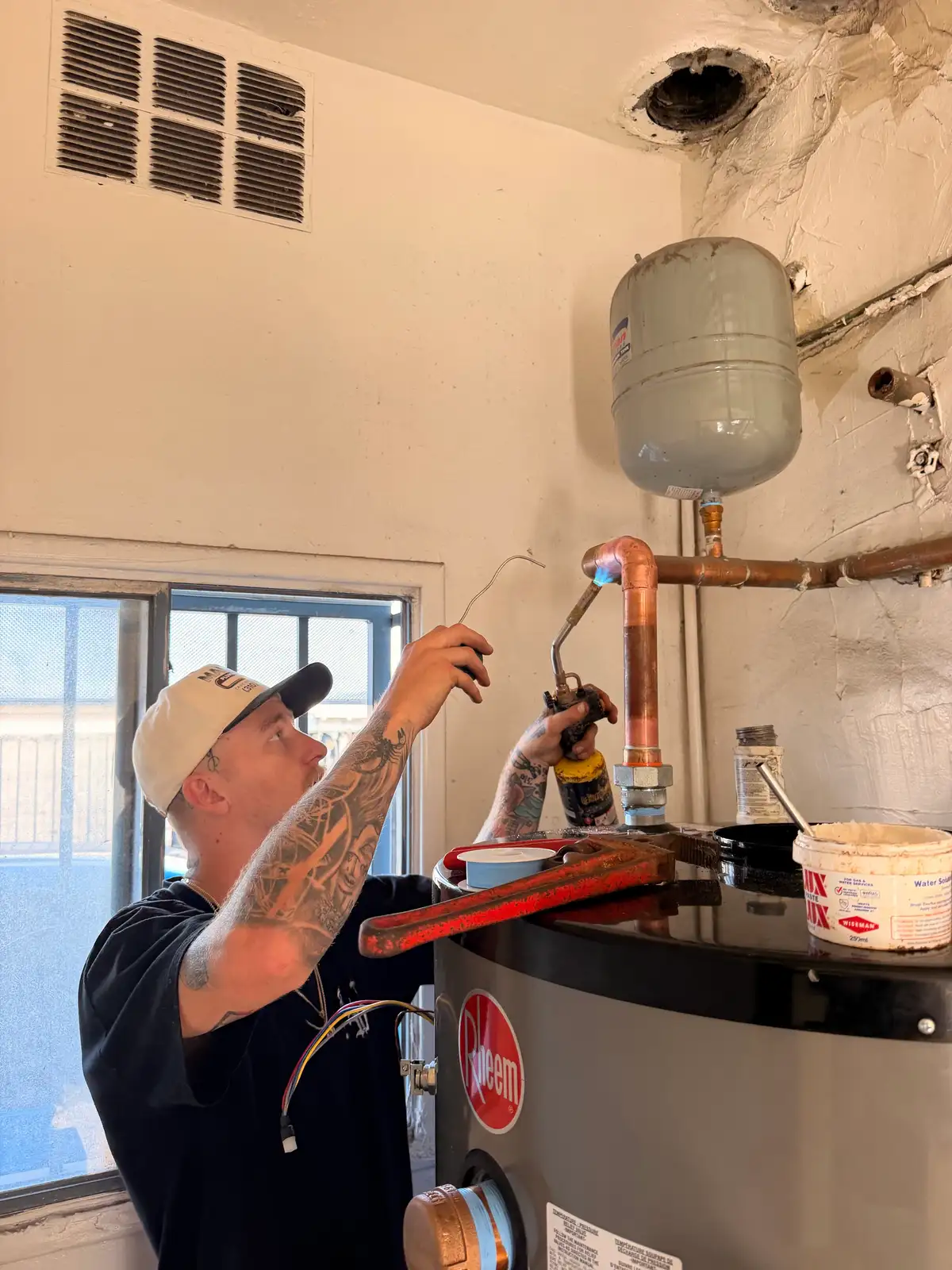
The rod threads into a hex fitting on the top of the tank — typically a 1-1/16-inch socket. On a tank that's never been serviced, that fitting is often seized from years of mineral buildup and heat cycling. Breaking it free without damaging the tank requires the right socket, a breaker bar, and some experience with the way these tanks torque. We've seen homeowners crack tank fittings trying to muscle a seized rod out with an adjustable wrench.
The process: shut off the cold water supply, turn the thermostat to pilot or low, attach a hose to the drain valve and pull 2–3 gallons to relieve tank pressure, then remove and inspect the rod. If it's down to wire core or coated in heavy calcium scale, it goes in the trash. New rod threads in with PTFE tape on the threads, torqued to spec. The job takes about 90 minutes when everything goes smoothly, longer on tanks with corroded fittings or difficult access.
Some water heaters installed in tight utility closets — common in Hawthorne's 1950s tract homes in Hollyglen, or in older Gardena properties along the Western Avenue Corridor — have clearance issues that make rod access awkward. It's solvable, but it adds time. If a tank is positioned flush against a wall with less than 4 inches above the rod fitting, a flexible socket extension becomes necessary.
For a Redondo Beach water heater service or similar coastal installation, our approach is the same: inspect the rod, replace if depleted, flush the tank, test the T&P valve, and check the anode thread seat for signs of early corrosion. That's a full service call, not just a parts swap.
Magnesium vs. aluminum vs. aluminum-zinc rods
Magnesium rods are the standard choice for most South Bay tank water heaters. They're more electrochemically active than aluminum, which means they sacrifice faster — a drawback in hard water, but also a sign they're doing their job aggressively. They're the right choice when your water isn't producing that sulfur smell.
Aluminum rods corrode more slowly, which sounds like an advantage but means less protection in aggressive water chemistry. They're typically used in softened water systems where a magnesium rod would deplete too quickly. In the South Bay's hard, unsoftened municipal water, aluminum rods are rarely the first choice.
Aluminum-zinc rods — usually 90% aluminum, 10% zinc — are the targeted solution for the sulfur smell problem. The zinc inhibits the sulfate-reducing bacteria that colonize tanks with depleted magnesium rods. If you've got that rotten-egg smell in hot water, an aluminum-zinc rod and a tank flush resolves it in most cases. It's not a water quality problem you need to address at the city level — it's a tank chemistry fix.
Tankless water heaters and the anode rod question
Tankless units don't have anode rods. There's no tank to protect. The corrosion dynamics are completely different — what you're managing with a tankless is scale buildup on the heat exchanger from the same hard water minerals, handled through annual descaling with a citric acid flush.
If you're considering a switch from a tank unit to tankless, [tankless water heater service](/services/water-heaters) is a separate evaluation that factors in your household's peak demand, gas line capacity, and venting requirements. The anode rod calculus disappears, but the hard water maintenance calculus doesn't — it just changes form.
For homeowners who want to stay with a tank unit — and there are plenty of good reasons to — anode rod maintenance is the single highest-leverage thing you can do to extend the life of your investment. A $1,500 water heater on a 12-year lifespan becomes a $1,500 water heater on an 8-year lifespan the moment the rod runs out and the tank starts corroding unchecked.
What to do next
If you don't know when your anode rod was last replaced — or you've never replaced it on a tank older than 4 years — schedule an inspection before the next water heater failure puts you in emergency replacement territory. A proactive rod check and flush runs a fraction of an emergency call, and it gives you a clear picture of how much life the tank actually has left.
We handle [water heater maintenance and anode rod service across Redondo Beach](/service-areas/redondo-beach/water-heaters) and all 16 South Bay cities. Licensed C-36 #901735. No overtime fees, 24/7 dispatch. Call Mainline at (310) 808-7343 to schedule a service call or ask about the current condition of your tank.
Tags