A sewer snake — also called an auger — is a rotating steel cable that drills through whatever is blocking your pipe. When it works, water flows again and most homeowners consider the problem solved. The problem is that a snake doesn't remove the obstruction. It punctures it. Grease coating the pipe wall, root mass clinging to a joint, mineral scale narrowing the bore — a snake punches through the middle of all of these and leaves the rest behind.
Hydro-jetting works differently. A nozzle delivers water at 3,000 to 4,000 PSI — sometimes higher on commercial lines — and scours the pipe wall from the inside out. The jet cuts in multiple directions simultaneously: forward to break up material ahead of the nozzle, and backward through radial ports to blast debris toward the cleanout. When it's done, the pipe interior is close to original diameter. That's a different outcome than what a snake produces.
Neither tool is universally better. The right call depends on what's actually in the pipe, the pipe's age and material, and whether you're solving a one-time problem or a recurring one. What follows is a straightforward breakdown of when each method earns its price.
What a sewer snake actually does
A standard sewer snake uses a 3/8-inch to 1/2-inch cable with a cutting head on the end. The cable spins and advances through the pipe. When it contacts a soft clog — a toilet paper wad, a clump of hair at a P-trap, a food mass at a kitchen drain — it breaks it apart or hooks it and pulls it back out. That's the scenario a snake is built for.
On a single, soft, near-access blockage, a snake is fast, inexpensive ($150–$300 for a professional service call), and effective. There's no reason to bring in a jetter for a shower drain clogged with hair. The physics are overkill and the cost difference isn't justified.
Where snaking falls short is on anything that requires the pipe wall itself to be cleaned. Snaking a grease-coated drain line is like drilling a hole through a snow bank — the hole closes behind you. Snaking through a root mass often leaves root fibers intact, which reattach and regrow within months. The symptom clears temporarily, but the underlying condition remains unchanged.
What hydro-jetting actually does
A hydro-jet uses a small-diameter, high-pressure hose fed into the pipe from a cleanout. The nozzle at the end has precisely angled ports that produce a combination of forward thrust and rearward jets. The rearward jets do most of the cleaning work — they strip material from the pipe wall and flush it downstream toward the sewer main.
At 3,500 PSI, hydro-jetting cuts through accumulated grease, mineral scale, soft root growth, and compacted sludge that a snake can't touch. On a commercial kitchen line with years of fat and soap buildup, the difference in pipe diameter before and after a hydro-jet service is measurable — sometimes recovering 30 to 40 percent of lost bore. That's not a minor improvement.
One prerequisite: the pipe condition has to justify jetting. Before we run a hydro-jet on any line, we run a [camera inspection](/services/trenchless) to verify the pipe wall can handle the pressure. Cast iron in good condition handles it well. A severely corroded pipe or a clay tile line with significant joint separation needs repair before jetting — the pressure can accelerate damage on an already compromised pipe.
Professional hydro-jetting typically runs $400–$900 for a residential line, depending on access, line length, and severity of buildup. Commercial lines with heavy grease load or long lateral runs cost more.
Grease: the case where snaking rarely wins
Grease accumulation is the clearest situation where snaking fails as a long-term solution. Cooking grease, soap fat, and food-derived oils cool as they move down the drain and adhere to the pipe wall. Over months and years, that layer builds inward, narrowing the effective diameter of the line. A snake punches through the soft center but doesn't disturb the coating on the wall.
This is the pattern we see most often in restaurant drain lines — particularly on commercial strips in Old Torrance and along the Hawthorne Boulevard corridor — but it's not exclusive to commercial properties. Any residential kitchen with heavy cooking volume can develop meaningful grease accumulation in the lateral within two to three years.
Hydro-jetting is the only method that reliably removes grease coating without excavation. Most commercial kitchens running high-volume service need jetting every 12 to 18 months to keep their laterals functional. Residential kitchens with recurring slow-drain symptoms typically benefit from jetting every two to three years rather than repeated snaking calls.
Root intrusion: it depends how bad it is
Tree root intrusion is more nuanced. Fine root tendrils that have just entered a joint crack respond to hydro-jetting reasonably well — the pressure cuts them off and flushes the debris. A light root intrusion caught early, confirmed by camera, can often be managed with hydro-jetting on a regular maintenance cycle.
Mature root masses are a different situation. When roots have fully occupied a pipe section — packing the bore, collapsing partial sections of clay tile — hydro-jetting alone isn't a fix. The roots need to be cut and the pipe needs to be repaired or replaced. In the Tree Section of Manhattan Beach, where jacaranda and ficus root systems extend well past the property line, we regularly find laterals that need [trenchless sewer repair in the South Bay](/service-areas/lomita/trenchless) before any maintenance jetting can even begin.
The pattern is consistent: early-stage root intrusion is a maintenance problem that jetting addresses. Late-stage root intrusion is a structural problem that requires pipe repair first. A camera inspection distinguishes the two and prevents a homeowner from spending $600 on a hydro-jet service that doesn't improve a structurally failed pipe.
Recurring backups: what the pattern tells you
If a drain backs up once and clears with a snake, that may be the end of it. If the same drain backs up every six to eight weeks, the snake isn't solving the actual problem — it's resetting a countdown. The frequency of recurrence is diagnostic information.
In older housing stock — the post-war tract homes that make up most of Gardena's Moneta and Strawberry Park neighborhoods, or the 1950s and 1960s slab homes concentrated in Lawndale — recurring backups almost always trace back to one of three things: accumulated grease, progressive root intrusion, or a partial pipe collapse that creates a low spot where debris catches. Snaking addresses none of these structurally.
Our standard approach on a recurring-backup call is to snake first if needed to restore flow, then run a camera to see what the pipe is actually doing. That image determines whether we're recommending a one-time hydro-jet, a jetting maintenance schedule, or a repair conversation. Recommending jetting without looking at the pipe first isn't diagnostic work — it's guessing.
Scale and mineral buildup: the slow-motion blockage
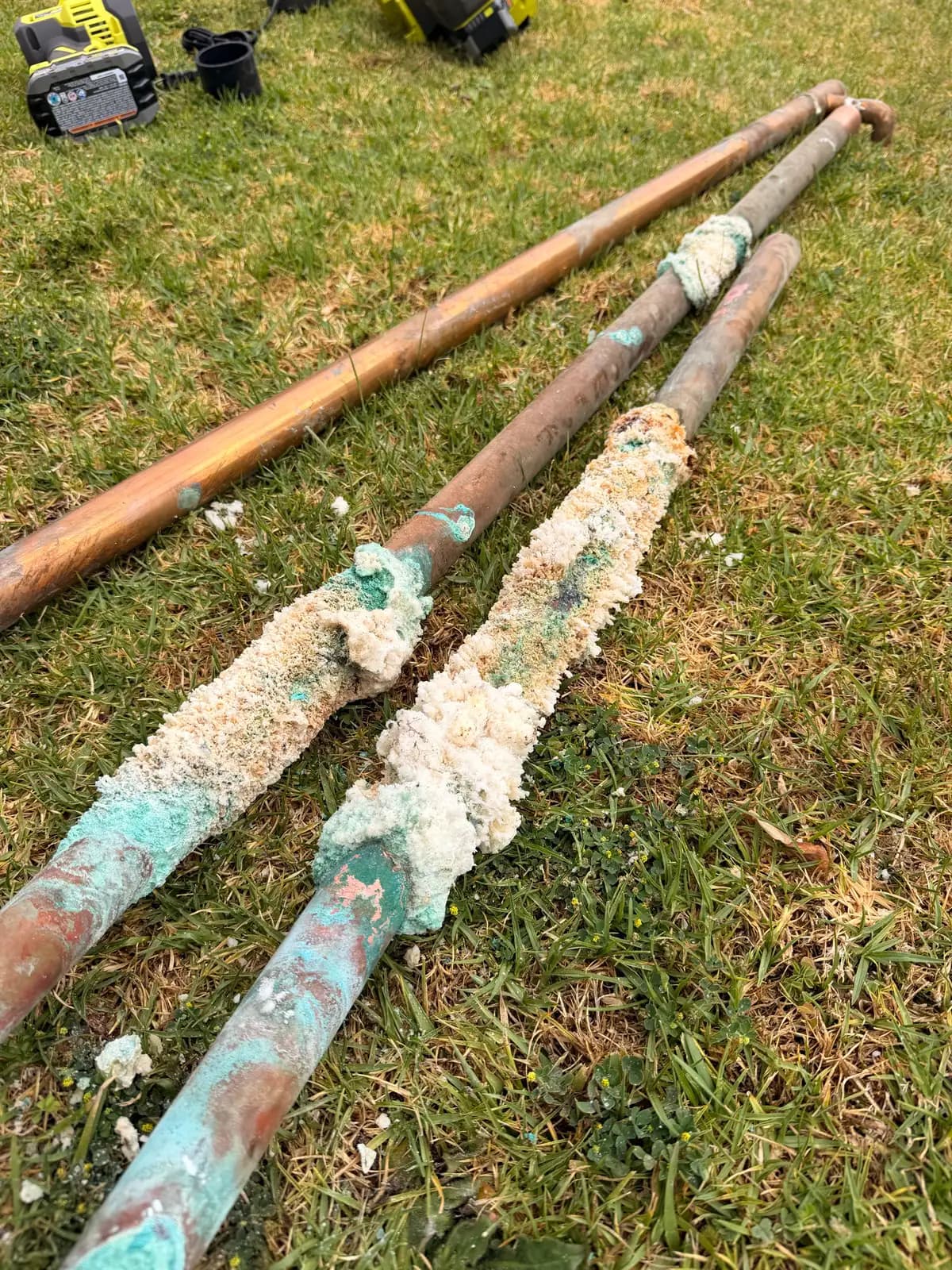
South Bay water runs 9 to 12 grains per gallon of hardness — enough to deposit calcium carbonate scale inside supply and drain lines over time. On drain lines, scale combines with soap residue and hair to create a dense, cement-like accumulation that builds inward from the pipe wall. This is especially visible in older galvanized pipes, where the roughened interior surface accelerates deposit adhesion.
A snake cuts through this material poorly. The cable deflects around it rather than removing it, and the calcified coating remains. Hydro-jetting at adequate pressure breaks up and flushes scale deposits. On galvanized lines with significant scale, jetting sometimes reveals that the effective pipe diameter has been reduced by 40 to 60 percent — which explains why pressure and flow have been declining for years.
Scale buildup this severe also signals that the galvanized pipe itself is nearing end-of-life. Jetting restores function temporarily, but a [whole-house repipe](/services/repipes) is often the more economical choice over a 10-year horizon than repeated service calls on a line that's fundamentally failing.
The bottom line
Use a snake for single, soft, localized blockages — hair at a P-trap, a one-time kitchen clog, a toilet paper mass near a cleanout. It's fast, it's less expensive, and it's the right tool for the right job.
Use hydro-jetting for grease accumulation, light to moderate root intrusion, recurring backups, scale buildup, or any situation where restoring the pipe wall matters — not just restoring flow. It costs more upfront but reduces the frequency of service calls on lines that would otherwise back up every few months.
Always scope before you jet. A camera inspection runs $250–$450 and prevents both misdiagnosed jetting jobs and missed repair needs. If you're not sure which situation you're in, that's where we start.
To discuss what your drain line actually needs, call Mainline No-Dig Trenchless Plumbing (Licensed C-36 #901735) at (310) 808-7343. We serve 16 South Bay cities with 24/7 dispatch and no overtime fees.
Tags
Related Services