A clay or cast-iron sewer lateral in Carlson Park or Sunkist Park is likely 60–80 years old. At that age, root intrusion, joint separation, and pipe collapse are the rule, not the exception — and a trenchless repair replaces or rehabilitates that pipe without opening the yard. No trenching, no destroyed hardscape, no removal of the mature trees whose roots caused the problem in the first place.
Culver City's 1917–1965 housing stock sits on lots where decades of landscaping investment — established oaks, jacarandas, concrete driveways, original brick walkways — can be worth more than the plumbing itself. That's the practical reason trenchless methods dominate here. The pipes fail on a predictable schedule, but the property doesn't have to absorb the cost of a full excavation to fix them.
What's actually in the ground under a Culver City mid-century home
Homes built in Carlson Park and Sunkist Park between the late 1930s and early 1960s were typically plumbed with vitrified clay sewer laterals. Clay is inherently brittle, and the bell-and-spigot joints used in that era rely on mortar or rubber gaskets that degrade over decades. Once a joint opens — even a few millimeters — tree roots find it within a single growing season.
The studio corridor running through Culver City generated significant mid-century residential development across Studio Village and Fox Hills as well. Homes in those areas often followed the same material specs. By now, most of those laterals have had at least one snake service, and many show active root intrusion or offset joints on camera.
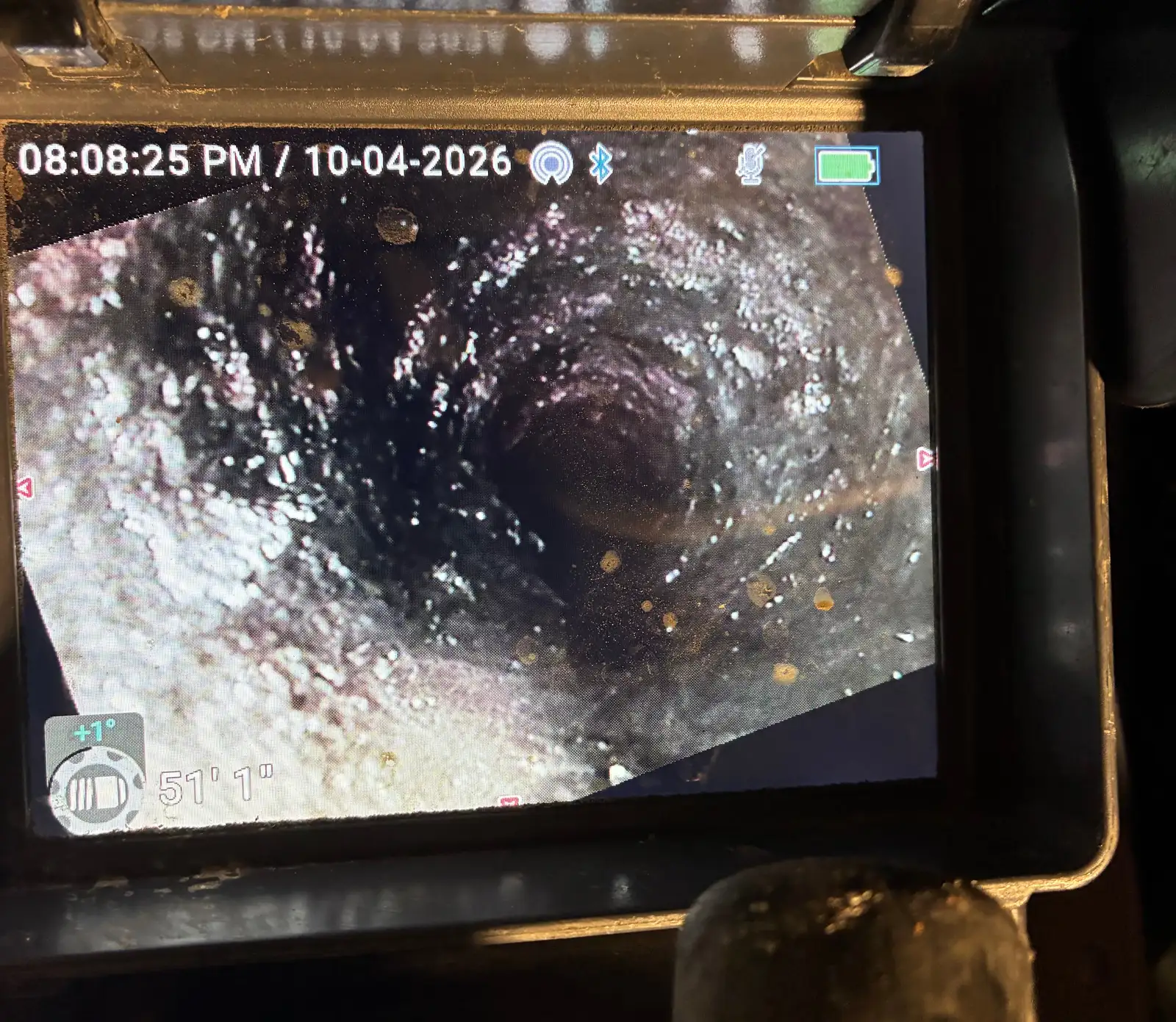
Cast iron appears in some of the older pre-WWII blocks in Downtown Culver City and Carlson Park originals. Cast iron corrodes from the inside out via hydrogen sulfide gas produced by organic waste — so a lateral that looks intact on the outside can have paper-thin walls. A [sewer camera inspection](/services/trenchless/camera-inspection) is the only reliable way to know what you're actually dealing with before committing to a repair method.
Root intrusion: why it keeps coming back without pipe replacement
Snaking a root-invaded lateral clears the blockage but leaves the entry point intact. Roots regrow toward the same moisture source, typically faster on the second cycle because the disturbed pipe joint is now wider. Most homeowners who call us for a second or third snake job in a three-to-five year window are dealing with this pattern.
The trees themselves are rarely the problem worth solving. A 40-year-old oak or a mature jacaranda in a Sunkist Park backyard has real value and isn't going anywhere. The answer is eliminating the pipe joint as an entry point — either by lining the existing pipe with a seamless CIPP sleeve or by bursting the old pipe and pulling in a continuous HDPE replacement that has no joints for roots to exploit.
After a trenchless repair using either method, root re-entry at the treated section is effectively eliminated. The root system doesn't disappear, but there's no longer a gap in the pipe for it to exploit. If adjacent untreated sections remain, those can be addressed incrementally rather than all at once.
Pipe lining vs. pipe bursting: which method fits a Culver City lateral
CIPP lining — cured-in-place pipe — works by inserting a resin-saturated liner into the existing pipe and inflating it against the pipe wall, where it cures into a rigid sleeve. It's the right call when the host pipe has structurally sound walls, even if joints are cracked or root-invaded. The finished liner reduces interior diameter by roughly 6–8mm, which is acceptable for most residential laterals. A [trenchless sewer repair](/service-areas/culver-city/trenchless) using CIPP requires only a small access point at each end — typically a cleanout or a modest hand-dig at the street connection.
Pipe bursting is the better choice when the existing pipe is too deteriorated to host a liner — collapsed sections, severe offset joints, or wall thickness below acceptable minimums. A bursting head is pulled through the old pipe, fracturing it outward, while simultaneously pulling a new HDPE pipe into place. HDPE is chemically inert, has no joints along its run, and carries a design life of 50-plus years under normal conditions.
We determine which method is appropriate after reviewing the camera footage. A lateral with 30% of its length showing intact walls and 70% showing collapse gets a different recommendation than one with uniform but joint-separated clay. Recommending lining on a pipe that can't support it wastes money and fails sooner than a proper replacement would.
Protecting Culver City landscaping and hardscape during a sewer repair
The mid-century-modern design ethic that defines much of Culver City's residential architecture — clean lines, integrated indoor-outdoor flow, original concrete flatwork — doesn't survive a conventional open-cut sewer excavation intact. A trench from the house foundation to the street connection typically means removing and replacing 40–60 linear feet of surface material, whether that's lawn, brick, decomposed granite, or a concrete driveway apron.
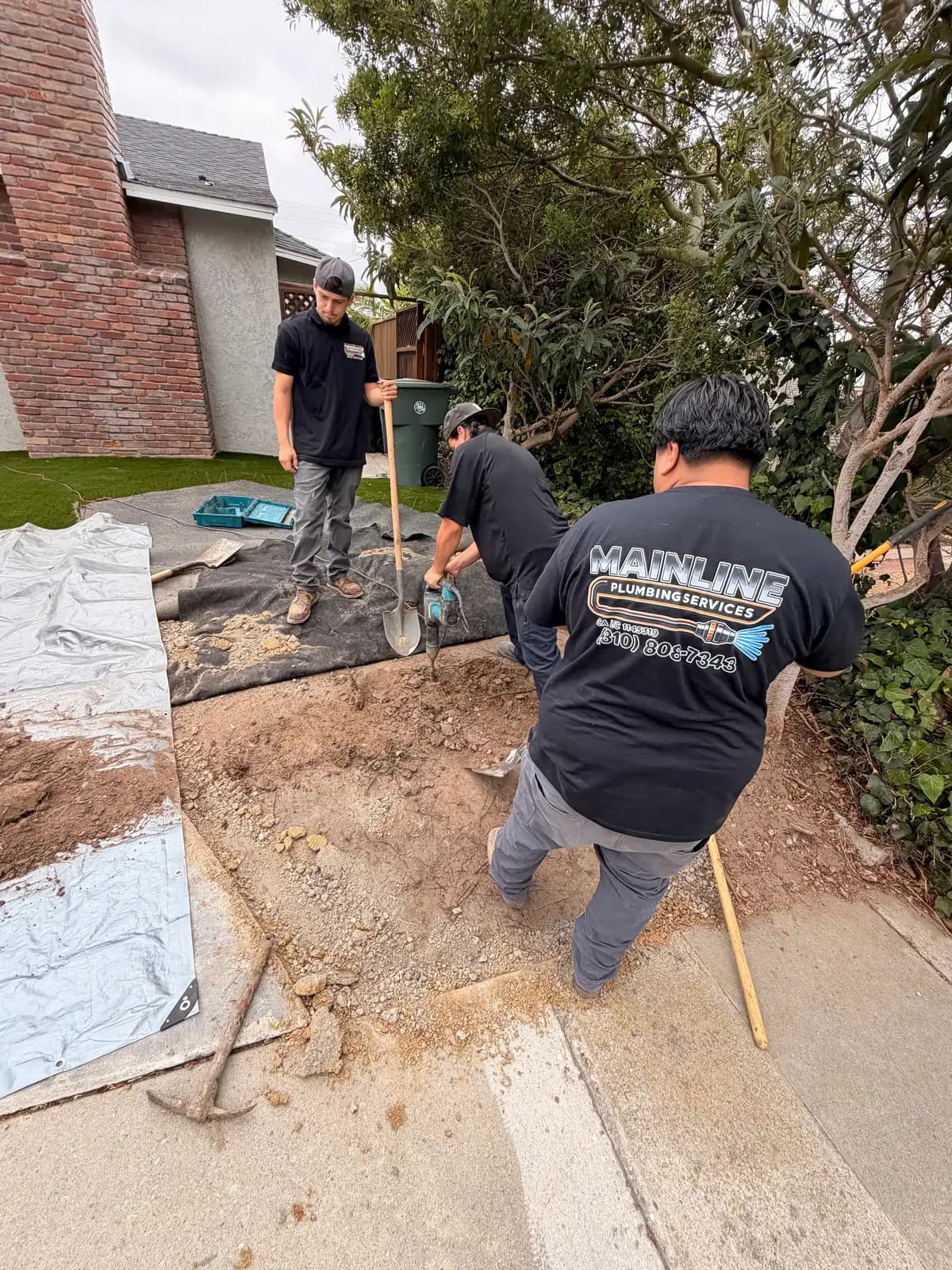
Trenchless methods reduce excavation to two points: the starting access pit, usually 2–3 feet square near the cleanout, and the termination point near the street tap. Total disturbed surface area in most Culver City residential jobs runs under 15 square feet combined. Root systems of established trees — the main culprit in most of these failures — are not severed in the process.
This matters beyond aesthetics. Replacing a mature tree that was removed for a conventional excavation can cost $3,000–$8,000 for a comparable specimen and 20 years of growth time. Protecting original concrete flatwork matters similarly on homes where the mid-century design intent is part of the property's value. Licensed C-36 #901735, we've been doing this work across Culver City and the South Bay for 18-plus years specifically because the no-dig method is the correct one for this housing stock.
What the repair process looks like, start to finish
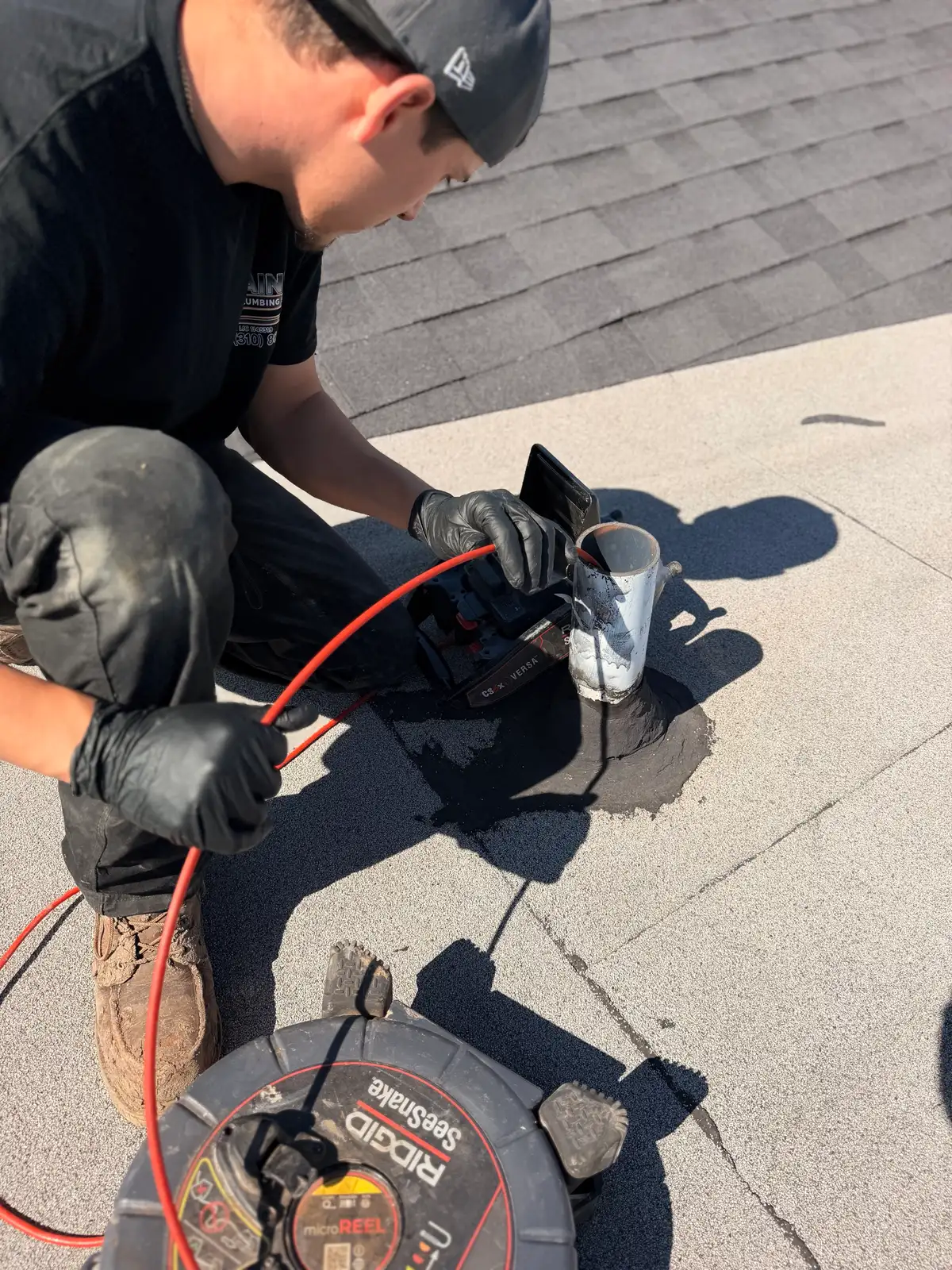
The job starts with a camera run down the lateral from the nearest accessible cleanout. We're documenting pipe material, pipe diameter, existing root intrusion, joint condition, any offset or collapse, and the distance and depth to the connection at the city main. That footage drives the repair specification — liner vs. burst, access point placement, and whether any pre-treatment (hydro-jetting to clear debris) is needed before the repair begins.
On a standard Culver City residential lateral — typically 4-inch clay running 40–60 feet from the foundation to the street — a lining job takes one day. A pipe-bursting job on the same lateral also typically completes in one day, though the access pits are slightly larger. In either case, the sewer is out of service for the portion of the day the liner is curing or the burst head is being pulled. We coordinate service interruption windows with the homeowner before starting.
Final camera inspection after cure or post-burst confirms the repair. We don't close the access pits until we've verified the new pipe interior is clean, dimensionally correct, and free of installation defects. Permits are pulled when required by Culver City Building and Safety — we handle that paperwork as part of the job.
Culver City trenchless sewer repair questions we hear most
**How do I know if my lateral needs repair or just a cleaning?** A cleaning makes sense once. If you're calling for drain service more than once every two to three years on the same line, camera the pipe. Recurring backups in a Carlson Park or Sunkist Park home almost always mean structural pipe damage, not just debris accumulation.
**Will the city require a permit for a trenchless sewer repair?** It depends on scope. Lining or bursting a lateral that connects to the city main typically requires a permit and inspection in Culver City. We pull the permit and schedule the inspection — it's part of the job, not an add-on.
**How long does a CIPP liner or HDPE replacement last?** CIPP liners installed correctly carry a 50-year design life. HDPE pipe used in pipe bursting is rated similarly. Neither is a permanent solution to every possible future failure, but both outlast the original clay or cast iron by a significant margin under normal conditions.
**Can you access a lateral that doesn't have a cleanout?** Yes. We can install a cleanout as part of the repair scope, which also gives you a permanent access point for future camera inspections. Some Culver City homes from the 1940s and 1950s were never plumbed with exterior cleanouts — adding one costs less than most homeowners expect.
**How do I verify your license?** Look up C-36 license #901735 on the CSLB website at cslb.ca.gov. That's our active contractor license for plumbing work throughout California.
**What's your response time in Culver City?** We target a 45-minute response for emergency calls in Culver City, dispatched 24/7 with no overtime fees. Trenchless repair jobs are scheduled work, not emergency response — but if you have an active backup or overflow, call us first and we'll triage the situation before deciding on next steps.
What to do next
If you're seeing slow drains, recurring backups, or wet patches in the yard on a Culver City mid-century property, the lateral is the first thing to camera. Waiting typically means the problem progresses from a repair candidate to a replacement — and a replacement is still manageable with trenchless methods, but it costs more than catching a deteriorating pipe before it collapses.
Call Mainline No-Dig Trenchless Plumbing at (310) 808-7343 or use the contact form on this site. We serve Culver City including Carlson Park, Sunkist Park, Studio Village, and Fox Hills, and we carry the [trenchless sewer repair](/services/trenchless) equipment on the truck to camera, diagnose, and scope a repair in a single visit.
Tags