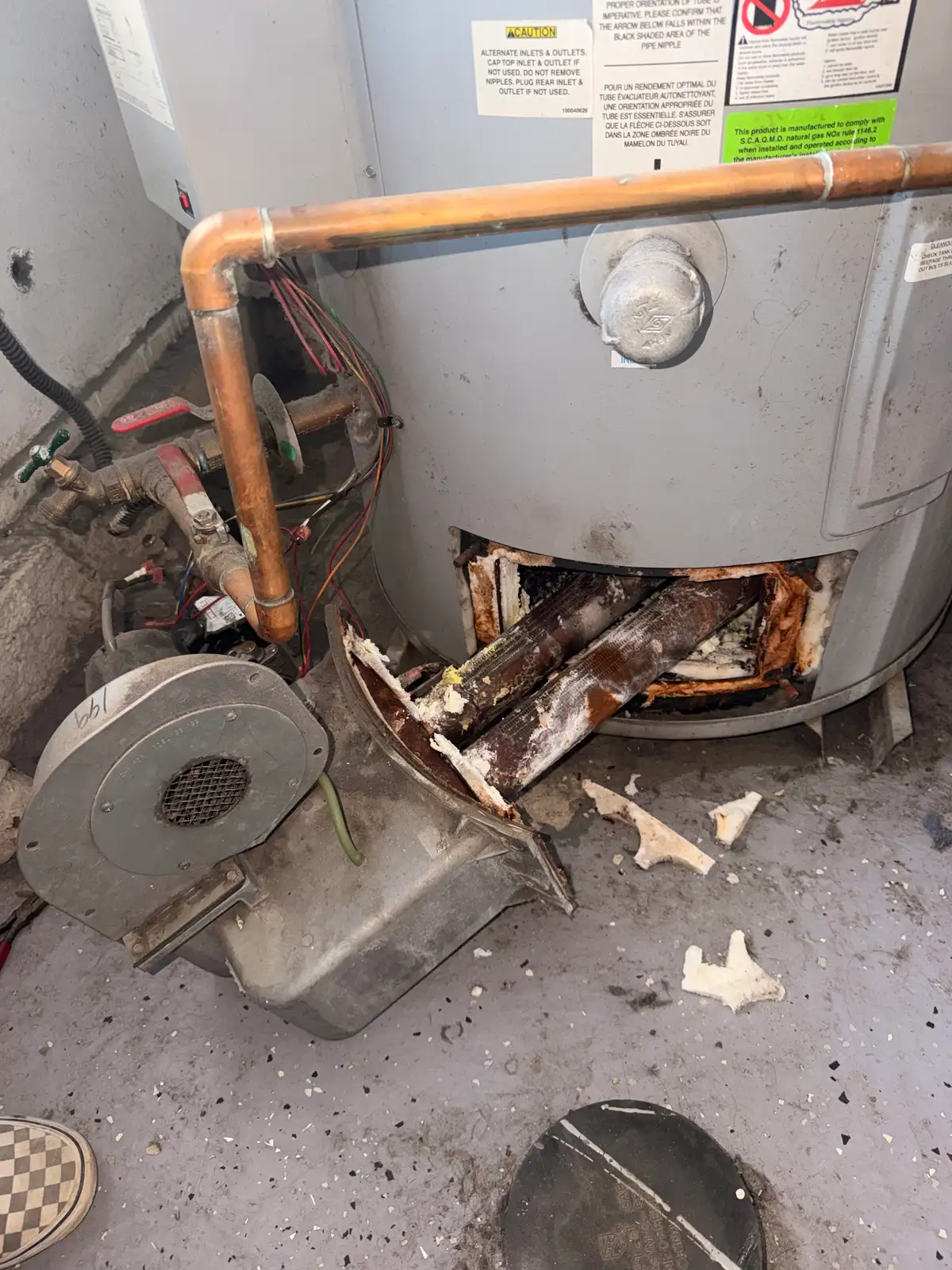
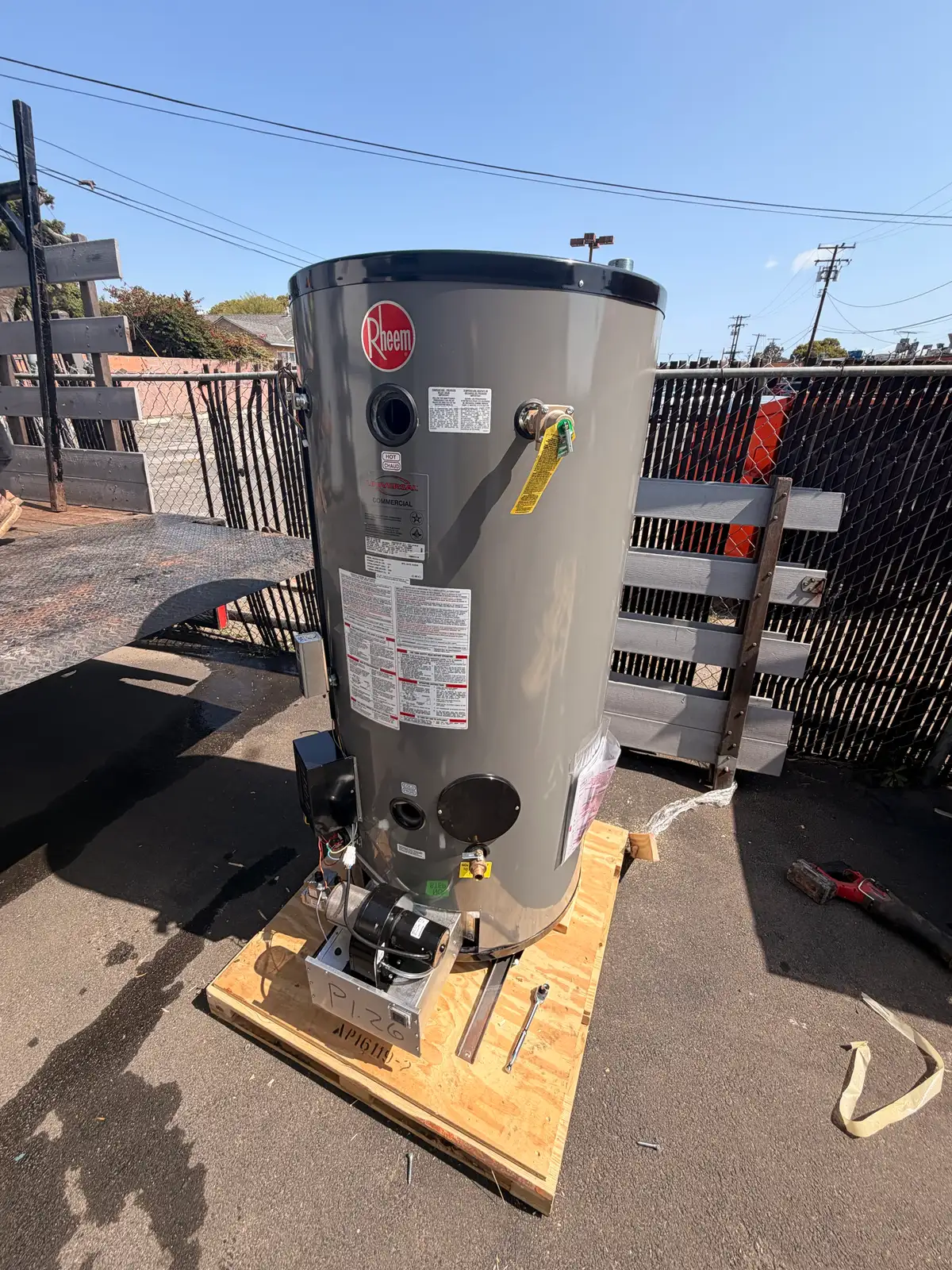
A standard 40-gallon tank water heater in a Lawndale tract home costs $900–$1,600 installed for a like-for-like replacement — more if the unit is a 50-gallon, if the gas line needs resizing, or if seismic strapping hasn't been updated to current code. Most jobs take three to four hours once the technician is on-site.
Lawndale's housing stock runs heavily post-war — the Hawthorne Boulevard Corridor, Marine Avenue, and Manhattan Beach Boulevard Corridor neighborhoods are full of slab-on-grade tract homes built between 1948 and 1965. The water heaters in those homes sit in garages or exterior closets, typically in the same spot they occupied at original construction. That original setup is now 60-plus years old in many cases, and the plumbing around the tank — flex connectors, shut-off valves, pressure relief discharge lines — often needs attention alongside the tank itself.
Why 10 years is the decision point
Most tank water heaters carry a 6- or 12-year warranty on the tank itself, depending on the model tier. That warranty reflects real failure probability — corrosion inside the tank accelerates after year 8, and a pilot or thermocouple failure before year 10 is usually worth repairing. After year 10, repair economics flip. A $250 gas valve repair on an 11-year-old tank still leaves you with an 11-year-old tank.
The math is straightforward. If the unit is under 8 years old, a single component failure is worth fixing. Between 8 and 10 years, it depends on what failed and what the repair costs relative to replacement. Past 10 years, replacement is almost always the right call — not because the tank will fail tomorrow, but because the cost of a second repair in 18 months plus an emergency replacement under pressure adds up to more than a planned swap would have.
Lawndale homes in the Inglewood Avenue corridor and near the Manhattan Beach Boulevard Corridor boundary frequently have tanks installed during the last remodel cycle — often the 1990s or early 2000s. If your home hasn't had a water heater replacement since before 2012, the unit is past the 10-year threshold regardless of whether it's symptomatic yet.
What garage installs actually involve
The garage is the most common water heater location in Lawndale's tract homes, and it creates a predictable set of conditions. The tank sits on a raised platform — code requires the ignition source be at least 18 inches off the floor in garages to keep it above potential gasoline vapor. That platform may be original construction, meaning it's 50-plus years old and sometimes undersized for a taller or wider modern unit.
Clearances matter. Current code requires a minimum of 18 inches in front of the unit for service access. Many original garage installs don't meet that standard and never triggered a correction because the old tank was never pulled. When we replace the unit, the job is done to current code — which can mean repositioning the platform or reconfiguring adjacent storage.
The gas supply line also gets evaluated. A 1/2-inch black iron line feeding a standard 40-gallon unit is typically adequate, but a step-up to a 50-gallon high-recovery unit or a tankless conversion may require a 3/4-inch line. That's not a surprise — it's a standard part of the scoping call.
Seismic strapping: what code requires and what we see
California requires water heaters to be strapped in two locations — upper third and lower third of the tank — using metal strapping anchored to structural framing or a dedicated anchor bracket system. This is not optional and it's not grandfathered. An unstrapped or improperly strapped tank fails inspection, and inspection is required when a permit is pulled for replacement.
In practice, we see three scenarios in Lawndale tract homes. The first is no strapping at all — common on tanks that were swapped without permits in prior decades. The second is a single strap only, which doesn't meet code. The third is correct strapping that's corroded and no longer structurally sound. All three need correction at replacement time, and that correction is included in our quoted scope — not added as a line item surprise.
Strapping hardware is inexpensive. The labor to anchor it correctly into stud framing or a masonry wall is a small part of the total job. It's worth doing right the first time because a water heater that topples in a seismic event causes gas leaks, flooding, and fire risk simultaneously.
Tank versus tankless in a Lawndale slab home
Tankless units make sense in Lawndale homes under specific conditions: the household uses hot water heavily across multiple simultaneous draws, the current gas line can support the higher BTU demand, and there's a suitable venting location. On a standard slab tract home with a two-person household and a single bathroom, a tankless unit typically costs more to install than the payback period justifies.
For a three- or four-bedroom home with two full baths and consistent morning demand, the calculation changes. A tankless unit eliminates standby heat loss, runs indefinitely without recovery lag, and — if the venting is routed through an exterior wall rather than up through a roof chase — can be installed cleanly on a Lawndale garage exterior wall. You can review both options in detail on our [water heater services page](/services/water-heaters) and then scope the specifics with us for your address.
The honest answer for most Lawndale tract homes doing a straightforward replacement: a 40- or 50-gallon high-efficiency tank is simpler, faster, and costs $600–$1,000 less upfront than a tankless conversion. If you're planning a full kitchen or bathroom remodel in the next two years, that may be the right time to revisit the tankless discussion.
Permits and what happens if you skip them
Lawndale is served by the City of Lawndale's Building and Safety division, which requires a permit for water heater replacement. The permit triggers an inspection that verifies strapping, T&P discharge routing, gas connection, and venting. It also creates a public record that the work was done and passed — relevant when you sell the home.
Unpermitted water heater replacements come up in home sales. A buyer's inspector who notes a water heater with no permit history can flag it, and depending on the transaction, you may end up having the work re-inspected or re-done at that point anyway — now under time pressure. The permit cost in Lawndale is a small fraction of the replacement cost. We pull permits on all water heater replacements. That's not negotiable for us.
Lawndale water heater replacement questions we hear most
How long does a replacement take from call to cold-to-hot? For a standard garage tank-to-tank swap, plan on three to four hours total job time. We target a 28-minute response to Lawndale addresses, including the Hawthorne Boulevard Corridor and Marine Avenue neighborhoods. Same-day service is typically available for non-emergency replacements when we're called before noon.
My pilot keeps going out — is that a repair or replace situation? A failed thermocouple is a $150–$250 repair and worth doing if the tank is under 8 years old. If the tank is 10 or more years old and showing sediment buildup (rumbling during heating), the thermocouple failure is a symptom, not the root problem. At that point, replacement is the cleaner path.
Do you haul away the old tank? Yes. Disposal of the old unit is included in the replacement scope. You don't need to arrange separate disposal.
Can I get a tankless unit installed in one day? In most cases, yes — if we've scoped the job in advance and confirmed gas line sizing and venting location. A same-day tankless swap without prior scoping risks mid-job discoveries that extend the timeline. We recommend a quick pre-job walkthrough for tankless conversions.
Are you licensed to do this work in Lawndale? Yes. We hold C-36 plumbing contractor license #901735, issued by the California State License Board. You can verify it directly at the CSLB license lookup tool at cslb.ca.gov. Our full [Lawndale water heater service details](/service-areas/lawndale/water-heaters) include what's covered in a standard replacement scope.
What if my pressure relief valve is also leaking? A dripping T&P valve on an aging tank usually means either the valve itself has failed (common after 10 years) or system pressure is running high. We check both at inspection. If the tank is already past 10 years, the T&P finding becomes one more data point supporting replacement over repair.
What to do next
If your Lawndale tract home has a tank that's approaching or past the 10-year mark — or if you're dealing with a failed component, sediment noise, or slow recovery — a planned replacement on your schedule is better than an emergency swap on a Saturday morning. We serve all of Lawndale, from the Inglewood Avenue corridor to the Manhattan Beach Boulevard boundary, with 28-minute target response and no overtime fees for after-hours calls.
Call Mainline No-Dig Trenchless Plumbing at (310) 808-7343 to schedule a same-day or next-day assessment. We're Licensed C-36 #901735, Lomita-based, and have been handling water heater replacements in South Bay tract homes for 18-plus years.
Tags