Trenchless sewer repair in Gardena typically costs $4,500–$8,800 depending on lateral length, access, and pipe condition. Most Gardena laterals run 40–80 feet from the foundation to the city main, and the majority of homes built between 1948 and 1968 have original vitrified clay pipe — material that was never designed to last beyond 50–60 years. Many of those pipes are now 60–75 years old.
Neighborhoods like Old Gardena, Moneta, and Strawberry Park sit on expansive clay soil that swells with moisture and contracts in dry periods. That ground movement is constant and cumulative — it cracks clay tile at joints, allows root intrusion, and eventually collapses sections entirely. The soil itself is part of why these laterals fail, not just the age of the pipe.
Why clay tile keeps failing in Gardena's soil
Vitrified clay pipe was the standard choice for residential sewer laterals through the mid-1960s. The pipe itself is reasonably hard and chemically inert, but it was laid in short sections — typically 2-foot or 4-foot lengths — joined by rubber gaskets or mortar. Every joint is a potential failure point, and Gardena's clay-heavy subsoil multiplies that risk significantly.
Expansive clay soil shrinks and swells with the seasonal wet-dry cycle Southern California produces. A lateral buried 3–5 feet below grade in Moneta or West Gardena can shift a quarter-inch or more across a single rainy season. Multiply that by decades and the cumulative joint displacement opens gaps that roots exploit immediately.
Once roots enter, the problem compounds. Fine feeder roots from ficus, sycamore, and older liquidambar trees — common throughout Old Gardena — penetrate hairline cracks, thicken over time, and eventually fracture the pipe wall from the inside. A camera inspection on a 1958 Gardena home will almost always show one of three failure modes: separated joints, root infiltration, or a collapsed mid-section. Often all three on the same lateral.
Clay isn't the only aging material under Gardena's post-war tracts. Many 1940s–1960s homes also have original cast-iron drainage, which scales internally, and settled soil creates offsets and bellies where debris catches. Recurring backups on these homes usually reflect structural failure rather than a one-time clog.
What a camera inspection shows before any repair decision
Before quoting any trenchless work, we run a [sewer camera inspection](/services/trenchless/camera-inspection) from the cleanout access point — typically in the yard near the foundation — through to the city main connection. The camera reads pipe material, joint condition, root presence, offset, and grade. That footage is the basis for every repair recommendation.
On a Gardena home built between 1950 and 1965, the camera commonly shows clay tile from the house to roughly 60–70 feet out, sometimes transitioning to an earlier concrete or Orangeburg section near the street. Each material fails differently and may require a different repair approach. A single camera run answers those questions before any excavation or liner is ordered.
The inspection also determines whether the pipe has enough structural integrity remaining to accept a CIPP liner, or whether the collapse or offset is severe enough that [pipe bursting](/services/trenchless/pipe-bursting) is the correct method. Trying to line a collapsed section wastes material and time. The camera eliminates that guesswork.
A cable may restore flow through a root mass while leaving the open clay joint untouched. Hydro-jetting can clean scale and grease but cannot lift a settled section back to grade. Conversely, a camera can show a sound line that only needed cleaning, saving the homeowner from premature replacement. The useful sequence is clear the obstruction enough to see, record the full run, locate defects at the surface, and then match the repair to the structural evidence.
CIPP lining vs. pipe bursting: which method fits Gardena laterals
CIPP (cured-in-place pipe) lining installs a resin-saturated felt liner inside the existing pipe, which cures into a seamless new pipe wall. It works well when the host pipe is cracked or root-infiltrated but still holds its shape and grade. For a Gardena lateral with joint separation and moderate root intrusion but no collapsed sections, CIPP lining typically costs $4,500–$7,500 for a 50–70 foot lateral and finishes in a single day.
Pipe bursting fractures the old pipe outward and simultaneously pulls a new HDPE pipe through the bore path. It's the right call when sections have collapsed, when the pipe has lost grade, or when the existing diameter needs to increase. Pipe bursting on a typical Gardena lateral falls within the same $4,500–$8,800 range for trenchless work, depending on length and access, and requires a small entry and exit pit — typically 2 feet by 3 feet at each end. The yard impact is minimal compared to open trench.
Open-trench replacement is still appropriate when multiple utilities cross the bore path at conflicting depths, or when a city connection requires a direct connection inspection. But for the majority of [trenchless sewer repair in Gardena](/service-areas/gardena/trenchless), either CIPP or pipe bursting avoids the concrete sawcutting, landscape demolition, and extended compaction periods that open trench requires on Gardena's clay-heavy lots.
A short open dig through bare soil can be less expensive than trenchless. The comparison changes when the lateral crosses concrete, mature landscaping, retaining features, patios, irrigation, or a finished driveway. Compare the entire restoration scope, schedule, permit, disposal, and disruption — not only the plumbing line item. Our [Gardena plumbing hub](/service-areas/gardena) covers the local housing and service context.
Permit process and Gardena Building & Safety timeline
Sewer lateral work in Gardena requires a plumbing permit pulled through Gardena Building & Safety. We handle the permit application as part of every job — the homeowner doesn't need to file anything. Based on standard permit submissions, Gardena Building & Safety typically processes plumbing permits within 1–3 business days for residential lateral work, which allows us to schedule most jobs within a week of the initial camera inspection.
The permit process requires a final inspection by a city inspector once the repair is complete. We schedule that inspection, and we also run a post-repair camera pass to confirm the pipe is seated, continuous, and correctly graded — that footage is a standard deliverable on every lateral job.
Pulling the permit also protects the homeowner. Unpermitted sewer lateral work can create disclosure problems at resale and may void the labor warranty if the installation wasn't inspected. It adds a day or two to the schedule, but there's no reason to skip it.
What to expect on job day in Old Gardena or Moneta
A typical CIPP lining job in a neighborhood like Old Gardena or Moneta starts with a hydro-jetting pass to clear roots and debris — the liner can't seat against root mass or sediment. That cleaning pass takes 45–90 minutes depending on how fouled the pipe is. After cleaning, a second camera run confirms the pipe is clear and maps the liner length precisely.
The liner itself is measured, saturated with resin, and inverted into the pipe from the access point. Curing takes 3–6 hours depending on liner thickness and ambient temperature. A final camera inspection after curing confirms the liner has bonded to the pipe wall without wrinkles, gaps, or void sections. The entire process from first camera to final inspection is typically completed in one day.
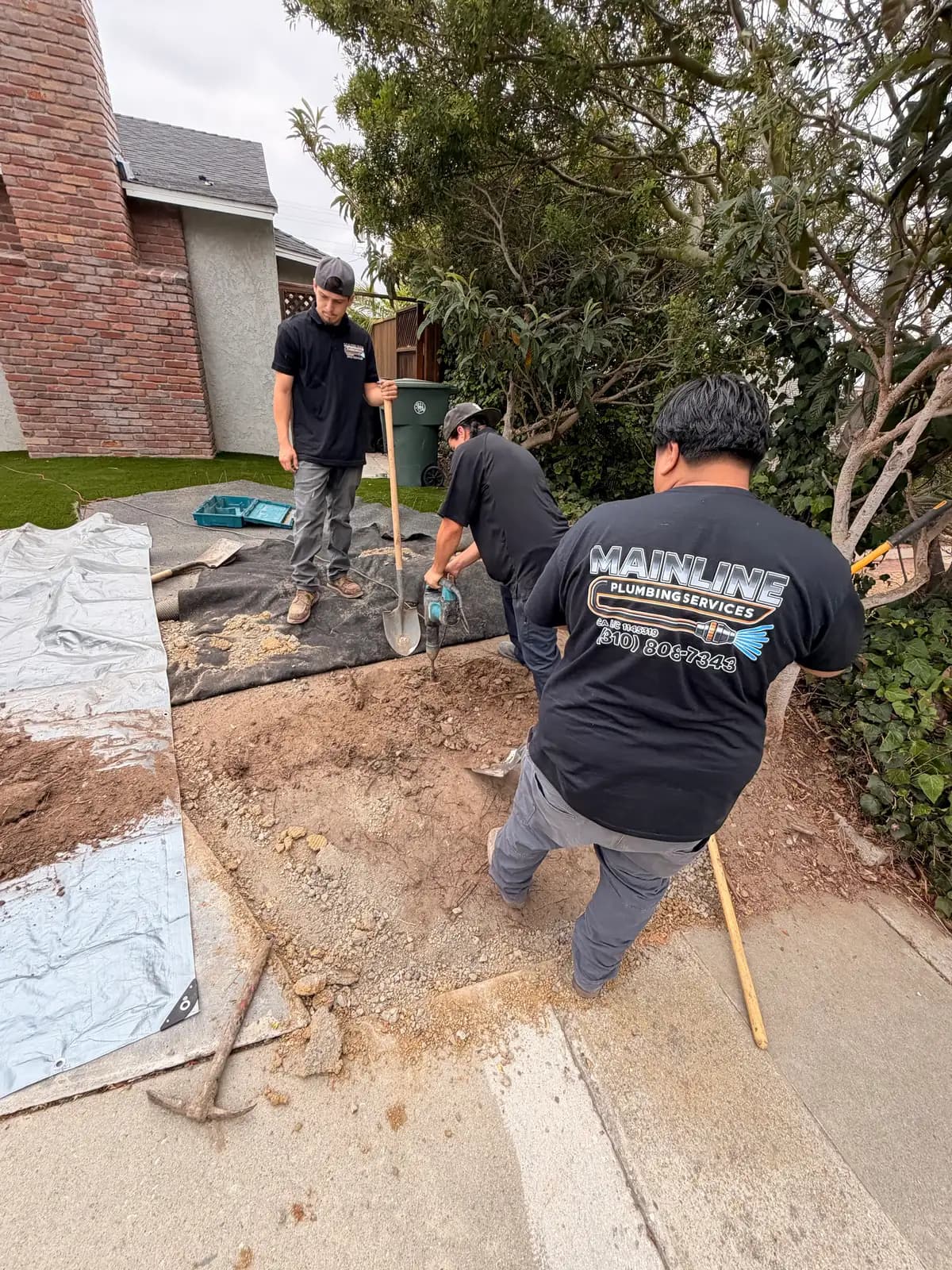
Pipe bursting takes slightly longer because the entry and exit pits require excavation and backfill, and HDPE pipe needs to be fused at the correct length before pulling. On a 60-foot Gardena lateral, expect a full day on-site. Both methods leave the yard in substantially better condition than open trench — no 4-foot-wide trench, no concrete or paving demolition unless the access pit happens to fall under hardscape.
A complete scope should identify the pipe condition, chosen method, access points, utility locating, permit responsibility, new material, reconnections, post-work camera verification, and surface restoration. Those details prevent the phrase 'trenchless' from hiding exclusions.
Access planning starts with utilities and finished features. Gardena's compact lots can put the cleanout behind a gate, an addition, or a narrow side yard, and the city connection may sit under a driveway apron or landscaped parkway, so we confirm equipment access and pit locations before mobilizing — and restoration follows the written scope rather than becoming a surprise change order.
Gardena trenchless sewer repair: questions we hear most
**How do I know if my Gardena home still has clay tile pipe?** If your home was built between 1948 and 1968 and you've never had sewer work done, it almost certainly still has vitrified clay. The only way to confirm the current pipe condition is a camera inspection. Previous owners sometimes replaced sections without documentation, which is another reason the camera is the starting point for every assessment.
**Does trenchless work hold up in Gardena's expansive soil?** HDPE pipe used in pipe bursting is flexible enough to accommodate the ground movement that fractures clay joints — it's rated for significant lateral deflection without failing. CIPP liners add a seamless interior wall that eliminates the joint gaps roots exploit. Both methods perform significantly better than the original clay tile in Gardena's soil conditions.
**Does the city inspect the work after it's done?** Yes. Gardena Building & Safety requires a final inspection on permitted lateral work. We schedule that inspection and give you the post-repair camera footage for your records. You don't need to coordinate with the city directly.
**Is Mainline licensed to do this work in California?** Yes. We hold C-36 Plumbing Contractor license #901735, which you can verify directly at the CSLB website (cslb.ca.gov). We've been operating under that license for 18+ years.
**What if my cleanout is buried or inaccessible?** Buried cleanouts are common on older Gardena homes — concrete or pavers sometimes went over them during previous work. We locate them with a camera and, if needed, install a new above-grade cleanout as part of the job. That cleanout also makes every future inspection easier.
**How long does the repair last?** HDPE pipe used in pipe bursting carries a 50-year material rating. Cured-in-place liners typically carry a 50-year design life as well, and because the liner is seamless, it eliminates the joint-gap failure mode that ended the original clay pipe's service life.
What to do next
If your Gardena home is from the 1948–1968 build-out and you haven't had a sewer camera inspection in the last 3–5 years, the most useful first step is scheduling one. A camera-only appointment is $250 — free with any service call or a trenchless or repair quote — takes about an hour, and tells you exactly what's in the ground before anything needs to be repaired urgently. Waiting until a backup or collapse forces the issue typically compresses your decision window and limits your options.
Mainline No-Dig Trenchless Plumbing is a licensed C-36 contractor serving Gardena and 15 other South Bay cities. Our Lomita headquarters means we can reach most Gardena addresses within 28 minutes on an emergency call, and we dispatch 24/7 with no overtime fees. Call us at (310) 808-7343 to schedule a camera inspection or to talk through a repair estimate.
Frequently Asked Questions
How do I know if my Gardena home still has clay tile sewer pipe?
If your home was built between 1948 and 1968 and you've never had sewer lateral work done, it almost certainly still has vitrified clay. A camera inspection is the only reliable way to confirm current pipe material and condition — previous owners sometimes replaced sections without documentation.
Is trenchless sewer repair always cheaper than digging in Gardena?
No. A short open dig through bare soil can cost less. Trenchless becomes the better value when the lateral crosses concrete, mature landscaping, patios, irrigation, or a finished driveway, because it removes most of that restoration work.
Does trenchless sewer repair hold up in Gardena's expansive clay soil?
HDPE pipe used in pipe bursting is flexible enough to handle the ground movement that fractures clay tile joints. CIPP liners create a seamless interior wall that eliminates the joint gaps roots exploit. Both methods outperform original clay tile in Gardena's soil conditions.
Does Gardena require a permit and inspection for sewer lateral work?
Yes. Gardena Building & Safety requires a plumbing permit and a final inspection on lateral work. We pull the permit as part of every job and give you post-repair camera footage for your records. You don't need to coordinate with the city directly.
Is Mainline licensed to do trenchless sewer work in California?
Yes. We hold C-36 Plumbing Contractor license #901735, verifiable at cslb.ca.gov. We've been operating under that license for 18+ years serving Gardena and 15 other South Bay cities.
What if my sewer cleanout is buried under concrete or pavers?
Buried cleanouts are common on older Gardena homes. We locate them with a camera and, if needed, install a new above-grade cleanout as part of the job. That cleanout makes every future inspection and service call faster.
How long does a trenchless sewer liner or pipe burst repair last?
HDPE pipe used in pipe bursting carries a 50-year material rating. Cured-in-place liners are designed to a similar 50-year service life. Because both methods eliminate the joint-gap failure mode of the original clay pipe, they're expected to outlast the houses they serve in most cases.
Tags
Related Services