Trenchless sewer repair replaces a failed or deteriorating sewer lateral without opening a trench across your yard, driveway, or landscaping. For most Redondo Beach properties — tight lots in the Avenues, hardscaped yards in Golden Hills, coastal bungalows in South Redondo — it's the method that avoids the real cost of a sewer job: breaking concrete you'll have to repour and destroying landscaping you've spent years building.
Redondo Beach lots are compact and heavily improved. In North Redondo the post-war tract homes along The Avenues sit on 50-foot-wide lots where the driveway, sideyard fence, and landscaping leave almost no margin for open excavation. In South Redondo and Riviera Village, older construction means original clay or cast-iron laterals running under decorative concrete or brick hardscape. The pipe is failing either way — the question is how much of the property comes up with it.
Why Redondo Beach sewer lines fail when they do
Most of North Redondo's tract housing was built between 1948 and 1965. The sewer laterals installed during that era are vitrified clay — a material with a design life of roughly 50 to 70 years. Those pipes are now 60 to 75 years old. Clay doesn't fail all at once; it cracks at joints, root systems find the gaps, and the line shifts as soil moves seasonally.
Salt air doesn't only attack above-grade plumbing. The coastal moisture environment in Redondo Beach accelerates corrosion on any ferrous components in the system — cast-iron cleanouts, older iron fittings at the building connection — which compounds the problem that starts with the clay lateral itself.
In South Redondo and the Hollywood Riviera, you also get soil movement from slope and proximity to the bluff. Laterals on hillside or near-slope lots develop offset joints and root infiltration faster than flat-lot equivalents. A line that tested fine 10 years ago may now show 40 to 60 percent occlusion on camera. A slow drain isn't always just grease — it's often the first sign the lateral geometry has shifted.
Two trenchless methods — and which one applies
Pipe bursting and CIPP (cured-in-place pipe) lining are the two standard trenchless approaches. They're not interchangeable. The right method depends on pipe condition, diameter, material, and what's above the line.
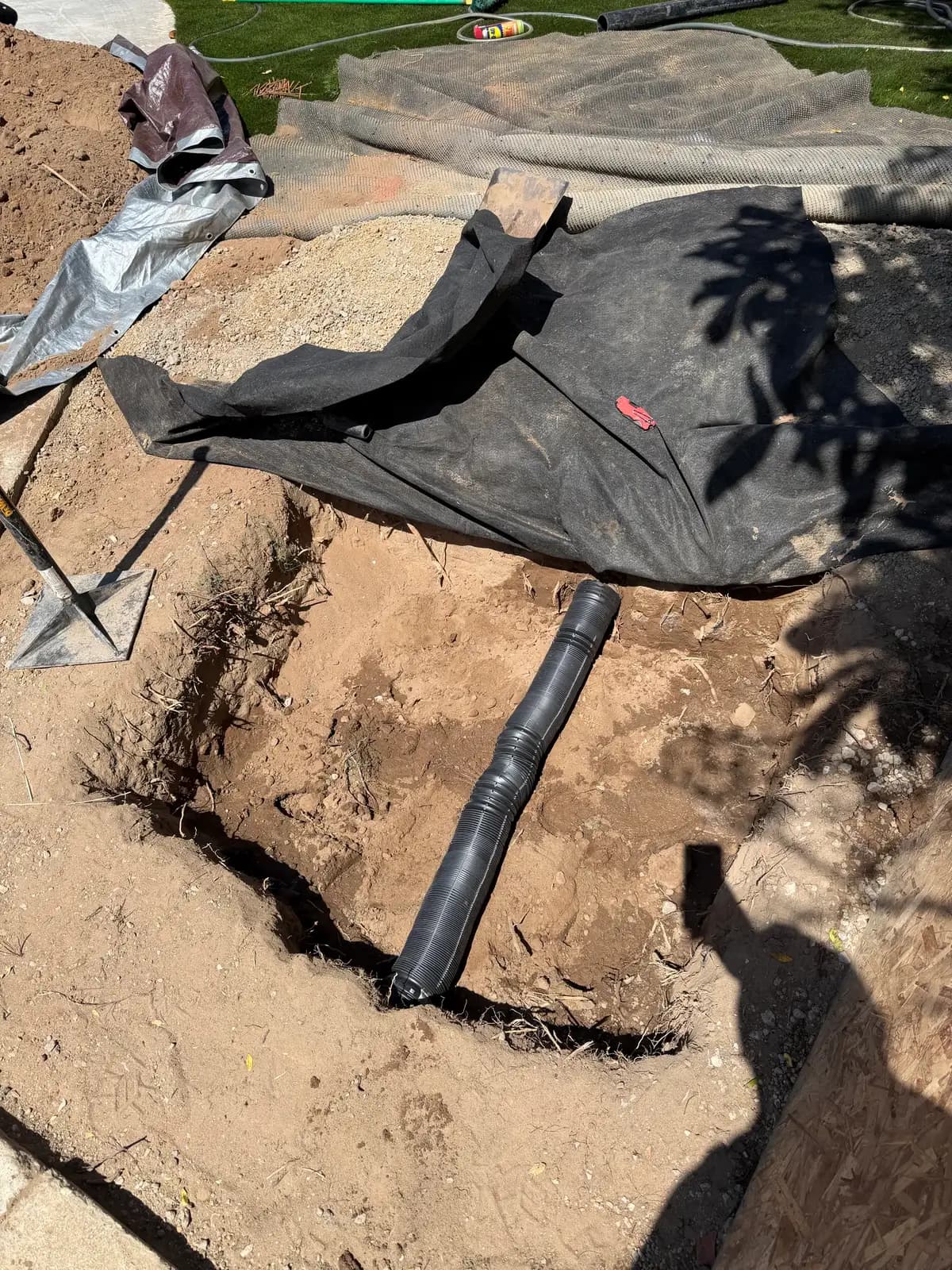
Pipe bursting is the right call when the existing pipe has lost structural integrity — collapsed sections, significant offset joints, or root intrusion that has physically deformed the pipe wall. A bursting head is pulled through the old pipe, fracturing it outward into the surrounding soil, while simultaneously pulling a new HDPE pipe into position. Access pits at each end are typically 24 to 36 inches wide. The old pipe is gone; a new pipe is in its place.
CIPP lining works when the pipe is structurally compromised but still roughly round — cracks, joint gaps, root infiltration that hasn't deformed the pipe. A resin-saturated liner is pulled into the existing pipe and cured in place, creating a new pipe wall inside the old one. The result is a slightly smaller interior diameter but a structurally independent pipe with a smooth bore that resists root re-entry. For Avenues-area homes where the lateral runs under a poured concrete driveway, lining is often the lower-disruption solution.
What happens to hardscape — and what doesn't
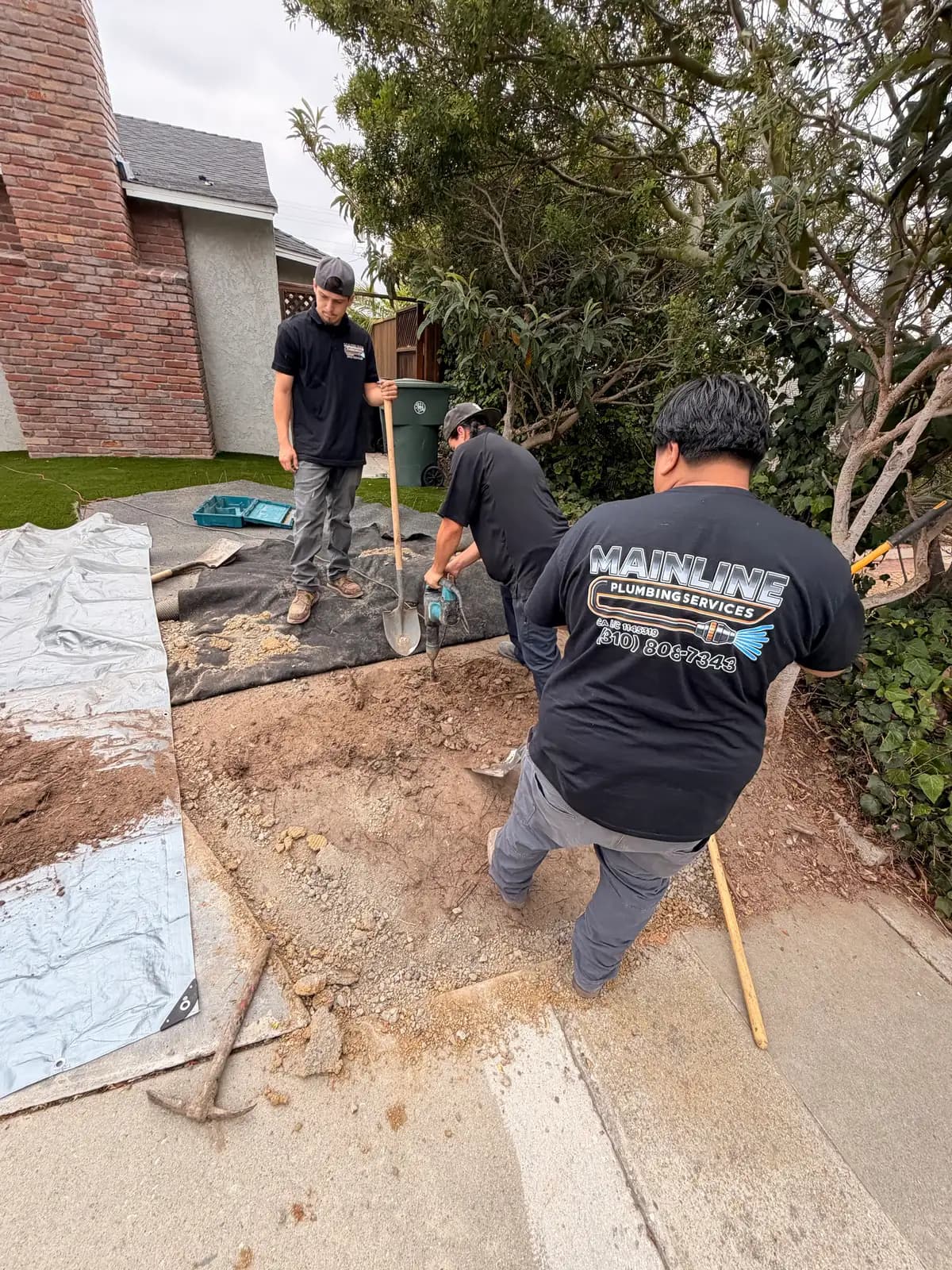
The honest answer is that trenchless work still requires access pits. Two of them, typically — one at the upstream cleanout near the building and one near the connection at the city main. In most Redondo Beach driveways and yards, those pits are positioned to minimize impact: concrete cutting is limited to a 30-by-36-inch section rather than a trench running the full length of the run.
That matters in Golden Hills and the Esplanade area, where homeowners have invested in brick, pavers, or stamped concrete. A traditional open-cut job on a 60-foot lateral through a paved backyard can mean removing and repacking 20 to 30 linear feet of hardscape. Trenchless reduces that to two small patches. The pipe replacement cost is similar either way — the savings are in the hardscape restoration you don't have to do.
One situation where open-cut becomes unavoidable: when the lateral runs directly beneath a structural element, or when intermediate access is required because the existing cleanout locations don't allow a direct pull. We identify these constraints during the [camera inspection](/services/trenchless) before any work is priced or scheduled.
The camera inspection step you shouldn't skip
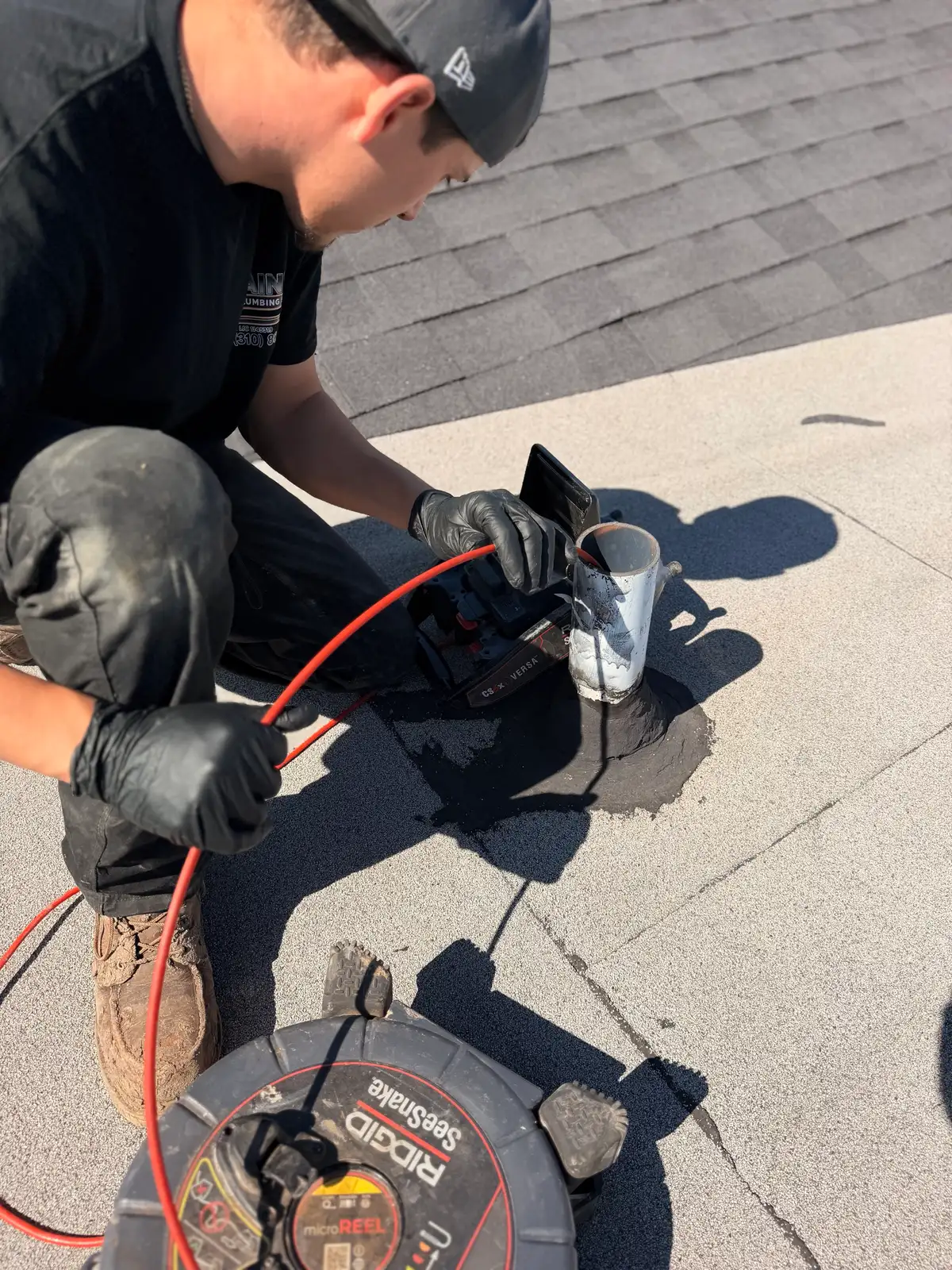
A camera inspection isn't optional pre-work — it's how we determine which method is appropriate, what the pipe condition actually is, and where the access pits need to go. Without it, any price quote is a guess.
For Redondo Beach laterals, the camera also reveals issues that change the scope entirely. A clay lateral with one root-infiltrated joint might need a spot repair, not a full-line replacement. A cast-iron line that looks intact from the cleanout might show 80 percent occlusion by scale 20 feet in. The camera is the diagnostic, and the findings drive the recommendation.
We use camera footage to mark the pipe centerline and depth, identify any mid-run cleanouts, and locate lateral transitions — where clay transitions to ABS or cast iron, for instance. Transition points are common failure locations on Redondo Beach properties built in the 1950s and 1960s, when contractors sometimes mixed pipe materials within a single run. Knowing those locations before work starts prevents surprises during the pull or the lining cure.
Permits, timelines, and what to expect on job day
Trenchless sewer work in Redondo Beach requires a permit from the city's Public Works department. We pull the permit — not the homeowner. The permit process typically adds two to five business days before work can begin on non-emergency repairs. Emergency situations are handled differently, but planned replacements follow the permit timeline.
On job day for a standard pipe-bursting replacement, expect four to seven hours on-site for a typical residential lateral — 40 to 70 feet from the building connection to the city main. CIPP lining jobs run similarly but involve a cure window (ambient or steam, depending on resin type) that adds time before the line can be returned to service. We'll give you a specific timeline when the scope is confirmed.
The city inspection happens after installation and before backfill of the access pits. We coordinate the inspection schedule and won't close the pits until the work passes. For properties in [Redondo Beach trenchless service area](/service-areas/redondo-beach/trenchless), our 25-minute target response time means we can mobilize quickly when the inspection window opens.
Redondo Beach trenchless sewer questions we hear most
How do I know if my lateral needs full replacement versus spot repair? A camera inspection gives the answer. A single cracked joint with otherwise sound pipe is a candidate for spot repair. Multiple offset joints, continuous root infiltration, or pipe-wall deformation that extends beyond a few feet typically warrants a full-length approach — either bursting or lining — because spot repairs on a deteriorated line tend to fail at the next weakest point within a year or two.
Will trenchless work under my concrete driveway without cracking it? The access pits require cutting two sections of concrete. Those sections are cored or saw-cut, not broken out, so the surrounding slab stays intact. The cut sections are repoured after inspection sign-off. The lateral beneath the driveway is replaced or lined without removing the slab above it.
Does salt air or coastal moisture affect trenchless pipe materials? HDPE pipe used in pipe bursting is inert to the coastal soil environment — it doesn't corrode, and root systems can't penetrate it at joints the way clay allows. CIPP liner resin is similarly non-reactive to soil chemistry. Both outperform clay and cast iron in the Redondo Beach coastal environment over a 50-year horizon.
How long does the new pipe last? HDPE pipe installed by pipe bursting carries a standard industry rating of 50 years. CIPP lining is rated similarly. Neither rating is a guarantee — it reflects performance under normal operating conditions. Proper installation and a passing city inspection are what determine whether that rating holds.
Are you licensed to do this work? Yes. We hold C-36 license #901735, issued by the California State License Board. You can verify it at cslb.ca.gov. We pull permits on every sewer lateral replacement — working without a permit isn't something we do, regardless of property or timeline pressure.
Can I get trenchless work done before a home sale? Yes, and it's often the right call. If a buyer's inspection surfaces a failing lateral, the negotiation shifts to price credits or repair contingencies that may cost more than the work itself. Having the lateral scoped and repaired before listing — with a permit and final inspection on record — removes that variable from escrow.
What to do next
If your Redondo Beach home was built before 1970 and the sewer lateral has never been inspected, start with a camera inspection. It takes less than an hour and gives you a clear picture of what you're working with — whether that's a line in better shape than expected or one that needs attention before it becomes a backup or a failed escrow.
Mainline No-Dig Trenchless Plumbing is headquartered in Lomita and has served Redondo Beach — from North Redondo and The Avenues to South Redondo and the Hollywood Riviera — for 18-plus years. We're Licensed C-36 #901735, dispatch 24/7 with no overtime fees, and aim for 25-minute response to Redondo Beach addresses. Call us at (310) 808-7343 to schedule an inspection or discuss a repair scope.
Tags
Related Services