Trenchless sewer repair lets Gardena homeowners replace or rehabilitate a damaged lateral through small access points instead of excavating the whole yard or driveway. Camera inspection determines whether a collapsed, root-filled, or undersized line needs pipe bursting, while a structurally sound pipe with cracks or minor intrusion may qualify for CIPP lining.
Gardena's broad post-war buildout left many 1940s–1960s homes with vitrified clay laterals, cast-iron drainage, and mature street trees. Those systems are now old enough that recurring backups often reflect structural failure rather than a one-time clog.
Why Gardena's housing era matters underground
Neighborhoods around Pacific Square, Hollypark, McCarthy, and the central Gardena grid contain large runs of post-war tract housing built with similar materials and installation methods. Clay joints admit roots; cast iron scales internally; settled soil can create offsets and bellies.
The failure pattern is not proof that every old line needs replacement. It is a reason to camera the line after repeat clogs so the next decision is based on pipe condition rather than another temporary clearing.
A cable may restore flow through a root mass while leaving the open clay joint untouched. Hydro-jetting can clean scale and grease but cannot lift a settled section back to grade. Conversely, a camera can show a sound line that only needed cleaning, saving the homeowner from premature replacement. The useful sequence is clear the obstruction enough to see, record the full run, locate defects at the surface, and then match the repair to the structural evidence.
Camera evidence chooses the no-dig method
A camera records roots, cracks, offsets, standing water, material transitions, and collapse, while a surface locate confirms length and depth. Cleaning may be needed before the pipe wall can be evaluated accurately.
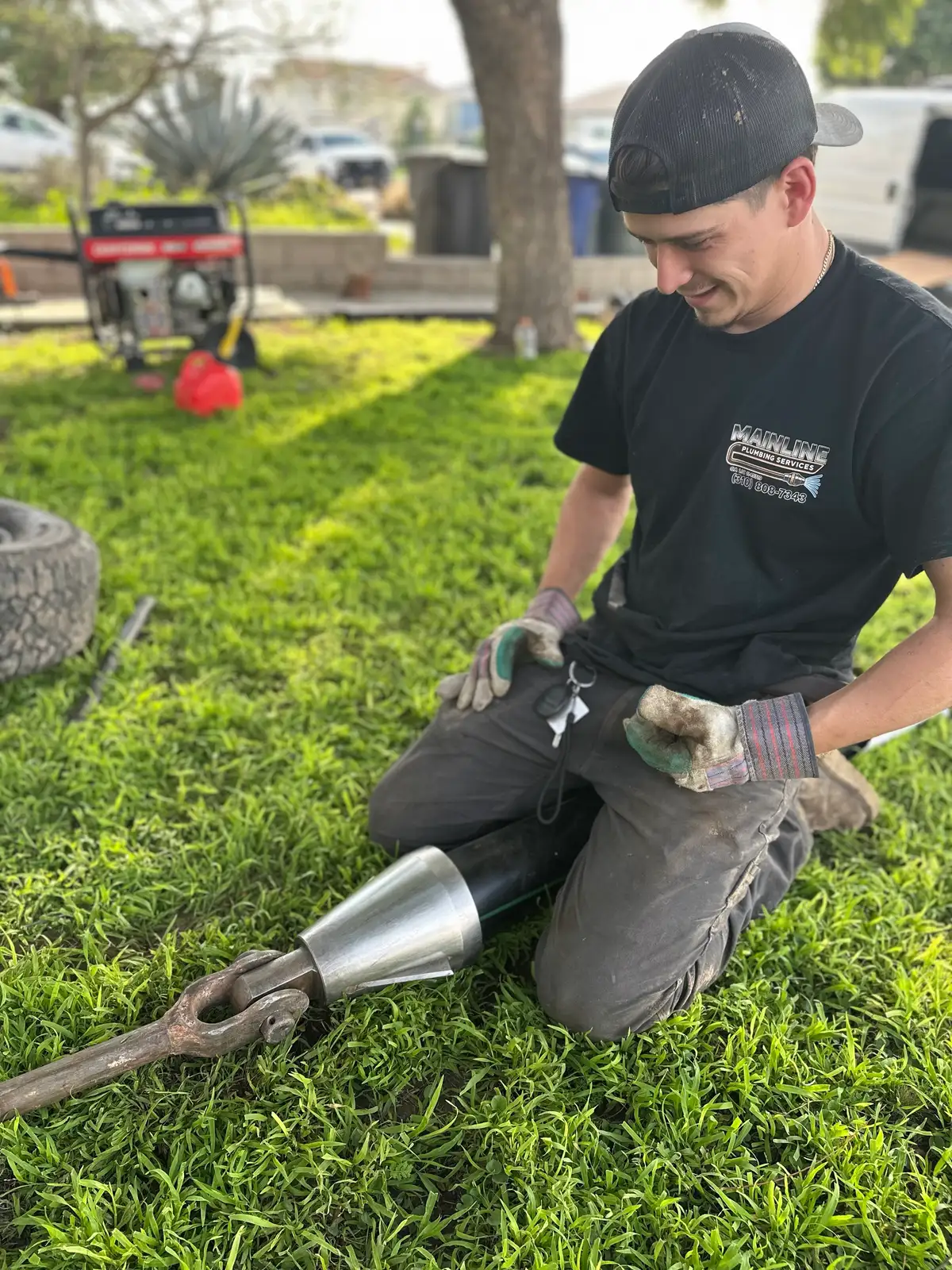
Pipe bursting installs new jointless HDPE along the old alignment and can increase diameter. CIPP creates a cured structural liner inside a host pipe that still holds its shape. Our [trenchless sewer repair service](/services/trenchless) explains both methods and their access requirements.
Bursting is generally stronger where the host pipe is collapsed, severely offset, undersized, or too deteriorated to support a liner. Lining can be attractive where the alignment and diameter remain usable but joints and cracks admit roots. Neither method corrects every belly, and branch reconnections still need careful execution. We explain what the camera rules in and out, including any segment that still requires a small targeted excavation.
When trenchless is cheaper than opening the yard
A short open dig through bare soil can be less expensive than trenchless. The comparison changes when the lateral crosses concrete, mature landscaping, retaining features, patios, irrigation, or a finished driveway.
Compare the entire restoration scope, schedule, permit, disposal, and disruption—not only the plumbing line item. Gardena homeowners can start with the local housing and service context on our [Gardena plumbing hub](/service-areas/gardena) without following a thin city-service landing page.
What a documented trenchless project includes
A complete scope should identify the pipe condition, chosen method, access points, utility locating, permit responsibility, new material, reconnections, post-work camera verification, and surface restoration. Those details prevent the phrase 'trenchless' from hiding exclusions.
Mainline plans small access pits around property features, verifies the completed line on camera, and gives the homeowner the record. If cleaning or a targeted repair is enough, the camera should make that clear too.
Access planning starts with utilities and finished features. A small pit in the wrong place can still damage irrigation, tree roots, or decorative concrete. We identify the cleanout, city connection, depth changes, branch ties, and equipment path before setting the work area. After installation, the camera should show continuous flow, completed connections, and the final interior condition. Surface restoration then follows the written scope rather than becoming a surprise change order.
Property access also affects schedule. Gardena's compact lots can place the cleanout behind gates, additions, or narrow side yards, while the city connection may sit beneath a driveway apron or landscaped parkway. We confirm equipment access and pit locations before mobilization. Compact machinery often solves the constraint, but an honest plan should identify fence panels, parking, utility clearances, and temporary surface protection in advance so 'no full trench' does not become 'no planning.' The final written scope records each of those access choices.
Gardena trenchless questions we hear most
Is trenchless always cheaper? No. It becomes especially competitive where demolition and restoration would otherwise be substantial.
Can roots come back through HDPE? Properly fused HDPE has no clay-style joints for roots to enter, though branch connections must also be completed correctly.
How do I verify your license? Mainline holds California C-36 license 901735, available through the official CSLB license lookup.
How much does trenchless repair cost? Length, depth, access, pipe condition, method, and restoration control the exact figure; camera inspection is required for a fixed quote.
Start with the pipe, not the sales method
Call (310) 808-7343 for a Gardena sewer camera inspection and written repair options. We serve Pacific Square, Hollypark, McCarthy, and surrounding neighborhoods, and we recommend pipe bursting, lining, cleaning, or targeted repair according to what the recorded line actually shows.
Tags
Related Services