Hawthorne's post-war tract neighborhoods were built fast — Bodger Park, Holly Park, and Ramona went up between roughly 1948 and 1965 to house aerospace workers flooding into the South Bay. The sewer laterals installed under those homes used clay tile or cast iron, both of which have a realistic service life of 50–70 years. That window closed on most of these properties 10 to 20 years ago.
Trenchless sewer repair — pipe bursting or CIPP lining — is the standard fix for failed laterals in Hawthorne because it replaces or rehabilitates the pipe without tearing up the slab, driveway, or landscaping. On a typical 50-foot Hawthorne lot, open-cut excavation means destroying hardscape that costs as much to restore as the pipe work itself. Trenchless methods avoid that entirely.
What's actually in the ground under a 1950s Hawthorne home
Hawthorne's build-out concentrated heavily in the 1950s and 1960s. The dominant lateral material from that era was vitrified clay tile, joined with cement mortar or push-fit rubber gaskets that have long since degraded. Some homes — particularly those with additions built in the 1960s and 1970s — also have sections of cast iron that have corroded from the outside in.
Clay tile fails in predictable ways: mortar joints crack, root intrusion follows, and sections eventually shift out of alignment as the soil moves beneath them. Cast iron oxidizes and pits internally, reducing the pipe bore and creating rough surfaces where grease and solids catch. Neither failure is sudden — they're progressive, which is why a [sewer camera inspection](/services/trenchless) is the only reliable way to know what you're dealing with before choosing a repair method.
Galvanized supply lines are a separate but related issue in Hollyglen and Hawthorne Boulevard Corridor homes from the same era. Galvanized at end-of-life affects pressure and water quality, but the sewer lateral is an independent system and typically fails on its own timeline.
How pipe bursting works on a standard Hawthorne lot
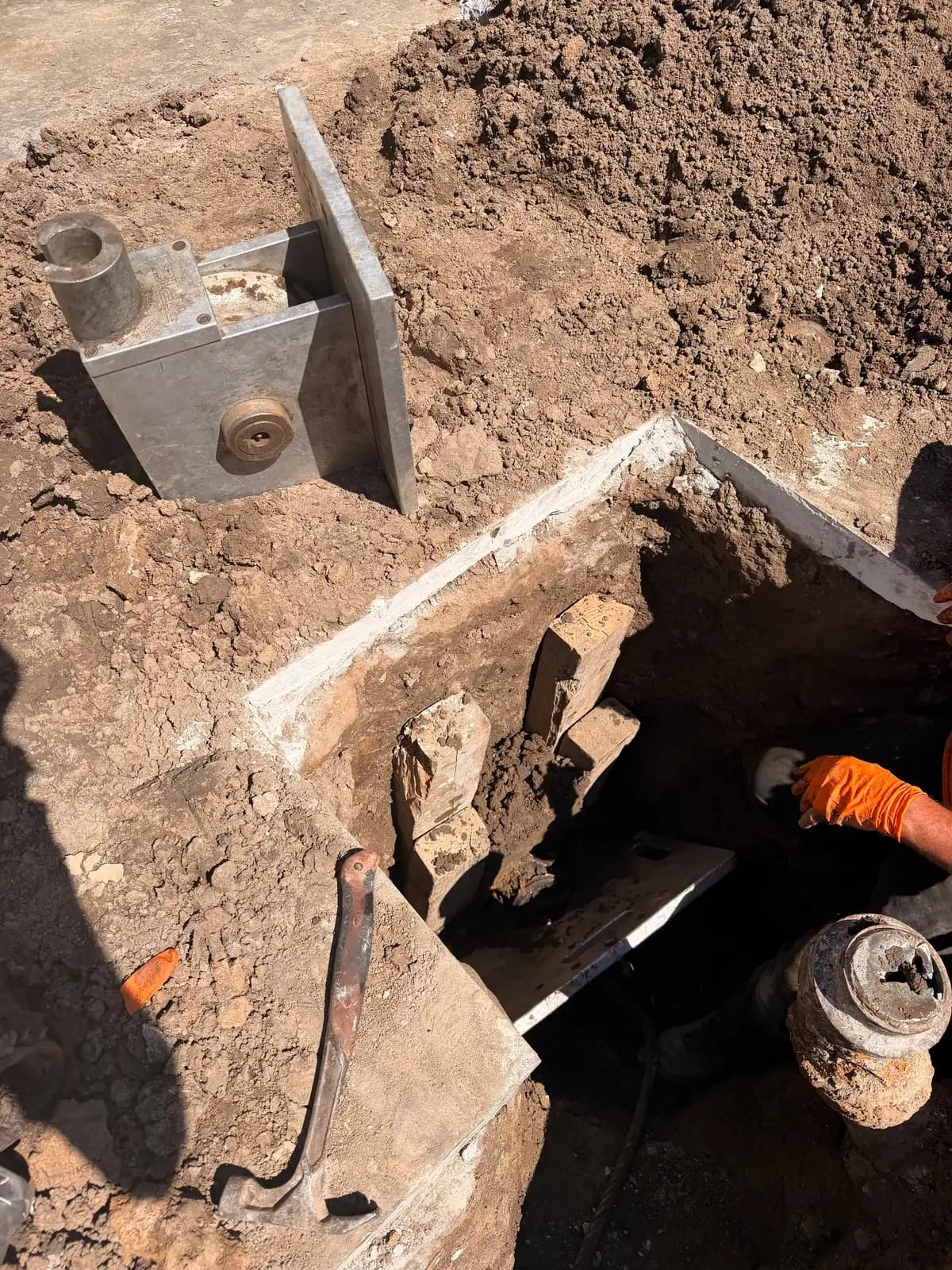
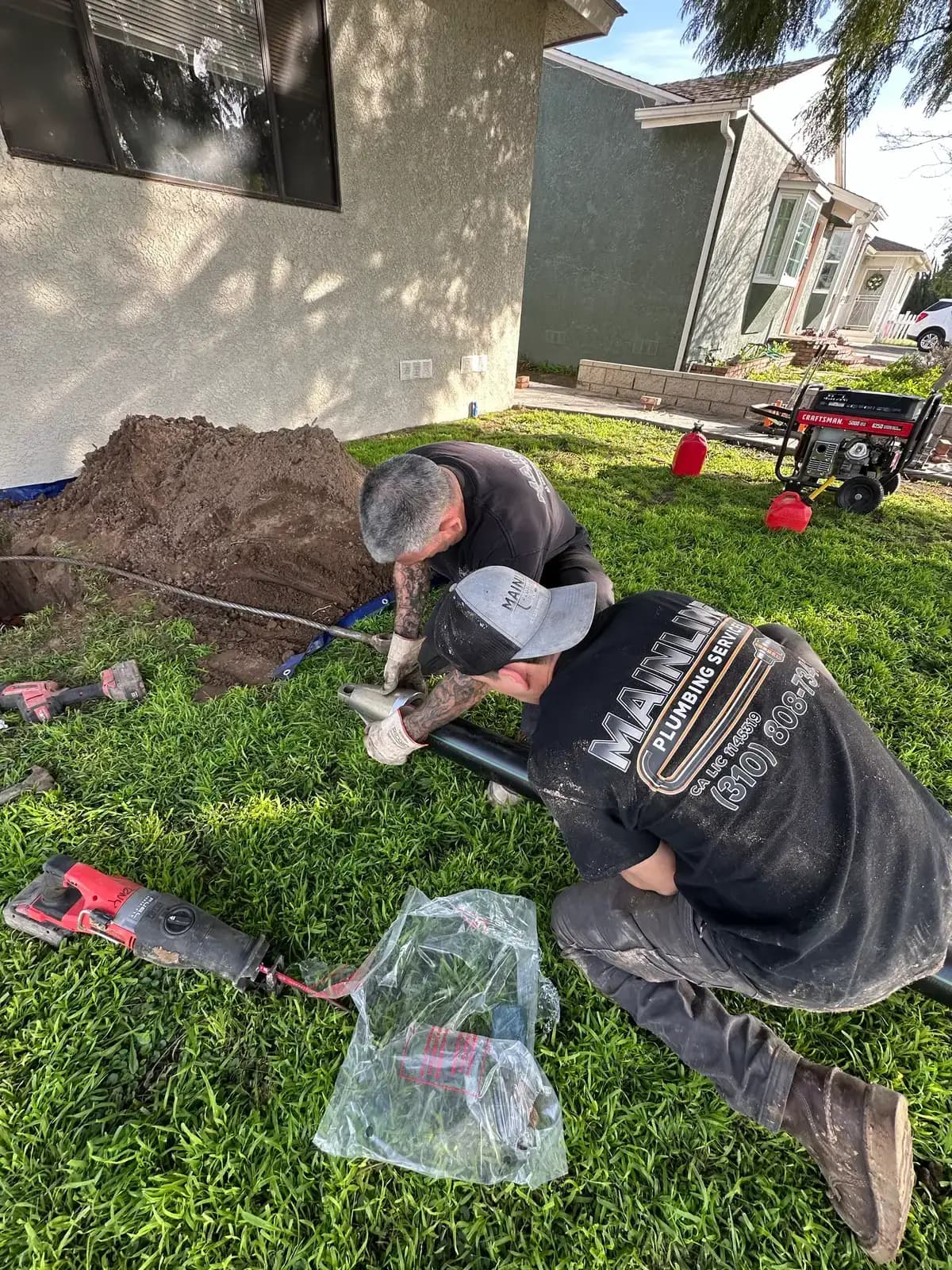
Pipe bursting replaces the existing lateral without excavating along its run. A hydraulic head is pulled through the old pipe, fracturing it outward into the surrounding soil while simultaneously pulling a new HDPE pipe in behind it. Entry and exit pits — typically 24 to 36 inches wide — are dug at each end of the run, usually at the building cleanout and near the city connection at the property line.
On a 50-foot Hawthorne lot with a driveway running front to back, the two access pits are dug at the ends of the lateral run, which means the driveway surface itself isn't disturbed along the middle section. That's the core advantage on these smaller lots. The new HDPE pipe is continuous, has no joints along the run, and carries a rated service life of 50 years or more under normal conditions.
The job typically runs one day for a standard residential lateral in the 40- to 60-foot range. Permit, inspection, and final backfill add time — plan for the cleanout to be active again within 24 to 48 hours of the work day itself in most cases.
CIPP lining as an alternative when the host pipe is still structurally intact
Cured-in-place pipe lining installs a resin-saturated felt liner inside the existing pipe, which is then cured to form a rigid new pipe wall inside the old one. It requires no access pits at all — the liner is inserted through an existing cleanout opening. The tradeoff is that the host pipe must retain enough structural integrity to hold the liner in position during curing.
For Hawthorne laterals with significant joint displacement, collapsed sections, or large root intrusion channels, lining isn't viable — pipe bursting is the correct call. Camera inspection determines which method applies. We don't select the method before we see what's in the pipe. For detailed comparison, see our overview of [trenchless sewer repair in Hawthorne](/service-areas/hawthorne/trenchless).
Where lining does apply — typically pipes with intact barrel sections but degraded interior surfaces and minor root infiltration — it's faster and causes even less surface disruption than bursting. The finished bore is slightly reduced (typically by the liner wall thickness), which is not a functional issue in a residential lateral sized for normal household flow.
Lot-size and access realities in Bodger Park, Holly Park, and Ramona
Hawthorne tract lots are compact. Standard parcels in Bodger Park and Holly Park run 50 by 120 feet, sometimes narrower on corner lots that were subdivided in the 1970s. The lateral typically runs under the driveway or a narrow side yard from the house to the city main. Access for equipment — a mini-excavator for the access pits — requires at least a 36-inch clear path to the entry point.
In Ramona, some blocks have alley-accessed garages, which means the lateral exits through the rear toward the alley rather than the front curb. That changes the pit locations and the permit scope — rear-yard access to the city connection on an alley sometimes involves a separate permit line item with the city. We scope this during the camera inspection so there are no surprises on job day.
Mature trees are a consistent issue throughout these neighborhoods. Ficus, magnolia, and some of the larger jacarandas planted in the 1960s have root systems that travel well beyond the canopy drip line. If a tree is within 20 feet of the lateral run, camera footage almost always shows root infiltration. Pipe bursting eliminates that root pathway permanently — the new HDPE pipe has no joints for roots to enter.
What triggers the need for trenchless repair — and what doesn't
Slow drains throughout the house — not just one fixture — point to the lateral rather than an individual branch line. Sewage odors in the yard, soft or wet ground above the lateral run, and recurring backups after snaking are all diagnostic signals that the lateral has structural damage, not just a clog. A snake clears obstructions; it doesn't fix a collapsed pipe or a joint that has separated 2 inches.
A single slow drain in one bathroom, or a gurgling toilet that clears with a standard snake, usually doesn't indicate a failed lateral. The camera tells the difference definitively. We run the [camera inspection](/services/trenchless) as a standalone service — it's not bundled with a repair commitment. If the pipe looks serviceable, we'll say so.
Hawthorne trenchless sewer repair questions we hear most
How long does a trenchless sewer repair job take in Hawthorne? For a standard residential lateral in the 40- to 70-foot range, the actual pipe work — bursting or lining — runs one day. Permit inspection scheduling adds 1 to 3 business days depending on the city's inspection queue. Plan for normal use to resume the same evening or the following morning after the work day.
Does Hawthorne require a permit for sewer lateral replacement? Yes. A sewer lateral replacement — trenchless or open cut — requires a plumbing permit from the City of Hawthorne and a final inspection sign-off. We pull the permit on your behalf as part of the job. Work done without a permit creates a disclosure obligation at sale and can complicate title transfer.
Will pipe bursting damage tree roots that extend under my driveway? The bursting head fractures the existing pipe outward and displaces the surrounding soil slightly. Roots inside the pipe are cleared in the process. Roots running parallel to the pipe in adjacent soil are not directly disturbed. If a tree is close enough that its structural roots are intertwined with the pipe trench zone, that's something we flag during the camera scope and the pre-job site walk.
How do I know if my Hawthorne home has original clay tile sewer lateral? Camera inspection is the only reliable confirmation. Homes built before 1968 in Hawthorne have a high probability of original clay tile. Homes with additions or remodels from the 1970s onward may have mixed-material laterals — clay from the street to a point, and cast iron or ABS from there to the house.
Is Mainline a licensed contractor for this work? Yes. We hold California C-36 Plumbing Contractor license #901735, which covers sewer lateral replacement and trenchless repair. You can verify the license status directly on the CSLB website at cslb.ca.gov. We operate out of Lomita and typically reach Hawthorne in under 30 minutes.
What does a trenchless lateral replacement cost in Hawthorne? Cost depends on lateral length, depth, access conditions, and whether bursting or lining is the appropriate method. We don't publish flat-rate ranges because a 40-foot lateral in a clear side yard and a 70-foot lateral under a concrete driveway with a buried tree root mass are genuinely different jobs. Camera inspection establishes the scope, and we quote from that scope.
What to do next
If your Hawthorne home was built between 1948 and 1968 and you're seeing any of the failure signals described above — recurring backups, yard odors, slow drains on multiple fixtures — the first step is a camera inspection of the lateral. That footage determines whether the pipe needs full replacement, lining, or neither.
Mainline No-Dig Trenchless Plumbing (C-36 #901735) is based in Lomita and services all of Hawthorne, including Bodger Park, Holly Park, and Ramona. We dispatch 24/7 with a 60-minute target response for emergencies and no overtime fees. Call us at (310) 808-7343 to schedule a camera inspection or to discuss what you're seeing at your property.
Tags
Related Services