Hermosa Beach averages 30 feet of lot width — sometimes less in the Sand Section near the Strand. That number shapes every trenchless sewer job we run here more than pipe material, depth, or soil type. You can have a straightforward lateral failure and still spend two hours working out where to site a 4-foot access pit before a single tool goes in the ground.
The city was largely built out as bungalows between 1900 and 1940, and while most of that original housing stock has been redeveloped into townhomes, the lot dimensions didn't change. A 1,500-square-foot townhome built in 2003 sits on the same footprint as the 1928 beach cottage it replaced — which means the lateral routing is often awkward, setbacks are tight, and parking is shared or nonexistent. When we work in East Hermosa or the Hill Section, we sometimes have a bit more room to maneuver. On the Strand side, the geometry is often at its most constrained.
This post explains the specific access and logistics challenges that come with [trenchless sewer repair on Hermosa Beach properties](/service-areas/hermosa-beach/trenchless), why open-cut trenching is rarely viable, and how we sequence a pipe bursting job to keep the work contained and neighbor impact minimal.
Why open-cut excavation almost never works here
On a standard South Bay lot — 50 to 60 feet wide with side yard clearance — a contractor can run a trench alongside a structure, keep equipment on the property, and backfill without touching adjacent pavement. On a 30-foot Hermosa Beach lot with a townhome built to the edges of the setback, that option usually doesn't exist. There is no side yard. The front yard may be 8 feet deep. The back patio might be pavers or concrete slab.
Open-cut work in that environment means cutting through finished hardscape, sawing concrete pavement in the public right-of-way, and disrupting the neighbor's access — all for a repair that could be done with two small pits and a pipe bursting head. The math doesn't favor trenching. It's not just property impact; excavation that wide also requires shoring at depth, adds crew time, and extends the permit scope.
Pipe bursting — pulling a new HDPE pipe through the old line while fracturing the failed pipe outward — is the standard approach here because it matches the access reality. Entry pit and exit pit, each roughly 4 feet by 4 feet, positioned at the ends of the failing section. Everything else is underground.
Siting the pits when every inch is contested
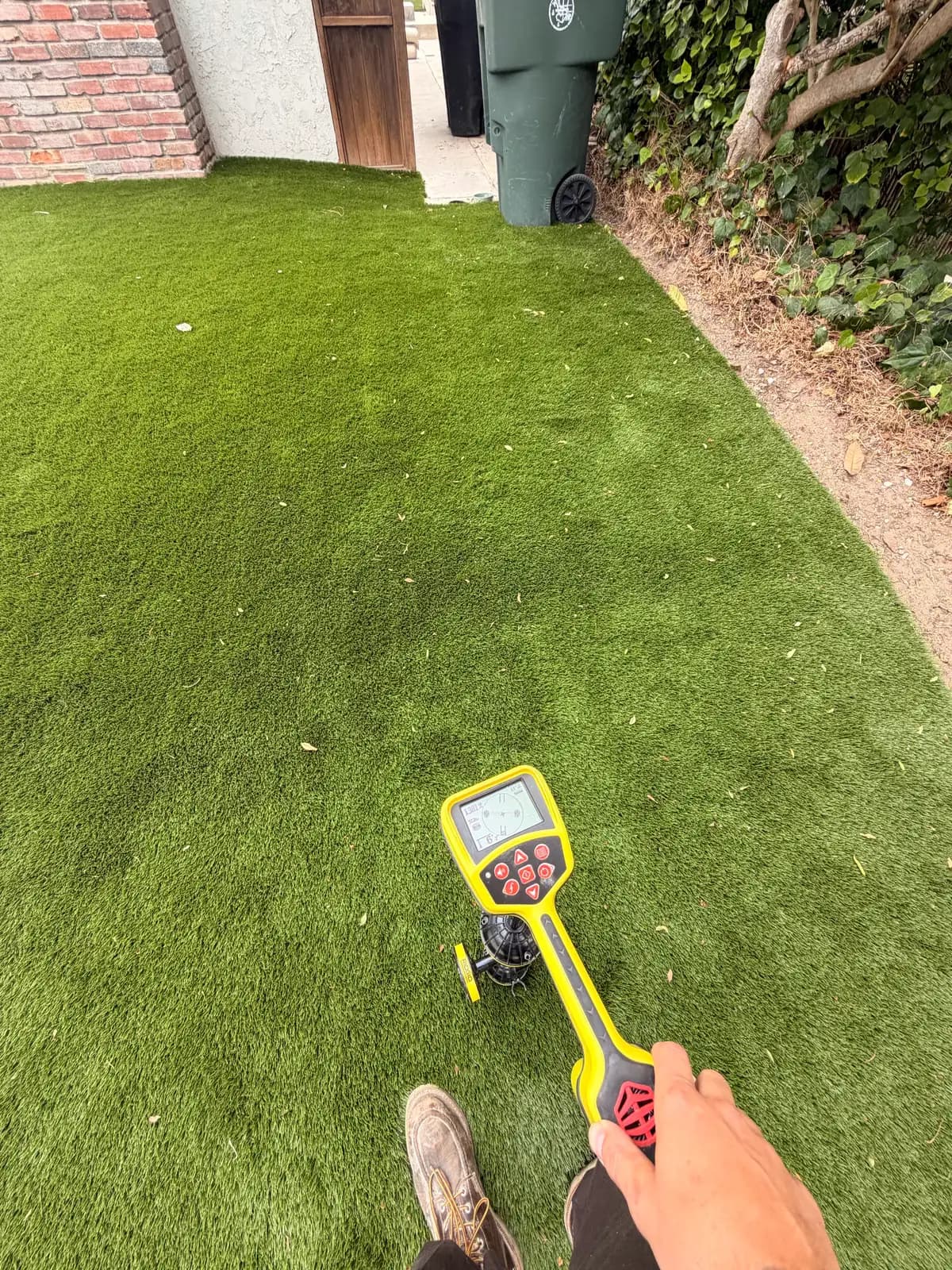
Pit location on a tight Hermosa Beach lot is a negotiation between three constraints: where the camera inspection showed the failure starts and ends, what's above ground at those points, and what's below ground around them. Gas service, electrical conduit, irrigation, and old abandoned laterals from prior structures all show up in the 0–4 foot depth range. We run a [video camera inspection](/services/trenchless) before any bursting job specifically to map the full lateral path and identify anything that would redirect the pit.
Front-of-property pits on lots in the Pier Avenue Corridor and the Sand Section often land partially in the public right-of-way, which requires a separate encroachment permit from the city. That permit has its own timeline — typically 5 to 10 business days in Hermosa Beach — and the work can't begin until it's issued. Scheduling the permit application before the job is confirmed is standard practice for us in this city. It's not a step you can compress later.
When the exit pit needs to fall near a neighbor's fence line or shared driveway, we make that conversation before mobilization, not the morning of. In most cases the neighbor's concern is not the pit itself — it's access to their parking during the work window. A confirmed, specific work schedule resolves most of it.
Shared laterals and the conversation no one wants to have
Older townhome complexes in Hermosa Beach — particularly those developed between 1985 and 2010 — sometimes have laterals that serve two units through a single connection point at the city main. That arrangement was common during the townhome redevelopment wave and it complicates repair in a specific way: if your unit's lateral is the failed section, the repair affects your neighbor's service continuity during the work window. In some configurations, both units share liability for maintaining the shared portion of that lateral.
We see this most often in the Valley Drive corridor and in some Hill Section complexes. The first step when a shared lateral is suspected is pulling the original as-built drawings from the city or from the HOA — not assuming the configuration based on how the cleanout is located. A camera inspection that follows the pipe all the way to the wye confirms whether the lateral is shared and exactly where the shared section begins.
If a shared lateral is confirmed, the repair coordination changes. You may need written agreement from the adjacent unit owner before a permit will be issued, depending on how the property was subdivided. This isn't a legal determination we make — that's for an attorney or the city planning counter — but we flag it early so the schedule doesn't get disrupted at the permit stage.
Dewatering near the Strand
The Sand Section sits on imported beach fill and sandy alluvial soil. Groundwater depth in that area can be as shallow as 3 to 5 feet below finished grade depending on the season and proximity to the ocean. For a pipe bursting pit that needs to go down 5 to 7 feet to reach a lateral at depth, that means dewatering — actively pumping water out of the pit faster than it infiltrates — before and during the pipe pull.
Dewatering on a 30-foot lot adds equipment: a submersible pump, a discharge line, and a place to route the water. Most of the time, the discharge routes to the street gutter under a stormwater permit condition. Hermosa Beach's Public Works department has specific requirements for discharge turbidity and volume — it's not a free-for-all. We coordinate that as part of the encroachment permit package when the job is in the Sand Section or within two blocks of the Strand.
Dewatering also slows the pit excavation. Hand digging is slower than mechanical, and in saturated sand you're shoring as you go. A job that takes 4 hours on a dry Torrance lot might take 7 on a waterlogged Sand Section lot. That timeline difference needs to be in the scope before the customer commits to a price.
Permit choreography on a compressed timeline
A standard Hermosa Beach sewer lateral repair requires a building permit from the city and, when work enters the public right-of-way, an encroachment permit from Public Works. Those two permits are separate applications, separate reviewers, and separate inspection schedules. The building permit inspection covers the pipe installation and connection at the wye. The encroachment permit covers the pit and any pavement restoration in the right-of-way.
Permit timelines in Hermosa Beach have ranged from 5 to 15 business days depending on current review load. We submit complete applications — site plan, pipe material specs, dewatering plan if applicable — so nothing comes back for revision. Incomplete applications that go back and forth add 5 to 10 days per round. When there's an escrow deadline or a health-and-safety condition driving urgency, we explain clearly what the city's timeline is and what we can and can't influence.
Inspection scheduling is the other variable. Hermosa Beach building inspections are typically available within 2 business days of request. We schedule the inspection before backfill and pavement restoration so the sequence doesn't get compressed at the end of the job.
What the pipe bursting process looks like on a tight lot
Once permits are issued, the actual pipe bursting sequence on a Hermosa Beach lot is methodical. Day one is excavation of both pits, dewatering if required, and verification of the existing pipe entry and exit points. The camera goes back in at this stage to confirm no surprises between the original inspection and today — shifting sand soil can move things. Day two is the pipe pull: the expander head attaches to the new HDPE pipe, enters the exit pit, and is pulled through by a hydraulic winch seated in the entry pit. The old pipe fractures outward as the head passes through.
The HDPE pipe fuses to the building connection on one end and the wye at the city main on the other. Both connections get pressure-tested before the pit is backfilled. Pavement restoration follows the permit's requirements — concrete-cut panels get replaced in kind, not patched with asphalt unless the permit allows it.
Total mobilization on a standard Hermosa Beach lateral — one that doesn't require dewatering and has a clean permit path — runs 2 days. Add a third day when dewatering is needed. Add another day if the encroachment permit requires a separate final inspection before pavement is restored. We give homeowners in the Sand Section, Hill Section, and East Hermosa a realistic schedule at the start, not a compressed estimate that falls apart on day one.
What to do next
If you're dealing with a slow or failed lateral on a Hermosa Beach property and you haven't had a camera inspection yet, that's the starting point. Everything else — pit locations, dewatering requirements, shared lateral determination, permit scope — flows from what the inspection documents. We run camera inspections with timestamped footage and distance-marked still images, so the report is actually useful when you're making decisions about scope.
We're a licensed C-36 contractor (#901735) headquartered in Lomita, and we work Hermosa Beach properties regularly. Our target response for non-emergency calls in Hermosa Beach is 28 minutes, and we dispatch 24/7 without overtime charges for genuine emergencies. To schedule an inspection or discuss a repair, call (310) 808-7343.
Tags