Gardena's commercial plumbing problems are grease problems. The Western Avenue Corridor and El Camino Village support a dense concentration of restaurants, food-prep operations, and light industrial tenants — all generating fats, oils, and grease (FOG) that LA County Public Works and local sanitation agencies actively regulate. An undersized or poorly maintained grease interceptor is the fastest way to draw a compliance notice, a lane closure fee, or a forced shutdown.
Mainline Plumbing has worked the Gardena commercial corridor long enough to know that most violations don't come from negligence — they come from interceptors that were sized for a prior tenant's menu and never reassessed. When the ramen shop replaces the deli, the FOG load changes significantly, but the interceptor usually stays the same.
How grease interceptors work and why sizing matters
A grease interceptor is a holding chamber — typically buried outside the building — that slows wastewater flow and allows FOG to separate from water before it reaches the municipal sewer. The clarified water exits through the outlet. Grease accumulates in the chamber until it's pumped out by a licensed hauler.
Sizing is based on daily wastewater flow, which LA County Environmental Health calculates using fixture units, meal counts, and the type of cooking equipment in operation. A 1,000-gallon unit that worked for a bakery may be wholly inadequate for a high-volume taqueria running multiple fryers. Overfilling accelerates grease carryover into the sewer lateral — the very violation that triggers enforcement.
LA County's FOG Control Program requires interceptors to maintain at least 25% capacity below the grease and solids accumulation level. Most operations need pump-outs every 30 to 90 days depending on volume. That schedule isn't optional, and it needs to be documented with hauler manifests that regulators can request.
What triggers a compliance inspection in Gardena
The county doesn't wait for a spill. FOG inspections are often triggered by a change in use permit, a new health permit application, a complaint from adjacent properties, or routine audits of high-FOG zip codes. Gardena's ZIPs 90247, 90248, and 90249 all fall within areas of active monitoring given the density of food-service and light-industrial operators.
A failed inspection can require interceptor replacement or upsizing within a short corrective-action window — sometimes 30 days. If the existing interceptor is undersized or deteriorated, that timeline is tight. Getting [commercial plumbing](/commercial-plumbing) work permitted and inspected in Gardena requires coordination with both the city and LA County, and the permit process doesn't pause for your operating hours.
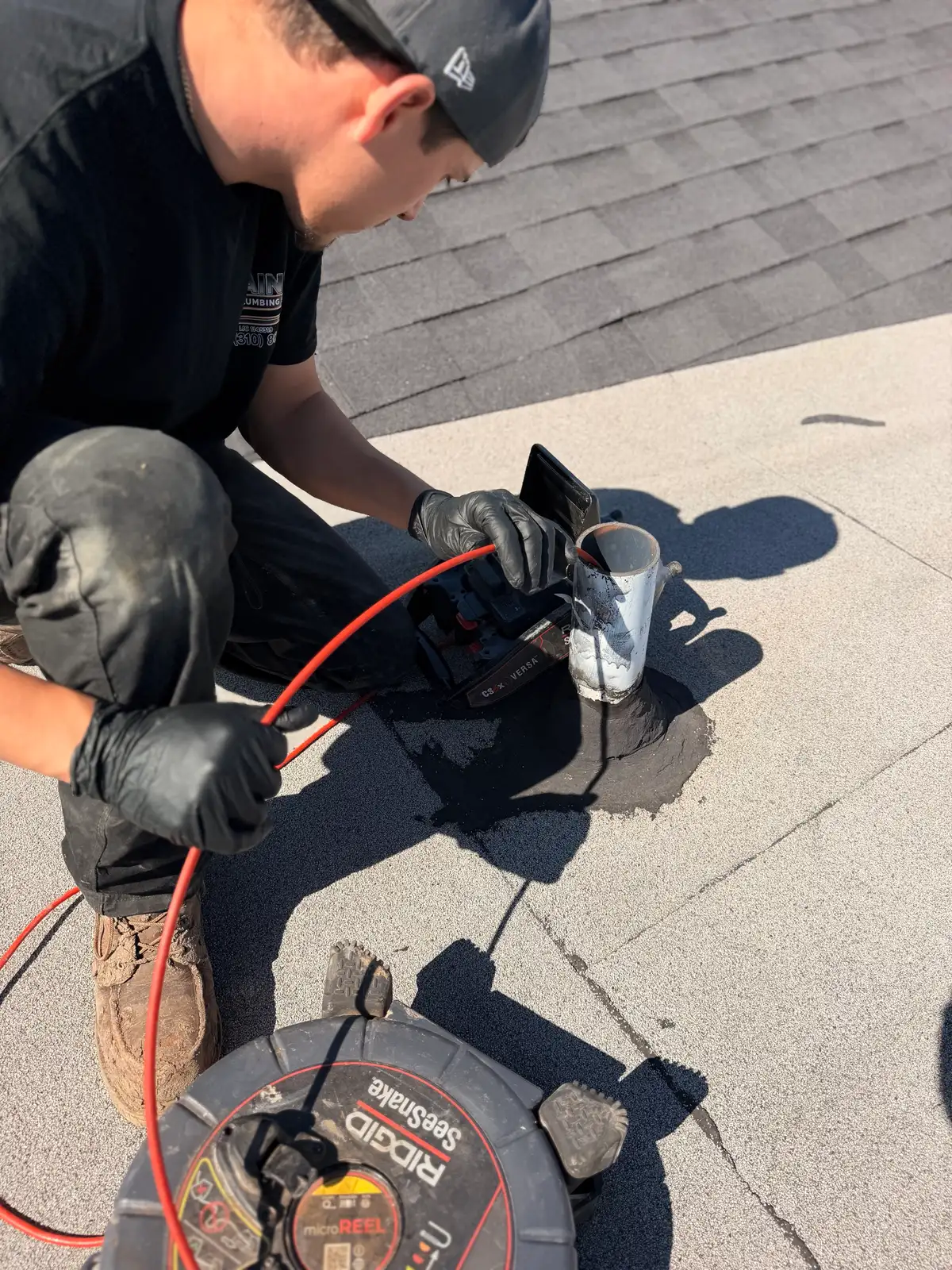
Older interceptors installed in Moneta and Old Gardena commercial properties from the 1970s and 1980s are frequently made of concrete with deteriorated baffles. A corroded baffle defeats the separation function entirely — water and grease pass through as a single stream. Camera inspection of the interceptor interior is the only reliable way to know whether the baffle is still intact.
Hydro-jetting the lateral after grease events
Even a properly maintained interceptor allows some FOG to pass through during peak load. Over time, that residual grease coats the walls of the sewer lateral, narrows the effective pipe diameter, and creates the conditions for a full blockage. A 4-inch lateral that's accumulated a half-inch of grease on the walls is functionally a 3-inch lateral — and it will back up.
[Hydro-jetting](/services/hydro-jetting) clears that accumulation by driving a high-pressure water stream through the pipe at 4,000+ PSI. Unlike a mechanical snake, which punctures a hole through the clog, jetting removes buildup from the pipe wall itself. For restaurant laterals, we typically recommend jetting on a scheduled basis — quarterly for high-volume kitchens, semi-annually for lower-volume operations — rather than waiting for a backup to force the issue.
Scheduling matters because a backup during a Saturday dinner rush doesn't give you the option of waiting. It closes the kitchen. A maintenance jetting contract turns that emergency into a line item on the operating budget instead.
Access and timing in a working kitchen
Commercial plumbing work in an operating restaurant requires coordination that residential jobs don't. Cleanout access is often under prep tables, behind refrigeration units, or in tight utility corridors. Interceptor pump-out access needs to be clear before the hauler or our crew arrives — in dense Gardena commercial buildings, that sometimes means temporarily moving equipment.
We schedule hydro-jetting and interceptor inspections during off-hours: before open, between lunch and dinner service, or after close. The line needs to be taken out of service for jetting, which means timing the work around the kitchen's actual schedule rather than a standard business-hours window. We dispatch 24/7 and carry no overtime fees, so the scheduling flexibility is real.
For multi-tenant commercial buildings — common along the Hawthorne Boulevard Corridor and El Camino Village — grease from one tenant's kitchen can accumulate in shared lateral sections that serve the whole building. In those cases, a single tenant's compliance may not be enough to keep the building out of violation.
New tenant buildouts and interceptor reassessment
When a Gardena commercial space changes hands or changes cuisine, the first question should be whether the existing grease interceptor is appropriately sized for the new operation. That assessment requires knowing the interceptor's current capacity, its condition, and the FOG load the new menu will generate.
A new tenant who inherits an undersized or failing interceptor becomes responsible for violations under their own health permit. Before signing a lease in a space that previously housed a restaurant, getting the interceptor inspected — and ideally, getting written documentation of its capacity and condition — is basic due diligence.
If a new interceptor is required, the installation is permitted work. Sizing, location, and access requirements are specified by LA County, and the interceptor must be installed before the kitchen can pass health inspection. We've handled interceptor replacements in tight Gardena commercial lots where excavation access was limited — in those cases, a concrete unit isn't always the right answer, and fiberglass or polyethylene alternatives may be specified instead.
Gardena commercial plumbing questions we hear most
**How often does a restaurant grease interceptor need to be pumped out in Gardena?** LA County's FOG Control Program requires that the combined grease and solids layer not exceed 25% of the interceptor's liquid capacity. In practice, that means most full-service restaurants need pump-outs every 30 to 60 days. High-volume fry-heavy operations may need monthly service. The hauler manifest is your documentation — keep it on file.
**Can we just use an under-sink grease trap instead of an exterior interceptor?** Under-sink traps (also called hydromechanical interceptors) are permitted for limited applications — typically single-fixture low-flow installations. They're not an approved substitute for an exterior interceptor on a full commercial kitchen. LA County will specify which type is required based on your fixture count and daily flow calculation.
**What's the difference between hydro-jetting and a standard drain snake for a grease blockage?** A snake mechanically punctures a hole through the blockage and restores flow, but it doesn't remove the grease coating the pipe walls. Jetting removes that buildup from the wall surface, which is why the lateral stays clear longer after jetting than after snaking. For recurring grease blockages, jetting is the appropriate long-term solution.
**Is your crew licensed for commercial plumbing work in Gardena?** Yes. Mainline Plumbing holds a C-36 plumbing contractor license, #901735, issued by the California State License Board. You can verify it directly at cslb.ca.gov. We're familiar with Gardena's permitting process and LA County FOG Control requirements.
**How quickly can you respond to a commercial backup during service hours?** We target a 28-minute response in Gardena, dispatched 24/7. For active backups during a kitchen shift, call (310) 808-7343 directly — don't route it through a general service request form.
**Our building is older and we've never had the lateral inspected. Where do we start?** Start with a camera inspection of the lateral from the building cleanout to the street. That gives you a baseline — pipe condition, any existing buildup, interceptor baffle integrity — before you're in a compliance situation. It's less expensive to find out now than during an inspection visit.
What to do next
If you're running a restaurant, food-prep operation, or multi-tenant commercial building in Gardena and haven't had your grease interceptor and lateral assessed recently, the right move is a scheduled inspection before a compliance notice forces the issue. We work across the [Gardena service area](/service-areas/gardena) — Old Gardena, Moneta, El Camino Village, and the full Western Avenue Corridor — and we schedule around your operating hours.
Call (310) 808-7343 to set up a commercial inspection or to get a same-day response to an active backup. Mainline Plumbing is a licensed C-36 contractor serving Gardena and 15 other South Bay cities, dispatched 24/7 with no overtime fees.
Tags
Related Services