Waiting 90 seconds for hot water at a master bath faucet isn't a minor inconvenience — it's a measurable waste. A 3/4-inch supply line running 60 feet from a water heater holds roughly 1.7 gallons of cold water that has to clear before the hot arrives. Run that faucet twice a day for a year and you've dumped over 1,200 gallons of water down the drain for nothing. In a drought-sensitive region like Southern California, that number matters.
A hot water recirculation loop solves this by keeping hot water staged close to every fixture. The concept is simple: water circulates continuously (or on demand) through the supply lines and back to the heater, so there's no cold column sitting in the pipe waiting to be flushed. The actual implementation varies significantly depending on whether your house was built with a dedicated return line or not — and that distinction drives the cost, the performance, and the tradeoffs you'll need to weigh.
Two fundamentally different system types
Houses built with recirculation in mind — typically custom estates and higher-end planned communities from the 1980s onward — have a dedicated return line running from the furthest fixture back to the water heater. This is the correct way to do it. The return line is typically 1/2-inch copper, it connects to the cold inlet of the heater through a small circulator pump, and the loop runs continuously or on a timer. Water stays within a few degrees of the heater's set temperature at every tap.
Most South Bay homes — the 1950s tract houses in Hawthorne's Hollyglen neighborhood, the 1960s builds in Carson Park, the post-war originals scattered across Gardena's Moneta district — were never plumbed with a return line. For these homes, a crossover valve (also called a comfort valve or bypass valve) is the standard retrofit solution. It installs under the furthest sink from the heater and connects the hot supply stub to the cold supply stub. The circulator pump draws cooled water from the hot line, pushes it back through the cold line, and returns it to the heater. No return line required.
The crossover valve approach works, but it has a real downside: for a few seconds after the pump activates, the cold supply at that fixture runs slightly warm. That's fine for a shower but can be annoying at a kitchen faucet if you want immediate cold water. This isn't a flaw in the installation — it's a physics constraint inherent to using the cold line as a return path.
Pump control: timer vs. on-demand vs. continuous
The circulator pump is a small device — typically drawing 25 to 85 watts — but it runs against the water heater's thermal losses, and those losses compound over time. How you control the pump determines most of the system's energy cost. Three control strategies are in common use: continuous operation, programmable timer, and on-demand (push-button or occupancy-sensor) activation.
Continuous operation keeps the loop at temperature around the clock. It's the most convenient and the most expensive. On a standard tank heater, continuous recirculation can add $15 to $40 per month to a gas bill depending on loop length, pipe insulation quality, and ambient temperature. That number climbs on poorly insulated older pipe runs common in 1950s and 1960s slab construction.
A programmable timer is the practical middle ground. Set it to run during the two or three windows when your household actually uses hot water — morning showers, evening dishes — and the pump stays off the other 18 hours. For most families this cuts recirculation energy costs by 60 to 70 percent versus continuous operation while eliminating nearly all of the wait time at peak hours. On-demand systems (a button at the fixture or a motion sensor) minimize energy use further but introduce a 20- to 45-second delay while the loop heats, which defeats some of the purpose.
Compatibility with tankless water heaters
Tankless water heaters and recirculation loops interact in ways that tank heaters don't. A traditional tank heater maintains stored hot water continuously, so the recirculation pump is just moving already-heated water. A tankless heater has a minimum flow rate — usually 0.5 to 0.75 gallons per minute — below which the burner won't fire. A recirculation pump moving water through a closed loop at low flow can cycle the burner on and off repeatedly, accelerating heat exchanger wear and increasing gas consumption.
Not all tankless units are built to handle recirculation. Some manufacturers offer dedicated recirculation-ready models with an internal pump and a separate return port; others require an external pump matched to specific flow parameters. If you're adding a recirculation loop to an existing [tankless water heater](/services/water-heaters/tankless), the model matters. We verify compatibility before any loop installation rather than assuming a generic pump will integrate cleanly.
For homeowners in Rolling Hills Estates or the larger custom homes in Palos Verdes Estates — where pipe runs from mechanical rooms to master suites can exceed 80 feet of vertical and horizontal travel — a recirculation-ready tankless unit paired with a dedicated return line is the spec that performs correctly long-term. A crossover valve retrofit on a non-compatible tankless unit is a short-term fix that creates service calls.
What the pipe run distance actually means
Sixty feet is roughly the threshold where recirculation shifts from a convenience upgrade to a meaningful quality-of-life improvement. Below that distance, most households tolerate the wait. Above it — especially in two-story homes where the heater is in a garage on one end and the master bath is at the far end of the second floor — the cold purge time crosses 60 to 90 seconds and that daily friction adds up.
In practice, the longest pipe runs we encounter in the South Bay are in the larger single-family homes along the Palos Verdes Peninsula, in the estate-lot properties in Rolling Hills Estates' Chandler Ranch and Dapplegray neighborhoods, and in the sprawling Ranch-style homes in Torrance's Hollywood Riviera. These homes were designed before recirculation was standard and often have 80- to 120-foot runs from the water heater to the master bath. A dedicated return line installed during a repipe or a major renovation is the clean solution. A crossover valve is a reasonable retrofit when the plumbing isn't being opened.
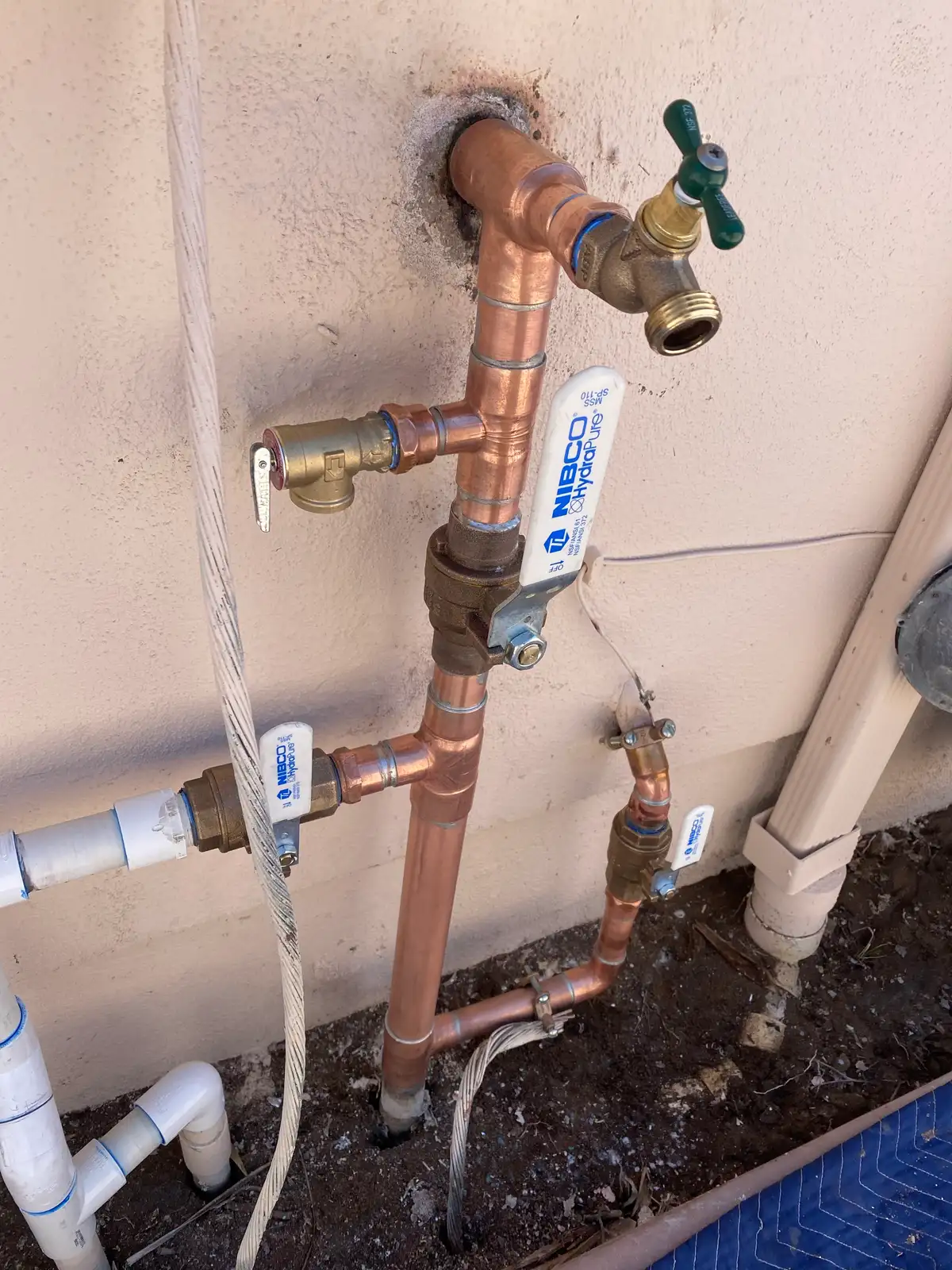
Pipe insulation along the return loop also matters more than most homeowners expect. Uninsulated copper in a hot attic or an exposed crawlspace loses heat fast, which means the pump runs longer and more frequently to maintain loop temperature. On a new dedicated return line installation, we sleeve the return in foam insulation as a standard step — not an upgrade.
Installation: what the job actually involves
A crossover valve retrofit is typically a half-day job. It requires access under the sink at the furthest fixture, compatible stub configurations on both the hot and cold supplies, installation of the circulator pump at the water heater, and wiring or programming the control timer. In most South Bay homes with accessible under-sink plumbing, there's no drywall work involved.
A dedicated return line is a different scope. It requires running 1/2-inch copper (or PEX) from the furthest fixture back through walls, attic space, or under-floor cavities to the water heater — however the house layout requires. In a single-story slab home in Torrance or Lawndale, that typically means attic routing. In a two-story with a crawlspace, it may go under the floor. The pump and controls are installed at the heater end. This work commonly runs one to two days depending on access and distance, and it may involve minor drywall patching at connection points.
For homes undergoing a full repipe, adding a dedicated return line during the same project is significantly more cost-efficient than returning later — the walls and access points are already open. If you're planning a [whole-home repipe](/services/repipes) and you have a long pipe run to a master suite, this is the time to spec the return line in.
Energy cost vs. convenience: the honest tradeoff
A recirculation system adds to your water heating energy load regardless of type. The question is whether the convenience and water savings justify that cost. For a household using 100+ gallons of hot water daily across multiple bathrooms, the water savings alone — eliminating the cold purge at each fixture — can offset a meaningful portion of the added energy cost. For a single-person household in a compact home, the math is less favorable.
The timer-controlled approach is where most households land when they think through the numbers. You get instant hot water during the hours you actually use it, you're not heating an empty loop at 2 a.m., and the incremental energy cost stays in the $8 to $18 per month range for a properly insulated loop on a gas heater. That's a reasonable tradeoff for eliminating 90-second waits at a master bath.
If you're in Redondo Beach's Golden Hills neighborhood or along the Avenues and you're already factoring in salt-air corrosion on your supply lines, a recirculation loop conversation is worth having during the same service call as an anode rod inspection or a water heater service — the two topics intersect directly at the heater connections.
Hot water recirculation questions we hear most
How much does a recirculation system cost to install? A comfort-valve retrofit, which uses the existing cold line as the return, typically runs $600 to $1,400 installed. A dedicated return line is $1,800 to $4,500 depending on how accessible the run is — straightforward in a crawlspace or accessible attic, considerably more where the pipe has to be chased through finished walls.
Will a recirculation pump raise my energy bill? Yes, though how much depends almost entirely on control strategy. A continuously running pump on an uninsulated loop is the expensive version, because you're reheating the loop around the clock. An on-demand pump triggered by a button or motion sensor costs very little to run. Insulating the loop matters more than pump selection.
Does recirculation work with a tankless water heater? Only with a unit specifically rated for it. Many tankless heaters have a minimum flow rate to fire, and a recirculation loop's low flow can sit below that threshold, causing short-cycling. Several manufacturers make tankless units with an integrated recirculation pump and buffer tank designed for exactly this.
How long should I wait for hot water without a recirculation system? A reasonable benchmark is under 30 seconds at the farthest fixture. Much beyond that usually means a long run, undersized pipe, or both. Measuring it at your farthest fixture is the honest way to decide whether the problem justifies the fix.
Can I install a comfort valve myself? Physically it's a straightforward swap under the farthest sink. What people get wrong is which fixture it goes under and whether the system's layout suits a crossover approach at all — put it in the wrong place and you get lukewarm cold water at that fixture with no meaningful improvement in wait time.
Is a recirculation loop worth it? It's a comfort upgrade, not an efficiency one, and it's most defensible where the hot water run is genuinely long. The water savings are real — a household waiting 60 seconds at multiple fixtures wastes a meaningful volume daily — but they rarely offset the pump's energy on their own. Buy it because you want hot water quickly.
What to do next
If hot water takes more than 45 seconds to arrive at your furthest fixture, a recirculation loop is worth scoping. The right system depends on your pipe layout, your water heater model, and how your household actually uses hot water across the day. We assess all three before recommending crossover valve versus dedicated return line.
Mainline No-Dig Trenchless Plumbing is a licensed C-36 contractor (#901735) serving 16 South Bay cities from our Lomita headquarters. For homeowners in Torrance, you can learn more about our [Torrance water heater services](/service-areas/torrance/water-heaters) including recirculation assessments. For any other city or to schedule a consult, call (310) 808-7343. We run 24/7 dispatch with no overtime fees — but a recirculation evaluation is a standard daytime appointment, not an emergency call.
Frequently Asked Questions
How much does a hot water recirculation system cost?
A comfort-valve retrofit using the existing cold line as the return runs $600 to $1,400 installed. A dedicated return line runs $1,800 to $4,500, depending mostly on whether the run is accessible through a crawlspace or attic or has to be chased through finished walls.
What's the difference between a dedicated return line and a crossover valve?
A dedicated return line is a separate pipe carrying cooled water back to the heater — the better-performing system, and the one to install during a repipe or new construction. A crossover or comfort valve pushes cooled water into the cold line instead, which needs no new pipe but can leave lukewarm water at the cold tap.
Does a recirculation pump waste energy?
A continuously running pump on an uninsulated loop does, because the loop is being reheated around the clock. An on-demand pump triggered by a button or motion sensor uses very little. Insulating the loop has a larger effect on running cost than which pump you choose.
Can I use a recirculation loop with a tankless water heater?
Only with a unit rated for it. Many tankless heaters need a minimum flow rate to fire, and a recirculation loop can fall below that threshold and cause short-cycling. Several manufacturers build tankless units with an integrated recirculation pump and small buffer tank for this purpose.
How long should you wait for hot water?
Under 30 seconds at the farthest fixture is a reasonable benchmark. Substantially longer usually indicates a long pipe run, undersized supply pipe, or both. Timing it at your farthest fixture is the practical way to decide whether the wait justifies the cost of fixing it.
Will a recirculation loop lower my water bill?
Somewhat. A household waiting a minute at several fixtures does waste a meaningful volume down the drain each day, and recirculation recovers most of it. But the savings rarely offset the pump's energy consumption on their own — treat it as a comfort upgrade that happens to save water.
Tags
Related Services