Trenchless sewer repair replaces or rehabilitates a failed sewer lateral without opening a trench across your yard. For most Lomita homes — built between 1930 and 1965 on compact lots with established landscaping — it's the method that makes sense both technically and practically.
Lomita sits 15 minutes from our headquarters in the same city. When a sewer emergency happens on Narbonne Avenue or in the Westside neighborhoods, we're on site faster than we are anywhere else in the South Bay. That speed matters when raw sewage is backing up into a house.
What's actually underground in a Lomita yard
Most of Lomita's housing stock went up between 1930 and 1965. That puts original sewer laterals at 60 to 90 years old. The material is typically vitrified clay tile — the standard choice through the mid-century build-out — and clay doesn't last forever. Joints crack, root intrusion finds every gap, and pipe sections settle out of alignment as soil shifts.
Old Lomita and the Eastside in particular have the oldest laterals. Homes along the Pacific Coast Highway Corridor and Narbonne Avenue Corridor are a generation newer, but still mostly pre-1970. If a lateral has never been replaced, it's probably overdue for a camera inspection at minimum.
Mature trees are part of what makes these neighborhoods appealing — and part of what destroys clay sewer pipe. Ficus, pepper trees, and large ornamentals will find a hairline crack in a clay joint and send roots in. A single blocked root mass can be cleared with a [sewer snake](/services/trenchless/sewer-snake), but if roots are returning every 12 to 18 months, the pipe structure itself is compromised.
Why open-cut trenching is the wrong call on most Lomita lots
A standard trench repair on a 40- to 50-foot lateral requires excavating a channel roughly 2 to 3 feet wide and 4 to 6 feet deep across the yard. On a Lomita post-war lot — typically 5,000 to 6,000 square feet — that trench can bisect the entire usable yard. Concrete flatwork, irrigation systems, and mature tree root zones all get cut.
Backfilling and compaction restore structural support, but disturbed soil settles. Flatwork either gets replaced or left with visible seams. Mature trees stressed by root damage around an excavation can take years to recover, and some don't. The plumbing problem gets solved; the property takes the hit.
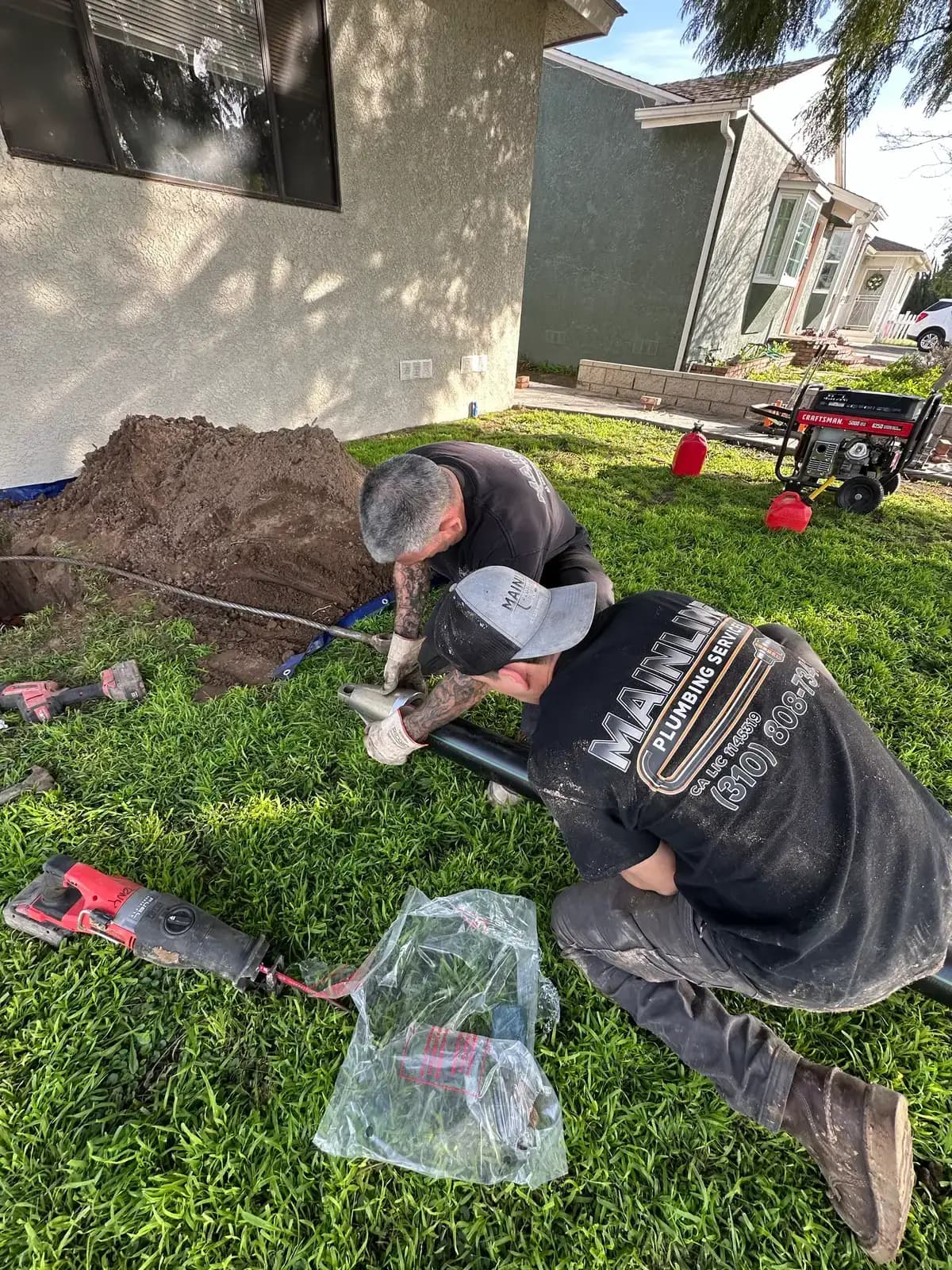
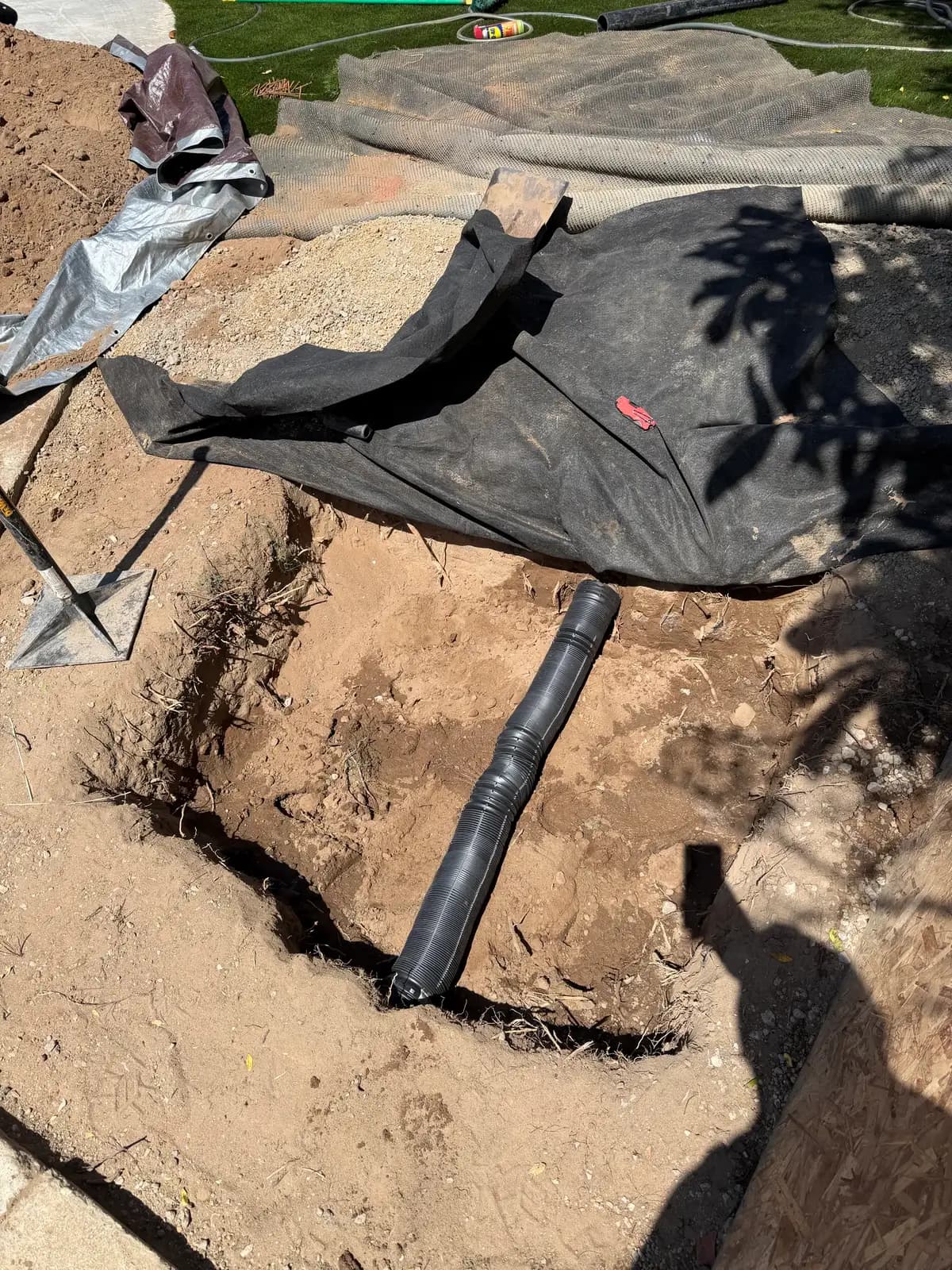
Trenchless methods — pipe bursting and CIPP lining — work from small access pits, typically 24 to 36 inches across, at each end of the failed section. The soil between those pits stays in place. Flatwork, root zones, and irrigation lines are left intact. On Lomita's smaller lots, that distinction is significant.
Pipe bursting vs. CIPP lining: which one applies here
Pipe bursting is the right choice when the existing pipe has structural failure — crushed sections, offset joints, or severe root intrusion that has compromised the pipe wall. A bursting head is pulled through the old pipe, fracturing it outward into the surrounding soil while simultaneously pulling a new HDPE pipe into position. The result is a full replacement, same alignment, no trench.
CIPP lining — cured-in-place pipe — works when the existing pipe is structurally intact but leaking at joints or showing early cracking. A resin-saturated liner is pulled into the pipe and inflated against the pipe wall, then cured in place. It creates a continuous pipe-within-a-pipe with no joints for roots to exploit. It adds roughly 50 years of service life to a lateral that still has its shape.
The camera inspection determines which method is appropriate. We run a [sewer camera inspection](/services/trenchless/camera-inspection) before recommending either approach. Pipe bursting on a pipe that only needed lining is unnecessary. Lining a pipe with a crushed section fails quickly. The footage tells us what's there.
What the job actually looks like on a Lomita property
For a typical Lomita lateral — 40 to 60 feet from the house cleanout to the city main connection — a pipe bursting job runs one to two days. Day one is excavating the two access pits, staging equipment, and completing the burst pull. Day two is connection verification, inspection, and pit backfill. The yard is functional by end of day two.
CIPP lining on the same lateral is often a single-day job. Access pits are smaller because there's no equipment to pull through — the liner is inverted or pulled in, inflated, and cured with hot water or UV light depending on the liner system. Connections are reinstated robotically.
We pull permits through the City of Lomita for lateral replacements that connect to the public main. The inspection is scheduled through the city, not left to the homeowner. For work entirely on private property that doesn't cross the right-of-way connection, permit requirements differ — we confirm scope before starting and advise accordingly. You can see details on how we handle [trenchless sewer repair in Lomita](/service-areas/lomita/trenchless) before calling.
The HQ-city response advantage
Our shop is in Lomita. When a sewer line backs up at a house in the Westside or along the Pacific Coast Highway Corridor at 11 p.m., response time from our crew isn't a calculation involving freeway conditions — it's a 10 to 15 minute drive. We target 60-minute response on emergency calls city-wide, but in Lomita that number is consistently at the low end.
Emergency sewer situations — sewage backing up into tubs or floor drains, foul odor from a cracked lateral under a slab, or a main line failure that's taken out all fixtures — get dispatched 24/7 with no overtime fee. Licensed C-36 #901735 covers all work performed.
Lomita trenchless sewer repair questions we hear most
How do I know if my Lomita lateral is clay tile? Most laterals installed before 1970 in Lomita are clay. A camera inspection confirms material and condition in about 30 minutes. You'll see the footage directly.
Will pipe bursting damage my tree roots? Pipe bursting fractures the old pipe outward into the surrounding soil, which can displace some soil near large roots. The access pits — not the burst path — are where root exposure is most likely. We note significant root zones before digging and adjust pit placement when possible.
Is trenchless more expensive than open-cut? On a simple lateral with clear access, open-cut can be slightly less expensive in materials. But when you account for concrete replacement, landscaping restoration, and irrigation repair, trenchless is typically cost-competitive or lower total cost on Lomita-size lots.
Does Lomita require a permit for lateral replacement? Work that touches the city main connection requires a permit and inspection through the City of Lomita. We handle that process. Work entirely on private property follows a different review — we confirm what applies to your specific address before starting.
Can you verify your plumbing license? Yes. License #901735 is a C-36 Plumbing contractor license issued by the California State License Board. You can verify it at cslb.ca.gov using that number.
How fast can you get here in an emergency? Our crew is based in Lomita. For emergency calls we target 60 minutes, and Lomita is where that target is easiest to meet. Dispatch runs 24/7.
What to do next
If you've had a camera inspection showing root intrusion, joint separation, or cracked clay pipe — or if you're experiencing recurring clogs on a lateral that's never been replaced — a trenchless repair assessment is the right starting point. We scope the pipe, show you the footage, and give you a specific recommendation before any work begins.
Call Mainline No-Dig Trenchless Plumbing at (310) 808-7343. We're based in Lomita, dispatch 24/7 for emergencies, and carry no overtime fees.
Tags
Related Services