Most drain clogs don't happen suddenly. They build over months — a thin film of grease on the pipe wall, a clump of hair catching soap residue, a so-called flushable wipe that doesn't actually break down. By the time water is standing in the sink or backing up into the tub, the restriction has usually been forming since the last time someone snaked the line.
This guide covers the six most common sources of residential drain backups we see across South Bay homes, what enzyme treatments actually do versus what chemical drain cleaners do to your pipe walls, and the simple habits that prevent most service calls before they happen.
None of this requires expensive equipment or regular professional visits. Most of it is a change in what goes down the drain — and what doesn't.
Grease is the most predictable drain killer in any kitchen
Liquid cooking grease cools within a few feet of the drain and solidifies on the pipe wall. It doesn't flush through — it accumulates in layers. A cast iron drain line that's 40 years old and has never been professionally cleaned will often have an internal diameter reduced by 30–50% just from grease buildup. We've seen this consistently in older homes in Gardena's Moneta neighborhood and throughout Old Torrance, where original drain lines from the 1950s are still in service.
The fix isn't complicated: let grease cool in the pan, wipe it into the trash with a paper towel, then rinse the pan. Bacon fat, duck fat, butter, coconut oil — all of it behaves the same way once it hits a cool pipe wall. Running hot water while pouring grease down the drain does not prevent buildup. It delays where in the line the grease solidifies, which often pushes the restriction further from the cleanout and harder to reach.
Dish soap helps emulsify small amounts of grease residue, but it's not a substitute for keeping volume out of the drain in the first place. The grease-to-soap ratio on a pan from a Sunday short-rib braise will always win.
Hair and soap scum combine to form the bathroom's version of the same problem
Hair doesn't dissolve. A single strand caught on a rough edge inside a drain or p-trap starts collecting everything that passes by — soap residue, conditioner, toothpaste, skin cells. Within a few weeks that strand becomes a mat. Within a few months the mat becomes a full restriction. Shower drains are the most common site, but bathtub drains in older homes in San Pedro's Vinegar Hill or Redondo Beach's Golden Hills neighborhood — where original cast iron drains have decades of interior roughness — clog faster because the pipe surface itself gives hair and soap scum more to grip.
A $4 drain cover with a mesh basket is the single highest-return maintenance item in any bathroom. Clean it after every shower. It intercepts almost all hair before it reaches the trap. Paired with a monthly flush of near-boiling water (not chemical cleaner) to soften soap scum, most bathroom drains won't need professional attention for years.
Shaving over the sink adds a different layer to this problem. Short facial hair passes through basket screens and accumulates in the p-trap below the vanity. If the trap hasn't been cleared in years, the buildup is usually a dense paste of hair and soap scum. That's a simple p-trap removal and cleaning — but it's one most homeowners don't think about until the sink drains like it's draining through clay.
Flushable wipes are not flushable — the label is a marketing claim, not a plumbing specification
Toilet paper is designed to disintegrate when wet. It begins breaking apart within seconds of contact with water. Wipes labeled flushable do not — they maintain their structural integrity long enough to travel through the toilet trap, but that's often as far as they get before they start catching on rough spots in the drain line or accumulating at the first change of direction in the waste stack.
In homes with cast iron or clay tile sewer laterals — common in pre-1960 construction throughout Inglewood's Morningside Park and Long Beach's California Heights — the interior pipe surface is rough enough to snag wipes reliably. Over time a partial restriction becomes a full blockage, and by then the problem isn't a plunger fix. It's an auger or hydro-jet call.
The same applies to cotton rounds, paper towels, feminine hygiene products, and dental floss. None of these belong in a toilet drain regardless of what any packaging suggests. Floss in particular wraps around other debris and creates a net that collects everything else passing through the line.
Food particles and garbage disposals: what the disposal doesn't finish, the drain has to deal with
A garbage disposal is a grinder, not a digestive system. It reduces solid food into smaller particles — it doesn't eliminate them from the drain. Starchy foods like pasta, rice, and potato skins absorb water after they pass the disposal and expand inside the drain line. Coffee grounds pass through the disposal completely intact and accumulate in the trap or horizontal drain runs where flow slows.
Running cold water for 15–20 seconds after the disposal shuts off helps flush particles further down the line before they settle. But the more effective practice is composting or trash-binning food scraps rather than routing them through the disposal at all. A disposal that handles incidental plate scrapings performs well. One that's used as a primary food waste processor will drive drain cleaning service calls on a predictable cycle.
Eggshells are a common misconception — many homeowners believe they sharpen disposal blades. They don't. Disposals use grinding rings, not blades, and eggshell membrane can wrap around the grinding components. More importantly, the fine shell particles behave like sand in the drain, accumulating in bends and low spots.
Enzyme treatments vs. chemical drain cleaners: what each actually does
Enzyme drain treatments introduce live bacterial cultures that produce enzymes capable of breaking down organic matter — grease, hair, food particles — at the molecular level. Applied monthly as a maintenance dose, typically poured down the drain at night and left to work while the drain is idle, they reduce the rate of buildup without affecting pipe material. They are not a fast fix for an active clog. They work over days and weeks, not hours.
Chemical drain cleaners — the lye-based (sodium hydroxide) and sulfuric acid products sold at hardware stores — work through an exothermic chemical reaction that generates heat and breaks down organic material quickly. The problem is that the reaction doesn't distinguish between the clog and the pipe wall. In PVC, repeated chemical treatments soften and warp the pipe over time. In older cast iron, the chemicals accelerate corrosion of already-compromised pipe walls. In chrome p-traps under bathroom vanities, a single treatment can etch the chrome and weaken the fitting.
We see the downstream effects of chemical drain cleaner abuse regularly on [drain cleaning](/services) calls across the South Bay. Pipes that should have another 20 years of service life are showing accelerated interior degradation. For a partial slow drain, a $10 bottle of lye cleaner feels like a win. For the pipe itself, it's a cumulative liability. Enzyme maintenance is slower but doesn't cost you pipe life.
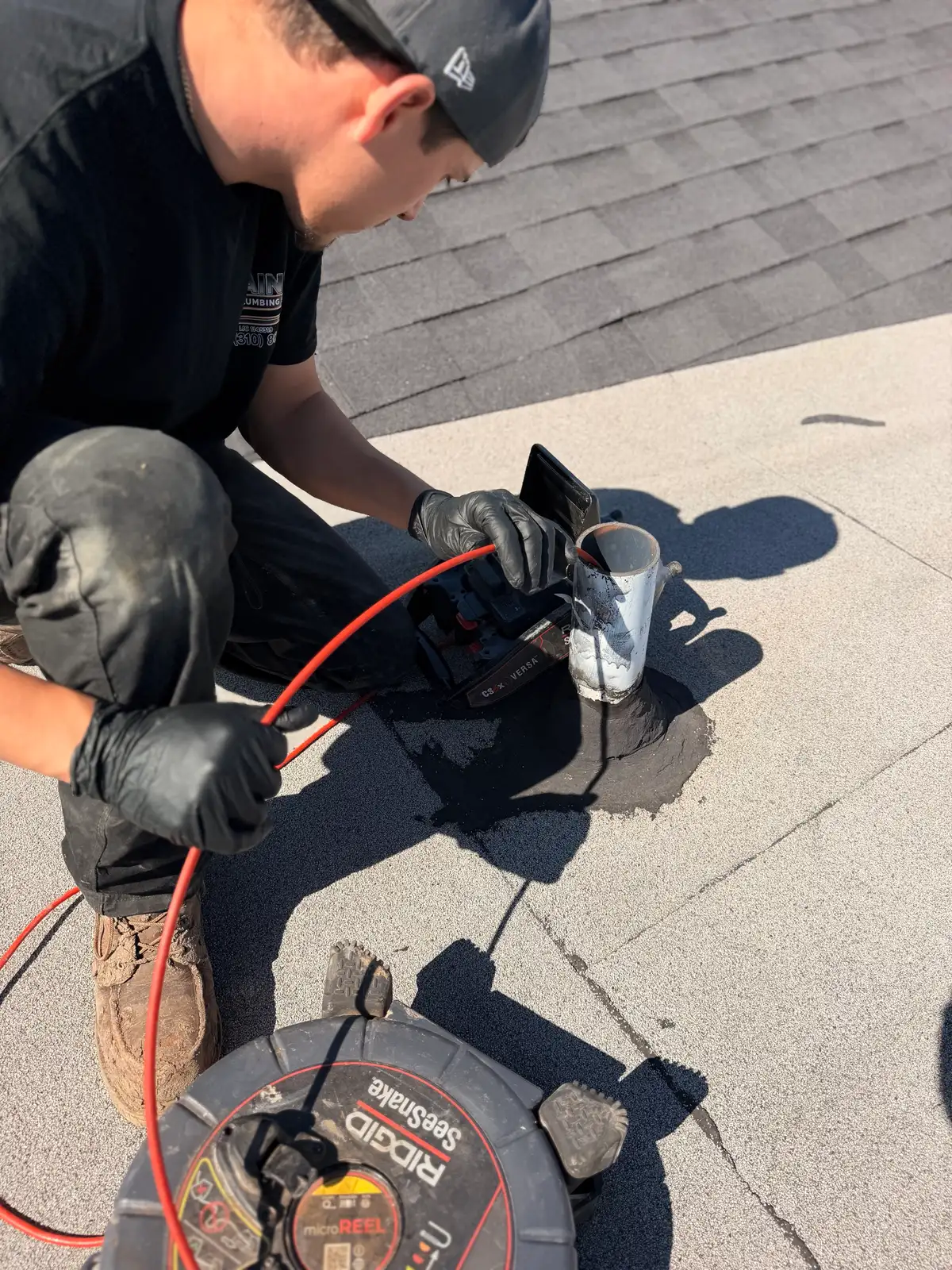
If a clog won't clear with a plunger and you're reaching for chemicals, stop. An auger or a [sewer snake service](/services/trenchless/sewer-snake) is the right tool — it physically removes the restriction without chemically attacking the drain infrastructure in the process.
Maintenance habits that actually work at scale
Monthly hot water flushes — water just off the boil, roughly a quart — soften accumulated soap scum and grease films before they harden into solid restrictions. This works best as a consistent habit on every drain in the house, not a one-time treatment when a drain starts to slow.
Mesh basket inserts in every shower and tub drain, cleaned after each use. A p-trap cleaning on bathroom vanities once or twice a year — unscrew the trap, dump it, rinse it, reinstall. A monthly enzyme treatment on kitchen drains if you cook regularly. These four habits together eliminate the majority of residential clogs we [service in South Bay homes across cities like Torrance, Carson, and Hawthorne](/service-areas/hawthorne).
A professional drain cleaning with a powered auger or hydro-jetting every 3–5 years makes sense as a baseline for any home with original drain lines from the 1960s or earlier. Not because something is wrong, but because those lines have accumulated enough interior roughness over decades that even careful maintenance leaves some buildup in places a homeowner can't reach.
What to do next
If a drain in your home is already slow or backing up, the habits above won't clear an existing restriction — they prevent new ones. A slow drain that doesn't respond to plunging within two attempts has a physical blockage that needs mechanical removal. Waiting it out or adding chemicals extends the problem and risks a backup into living space.
We run drain service calls across 16 South Bay cities seven days a week with no overtime fees. For a drain that's actively backing up, call us at (310) 808-7343. For a slow drain you're trying to get ahead of before it becomes an emergency, that same number reaches our dispatch line. We're a Licensed C-36 #901735 plumbing contractor based in Lomita, and most South Bay drain calls are on our schedule within the same day.
Tags
Related Services