For most Redondo Beach homes, PEX is the stronger repipe choice — not because copper is inferior pipe, but because Redondo's specific water chemistry and salt-air environment accelerate copper failure in ways that don't apply inland. Chloride from ocean air attacks copper fittings from the outside. Chloramine residuals in LA's treated water attack from the inside. PEX isn't affected by either mechanism.
That doesn't make copper wrong in every case. If your home is in the Hill Section or Golden Hills, farther from the water, and you're replacing a short run of supply in a conditioned space, copper remains a legitimate option. But for a full repipe of a home in South Redondo, The Avenues, or anywhere near the Esplanade, the environmental math favors PEX.
What Redondo Beach water actually does to copper pipe
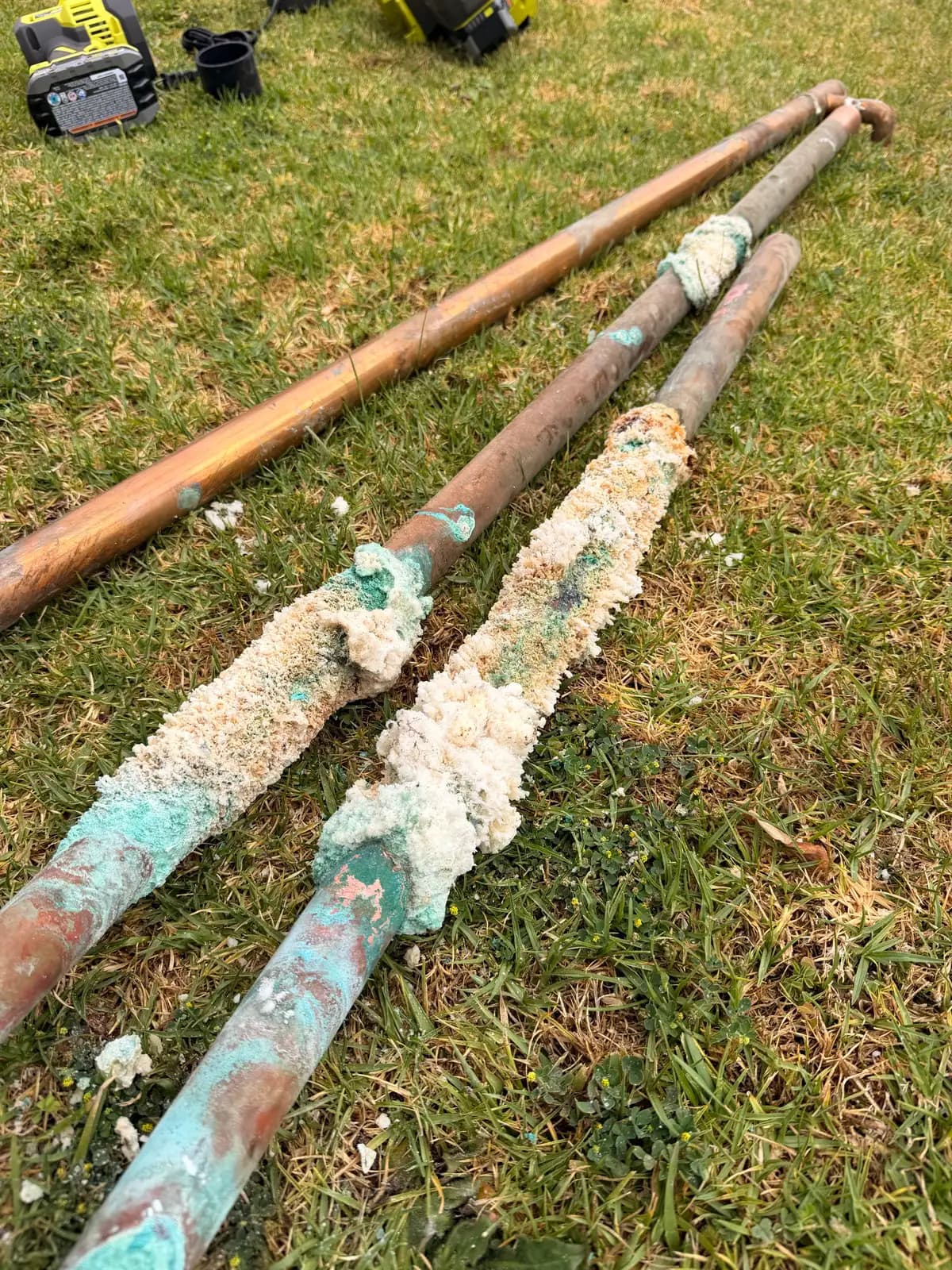
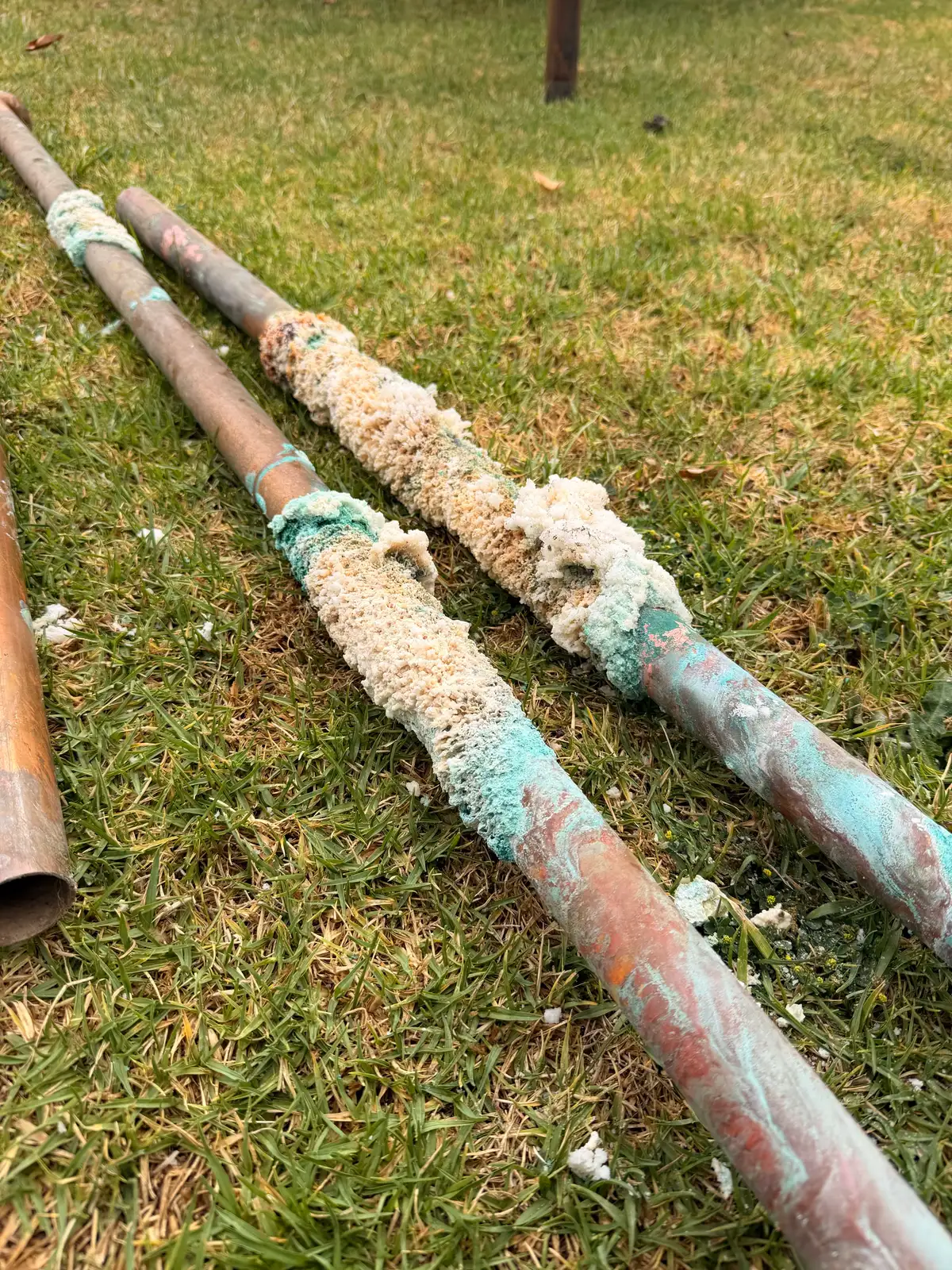
Redondo's imported municipal supply is treated with chloramine rather than free chlorine. Chloramine is a more stable disinfectant, but it's also more aggressive toward copper at the microscopic level — it accelerates pitting corrosion from inside the pipe wall. You won't see it happening, but you'll eventually see blue-green staining at fixtures, pinhole leaks in walls, or both.
The salt-air factor compounds this. Homes within a few blocks of the beach — along the Esplanade, through the Sand Section streets of South Redondo — have measurable chloride deposition on exterior surfaces. Copper supply lines running through exterior walls, crawlspaces, or garages are exposed to that chloride on their outer surface simultaneously. That dual-front attack shortens copper service life noticeably compared to an identical pipe in, say, Torrance's Old Torrance neighborhood a few miles inland.
The failure mode is pinhole leaks, not sudden bursts. A pinhole in a wall cavity leaks slowly, soaks framing and drywall, and often doesn't get noticed until there's visible water damage or mold. By then, the remediation cost has already exceeded what a repipe would have cost.
How PEX holds up against the same conditions
PEX — cross-linked polyethylene — is chemically inert to chloramine and to chloride. Neither the water chemistry nor the salt air degrades the pipe material itself. That's the core reason it's displaced copper as the default repipe material in coastal California markets.
PEX does have known vulnerabilities worth understanding. UV exposure degrades it — any run left exposed to direct sunlight, even in a garage, needs to be sleeved or painted. It also can't be used for gas lines and shouldn't be used for connections to water heaters without a short copper or CPVC transition stub. And not all PEX is equivalent: PEX-A (manufactured via the Engel method) has better burst and flow characteristics than PEX-B in cold temperatures, though Redondo's climate makes that distinction less critical than in colder regions.
The practical advantage in Redondo's older housing stock is flexibility. Beach bungalows from the 1900–1940 era and North Redondo tract homes from the 1948–1965 period often have tight wall cavities and supply routing that wasn't designed for easy access. PEX runs continuously from manifold to fixture without mid-run fittings, which means fewer potential leak points inside walls — and the flexibility makes routing through existing framing significantly easier than rigid copper.
Where copper still makes sense in Redondo Beach
Exterior hose bibs, boiler connections, and any supply stub connecting to a gas appliance should use copper or another approved rigid material — PEX isn't the right tool there. If you're doing a partial repair rather than a full repipe, matching existing copper with copper is sometimes cleaner and faster than introducing a PEX transition.
Some homeowners have a straightforward preference for copper based on a longer track record and the fact that it's a rigid, certifiably recyclable metal pipe. That's a reasonable position. If you're going copper in a home east of Prospect Avenue in North Redondo — farther from direct marine exposure — and you're willing to replace anode rods on a 3-year cycle and monitor your water heater connections annually, the corrosion risk is lower and copper performs well.
The situation where copper is the wrong choice is a full repipe of a South Redondo or Esplanade-area home where the pipe will run through exterior walls and the owner doesn't plan to be in the house long enough to monitor gradual deterioration. That's where we see the regret calls — copper installed five to eight years ago on a house two blocks from the beach, now leaking at three or four pinhole sites.
What a full repipe in Redondo Beach actually involves
A complete hot-and-cold water repipe replaces every supply line from the water main shutoff to the fixtures. On a typical 3-bedroom, 2-bath Redondo Beach home, that's 200 to 350 linear feet of pipe depending on layout, with 15 to 25 fixture connections. The work requires opening walls and ceilings at access points — usually 4-inch to 6-inch inspection cuts, not full drywall removal — and patching after the pipe is in.
Permits are required. Redondo Beach requires a plumbing permit for repipe work, and we pull it on every job as the licensed contractor of record under C-36 #901735. The inspection typically occurs while walls are open, before patching, so the city inspector can verify the pipe runs and connections. Timeline from permit application to final patch is usually 3 to 5 days for a single-family home.
A [camera inspection](/services/trenchless) run beforehand is worth doing if you're in a pre-1960 home and haven't had one recently — it tells you whether the sewer lateral needs work while the walls are already open, rather than discovering it six months later. We've had jobs in The Avenues where a repipe and a lateral lining were both needed, and scheduling them together saved the homeowner a second round of access cuts.
Salt air and anode rods: the water heater connection
If you're repiping, you're already looking at supply line infrastructure — this is the right moment to inspect the water heater connection points and the anode rod. In Redondo Beach's salt-air environment, anode rods need inspection on a 3-year cycle, not the standard 5-year cycle you'll see in manufacturer documentation written for inland conditions.
A deteriorated anode rod in a tank water heater leads to tank corrosion and eventually tank failure, which can mean water damage on top of whatever else is happening. It's a straightforward inspection — pull the rod, measure remaining magnesium — and replacement costs less than $100 in parts. If you're doing a [full home repipe](/services/repipes) anyway, ask us to check the anode while we're there.
Redondo Beach repipe questions we hear most
**Does PEX last as long as copper in a beach city?** In Redondo Beach's specific environment — chloramine water chemistry plus salt-air chloride exposure — PEX carries a longer practical service life for full repipe applications. Copper can last 50+ years in neutral water conditions; in Redondo's dual-front corrosion environment, that timeline shortens. PEX isn't subject to either mechanism and carries manufacturer warranties of 25 years or more on quality product.
**Will a repipe require me to leave the house?** Water is shut off while supply lines are being replaced, so the home isn't usable during active work. Most single-family repipes take one to two full working days of active plumbing, though permit and inspection scheduling affects the total timeline. We sequence work to minimize the water-off window each day.
**Do I need a permit for a repipe in Redondo Beach?** Yes. Repipe work is a permitted plumbing project. We pull the permit as the licensed contractor — it's not optional, and an unpermitted repipe creates disclosure problems at resale if a buyer's inspector or the city catches it.
**How do I verify Mainline's license?** Mainline No-Dig Trenchless Plumbing holds C-36 plumbing contractor license #901735. You can verify it directly at the CSLB license lookup at cslb.ca.gov — enter the license number or the business name.
**What neighborhoods in Redondo Beach have the worst copper corrosion?** South Redondo and The Avenues closest to the waterfront see the most accelerated corrosion in our experience — homes within 3 to 4 blocks of the ocean where salt deposition on exterior surfaces is measurable. North Redondo homes east of Inglewood Avenue are meaningfully less exposed, though chloramine-related interior pitting still applies citywide.
**Can you repipe just part of the house?** Yes, but we scope it carefully first. Partial repipes make sense when a specific zone is failing and the rest of the supply is in documented good condition from a camera inspection or visual access. Repiping half a house and leaving original pipe that's already showing pitting often results in a callback 2 to 3 years later for the other half.
What to do next
If you're seeing blue-green staining at faucets, finding pinhole leaks at copper fittings, or just know your home is running original 1940s or 1950s supply, the right first step is a diagnostic conversation — not a guess at material type. We'll look at what you have, where the home sits relative to the water, and give you a straight assessment of whether PEX, copper, or a hybrid approach fits the situation.
Mainline No-Dig Trenchless Plumbing serves [Redondo Beach](/service-areas/redondo-beach) from our Lomita headquarters with a 25-minute target response. Licensed C-36 #901735. Call us at (310) 808-7343 to schedule an on-site assessment or ask questions before committing to anything.
Frequently Asked Questions
Does PEX last as long as copper in a beach city like Redondo Beach?
In Redondo Beach's specific environment — chloramine-treated water plus salt-air chloride exposure — PEX carries a longer practical service life for full repipe applications. Copper can last 50+ years in neutral water conditions, but Redondo's dual-front corrosion shortens that considerably. PEX isn't affected by either mechanism and carries manufacturer warranties of 25 years or more on quality product.
Will a repipe require me to leave the house?
Water is shut off while supply lines are being replaced, so the home isn't usable during active work hours. Most single-family repipes take one to two full working days of active plumbing, though permit and inspection scheduling affects the total timeline. We sequence work to minimize the water-off window each day where possible.
Do I need a permit for a repipe in Redondo Beach?
Yes. Repipe work is a permitted plumbing project in Redondo Beach. We pull the permit as the licensed contractor of record — it's not optional, and an unpermitted repipe creates disclosure problems at resale if a buyer's inspector or the city flags it.
How do I verify Mainline's plumbing license?
Mainline No-Dig Trenchless Plumbing holds C-36 plumbing contractor license #901735. You can verify it directly at the CSLB license lookup at cslb.ca.gov by entering the license number or business name.
Which Redondo Beach neighborhoods have the worst copper corrosion problems?
South Redondo and The Avenues closest to the waterfront see the most accelerated corrosion — homes within 3 to 4 blocks of the ocean where salt deposition on exterior surfaces is measurable. North Redondo homes east of Inglewood Avenue are meaningfully less exposed, though chloramine-related interior pitting still applies citywide.
Can you repipe just part of the house instead of the whole thing?
Yes, but we scope it carefully first. Partial repipes make sense when a specific zone is failing and the rest of the supply is in documented good condition. Repiping half a house and leaving original pipe that's already showing pitting often results in a callback 2 to 3 years later for the remaining half.
Tags
Related Services