Water heaters in Redondo Beach fail 2 to 4 years earlier than the same unit installed inland. The reason is salt-laden air — it accelerates corrosion on steel tanks, brass fittings, and the sacrificial anode rod that's supposed to protect the tank lining. A unit rated for 12 years in Pomona realistically runs 8 to 10 years in South Redondo or on the Esplanade.
This isn't a manufacturer defect or bad luck. It's a predictable consequence of living within a mile of the ocean. The fix isn't buying a different brand — it's adjusting your maintenance cadence and catching failure signs before they become a flooded garage.
What salt air actually does to a water heater
Airborne salt particles settle on exposed metal and accelerate electrochemical corrosion. On a standard tank water heater, the most vulnerable points are the top fittings — the cold inlet and hot outlet — and the pressure relief valve. These are typically brass or galvanized steel, and both corrode faster in coastal air than in an inland environment.
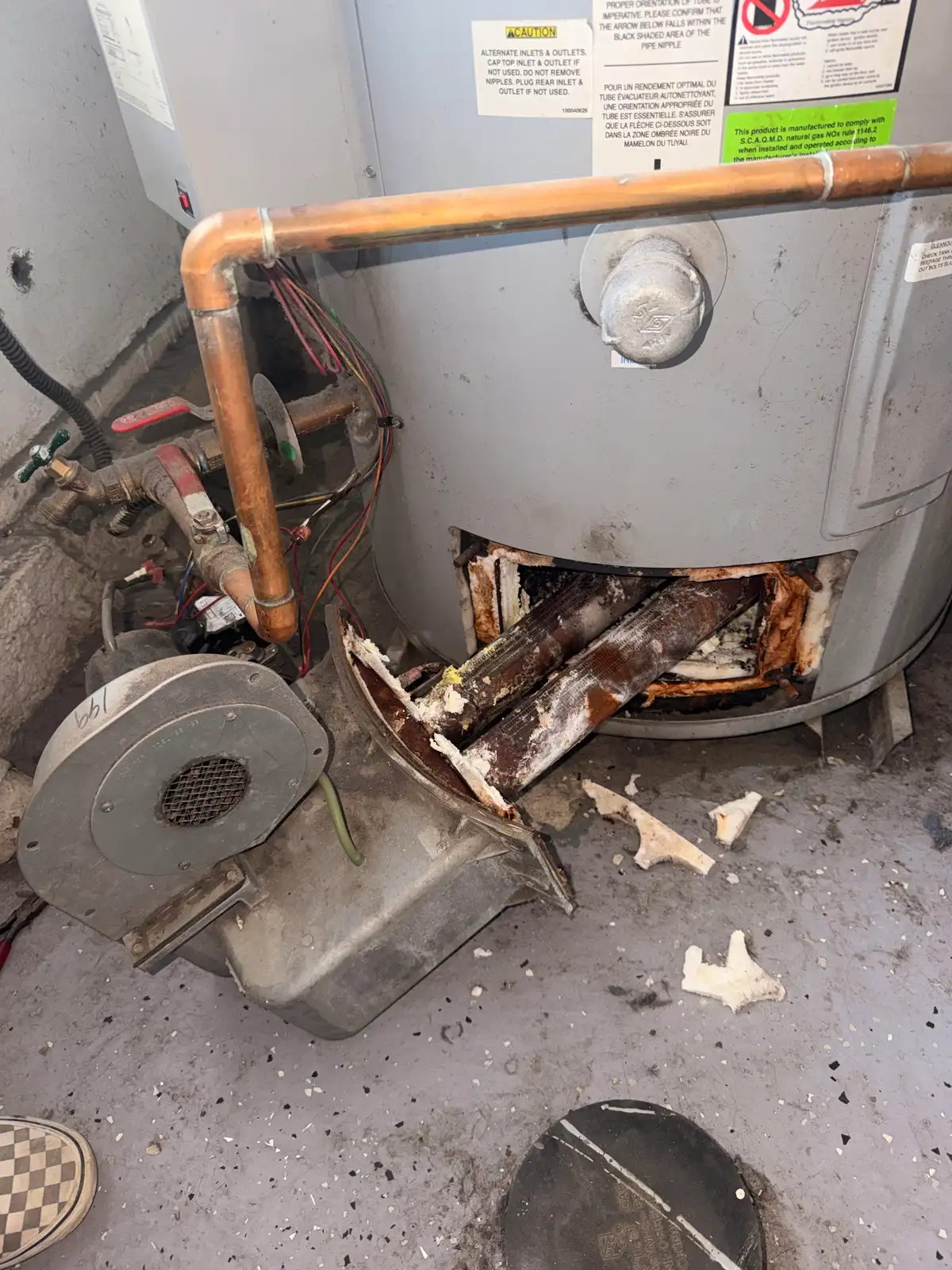
The tank exterior is also at risk if the unit sits in an uninsulated garage or an exterior closet. Salt corrosion on the outer shell doesn't cause a leak directly, but it degrades the outer jacket, which can mask internal rust until the tank is already compromised.
Inside the tank, the anode rod is doing the heavy lifting. It's a magnesium or aluminum alloy rod suspended in the water column, designed to corrode preferentially so the steel tank lining doesn't. In normal conditions, an anode rod lasts 4 to 6 years. In a coastal garage in the Avenues or Golden Hills, that window shortens to 2 to 3 years.
The anode rod is the first thing to check
When an anode rod is fully consumed, the tank lining starts corroding directly. You won't see this happening — it's inside the tank, underwater. The first visible sign is usually rust-tinted hot water or a rotten-egg smell when you run the hot tap. By that point, the rod has been depleted for months.
Standard manufacturer guidance suggests inspecting the anode rod every 4 to 5 years. For Redondo Beach homes — particularly those within a half-mile of the water in the Esplanade or Sand Section neighborhoods of South Redondo — a 2 to 3 year inspection cycle is more appropriate. This is not a complicated service: a plumber drains down the tank, removes the hex plug at the top, pulls the rod, and assesses whether it needs replacement.
Anode rod replacement itself runs $150 to $300 depending on access and rod type. That's a fraction of a full tank replacement, which in Redondo Beach typically lands between $1,100 and $1,800 for a standard 40 or 50-gallon gas unit when you include permits and installation.
Signs your water heater is already failing
Rust-colored water from the hot tap only — not cold — points to internal tank corrosion. If the same discoloration appears on both hot and cold lines, the problem is more likely in the supply piping, not the heater. Knowing which line is affected tells you where to look first.
A rumbling or popping sound during heating cycles usually means sediment has accumulated on the tank floor. Hard water minerals precipitate out during heating and build up over years. In a coastal home where the anode rod was depleted early, sediment accumulation accelerates because the tank lining begins shedding rust particles that mix with mineral scale.
Water pooling under the tank is a late-stage signal. Small seeps from fittings or the T&P valve can sometimes be addressed independently, but water coming from the tank body itself means the tank is done. At that point, repair is not a viable option — the tank needs to come out.
On our [water heater repair and replacement calls in Redondo Beach](/service-areas/redondo-beach/water-heaters), we see a consistent pattern: homeowners who skipped the 3-year anode inspection are dealing with full replacements 3 to 5 years ahead of schedule.
Fitting and valve corrosion: the overlooked failure points
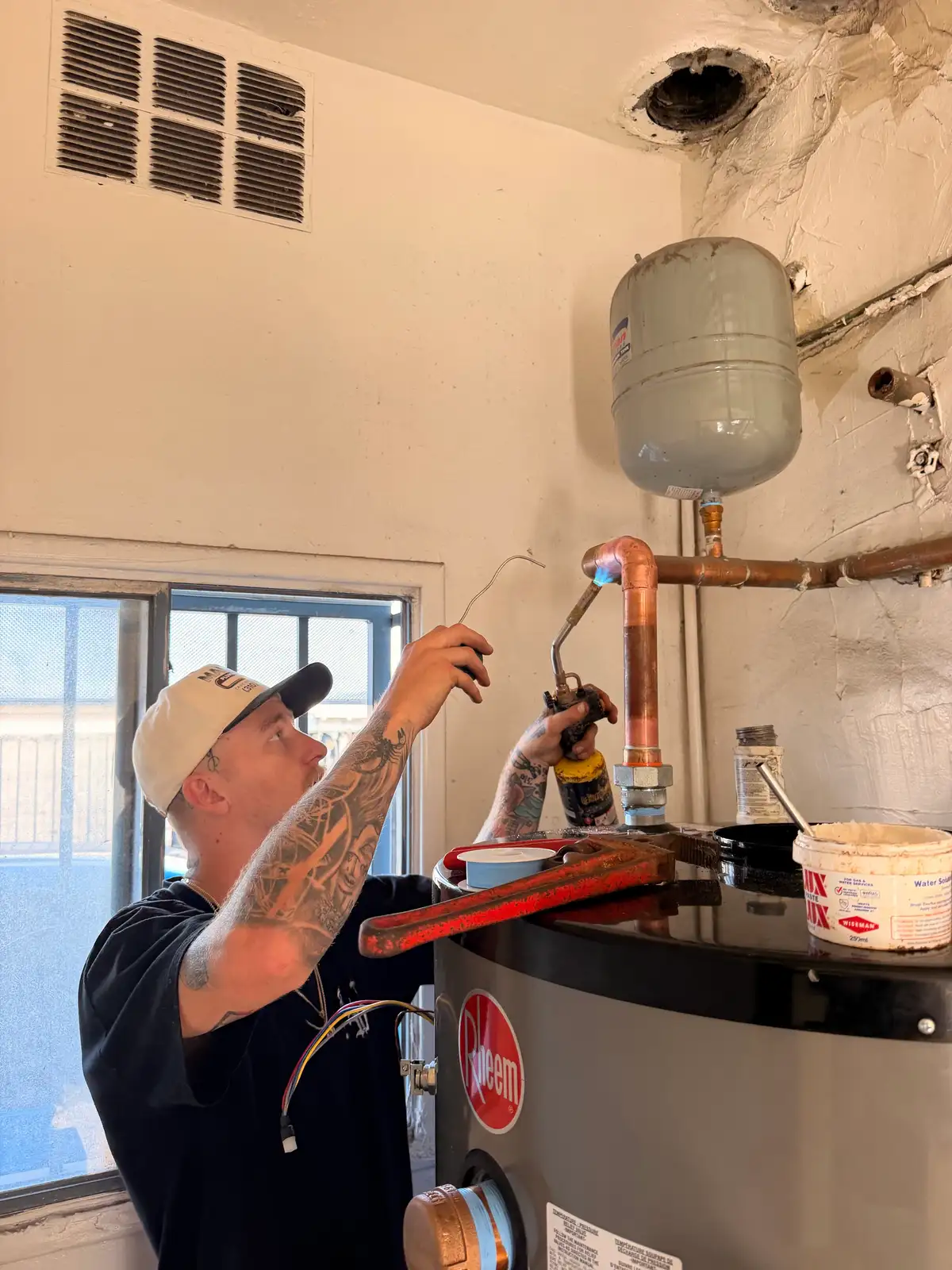
The dielectric unions connecting copper supply lines to the steel tank nipples are designed to prevent galvanic corrosion between dissimilar metals. Salt air degrades the plastic insulating sleeve inside these unions faster than in dry-air environments. When that sleeve fails, galvanic corrosion at the connection point accelerates — and fitting leaks follow.
The temperature and pressure relief valve — required by code on every water heater — is another common coastal failure point. Salt air corrodes the brass body and the spring mechanism. A T&P valve that corrodes shut is a code violation and a safety hazard; one that corrodes open drips constantly and signals that replacement is overdue.
Inspecting fittings and the T&P valve doesn't require draining the tank. It's a 15-minute visual check that any licensed plumber can perform during a routine service call. For Redondo Beach homes, we recommend adding it to the same visit as the anode rod inspection — every 2 to 3 years, not 5.
Tank vs. tankless in a coastal environment
Tankless water heaters aren't immune to salt-air effects, but their failure profile is different. The heat exchanger and gas valve components are sealed, so airborne corrosion has less direct surface contact than it does with a traditional tank. The exposed risk points shift to the venting termination and any outdoor-mounted components.
For a [tankless installation](/services/water-heaters) in a coastal location, the vent termination cap needs to be corrosion-resistant — stainless or polypropylene — and positioned away from prevailing ocean-facing airflow when possible. On North Redondo properties along the Avenues, we typically see standard PVC vent caps that weren't spec'd for coastal exposure. They degrade in 3 to 5 years and need replacement before they start admitting moisture.
If you're replacing a failed tank unit in Redondo Beach, the decision between tank and tankless depends more on your gas line capacity and venting path than on which is more coastal-durable. Either option will outlast a neglected tank-with-depleted-anode in a garage two blocks from the water.
Redondo Beach water heater repair questions we hear most
How often should I really replace the anode rod near the beach? In South Redondo and the Esplanade area, every 2 to 3 years is the right interval — not the 4 to 6 years printed in most manuals. Those recommendations were written for inland installations. Coastal air consumes sacrificial metal faster.
My hot water smells like sulfur. Is that the anode rod? Usually, yes. A depleted or magnesium-composition anode rod can react with certain bacteria present in municipal water, producing hydrogen sulfide gas. The smell is most noticeable when you first run hot water after the system has been idle. Replacing the rod — or switching to an aluminum/zinc alloy rod — typically resolves it.
The tank is 7 years old and just started leaking at the base. Is repair an option? Not if the leak is coming from the tank body itself. A pinhole or seam failure in the steel shell means the tank lining has breached. There's no patch for that. A leak from a fitting or the drain valve is a different story — those can be isolated and replaced.
What does water heater repair cost in Redondo Beach? For fitting replacements, T&P valve swap, or anode rod service, expect $150 to $350 depending on parts and access. A full tank replacement with a permit runs $1,100 to $1,800 for a standard 40 to 50-gallon gas unit. Tankless conversions start around $2,800 and go up based on gas line and venting requirements.
How do I verify your license? Mainline No-Dig Trenchless Plumbing holds C-36 license #901735. You can verify it directly at the CSLB license lookup at contractors.cslb.ca.gov.
How fast can you respond in Redondo Beach? Our target is 60 minutes for emergency calls, 24 hours a day, 7 days a week. There are no overtime fees for after-hours dispatch. From our Lomita headquarters, Redondo Beach is typically a 25-minute drive under normal traffic conditions.
What to do next
If your water heater is over 6 years old and you haven't had the anode rod inspected, schedule that service before the next failure sign appears. In Golden Hills, Hollywood Riviera, and coastal South Redondo, that inspection interval should be every 2 to 3 years going forward — not when something starts leaking.
If you're already seeing rust-colored hot water, pooling at the base, or a T&P valve that's dripping, call us before the tank fails completely. A managed replacement on your schedule costs less and causes less disruption than an emergency swap after a flood.
Reach the Mainline crew at (310) 808-7343. We dispatch 24/7, there are no overtime charges, and our licensed C-36 plumbers can assess whether you need a repair, an anode service, or a full replacement — without a sales pitch attached to the answer.
Tags