Rolling Hills Estates is unlike any other city we work in across the South Bay. The lots are large, the terrain drops hard — sewer laterals with 50-plus feet of vertical fall are routine — and a significant portion of properties have working stables, paddocks, and horses on-site. That combination changes how a trenchless sewer job gets planned before we ever pull a permit.
The plumbing itself is often straightforward by our standards. The logistics around it are not. A pipe bursting rig running a pneumatic hammer 40 feet from a paddock is not a neutral event for the horses in it. Feed schedules, turnout windows, and the distance between your sewer lateral and your stable layout all factor into how we sequence a job on equestrian properties in Dapplegray, Chandler Ranch, and The Terraces.
This post walks through how we approach trenchless work on horse properties in Rolling Hills Estates — what we ask before scheduling, how we structure work windows around animal welfare, and what terrain factors are already baked into the planning before we arrive.
Why these properties need a different pre-job conversation
On a standard residential lot in Lomita or Hawthorne, the pre-job conversation covers access points, permit requirements, and whether the homeowner needs water service during the work. On an RHE equestrian property, we add a separate set of questions: How many horses are on the property? Where are they housed relative to the work zone? What is the daily turnout and feeding schedule? Is there a farrier, vet, or trainer scheduled during the work window?
These aren't courtesy questions. A horse that spooks from compressor noise and hits a fence panel can injure itself or a person. Disrupting a feeding schedule in a boarding situation can create liability for the property owner. We need this information to write a work plan that accounts for it — not to work around it arbitrarily, but because the alternative is a job that stops mid-pull because an animal is in distress 30 feet from the equipment.
Properties in Ranchero and Highridge tend to have more complex stable configurations — multiple paddocks, shared fencelines with neighboring parcels, and secondary water lines feeding troughs and wash racks. The sewer lateral on these properties may run within 15 to 20 feet of permanent fence infrastructure that we cannot move and should not damage.
Noise zones and equipment placement
Pipe bursting uses a hydraulic or pneumatic expander head that fractures the existing pipe outward while simultaneously pulling new HDPE pipe into place. The equipment is not silent. A hydraulic unit running at operating load produces noise in the 80–90 dB range at the machine itself, attenuating to roughly 65–70 dB at 50 feet under open conditions. On a flat lot that's manageable. On RHE terrain, where equipment may be staged uphill from a paddock with no wind break, sound carries differently.
Our standard practice on equestrian properties is to establish a noise radius before scheduling. We walk the property during the estimate, identify where horses are housed, measure approximate distances, and determine whether natural terrain features — ridgelines, grade changes, existing structures — provide acoustic attenuation between the work zone and the stable. If they don't, we build in a requirement that horses be moved to a far paddock or trailered off-property during the active pull phase.
The active pull phase on a standard lateral replacement runs 45 minutes to 2 hours depending on run length and pipe condition. It is the loudest segment of the job. Pre- and post-work phases — camera inspection, access pit excavation, HDPE staging — are substantially quieter and can typically proceed with horses on-property in their normal locations.
Turnout windows as work windows
Most horses on RHE properties are turned out in the morning — typically between 7 and 10 a.m. — and brought in for the evening feed. That two-to-four-hour morning window, when horses are in a far pasture or turnout area away from the stable, is usually the best time to run the loud phase of a pipe bursting job. The animals are at distance, occupied, and not anticipating feed.
We ask property owners to share their daily schedule before we finalize a start time. On jobs where the pipe run passes close to or under the stable structure, we may request that the active pull phase be timed to a trailering window — when horses leave the property entirely for a ride or a vet appointment. This is a scheduling coordination item, not a plumbing constraint.
Feed times are a hard boundary. Horses on regular feeding schedules become acutely aware of time and routine. Running loud equipment during a scheduled morning or evening feed creates stress in animals that is both visible and audible to experienced owners. We don't schedule active work phases within 30 minutes of a known feeding window on equestrian properties.
Terrain, grade, and what's already in the ground
Rolling Hills Estates sewer laterals drop steeply — this is a feature, not a problem. Grade that steep means waste moves fast and root intrusion is less common in the lower sections of the run where velocity is highest. But steep grade also means access pits are harder to stabilize, and the entry and exit points of a pipe bursting run need to account for the angle of pull. On a lateral dropping 40 feet over 80 linear feet of run, the geometry of the pull changes the equipment setup compared to a flat residential lot.
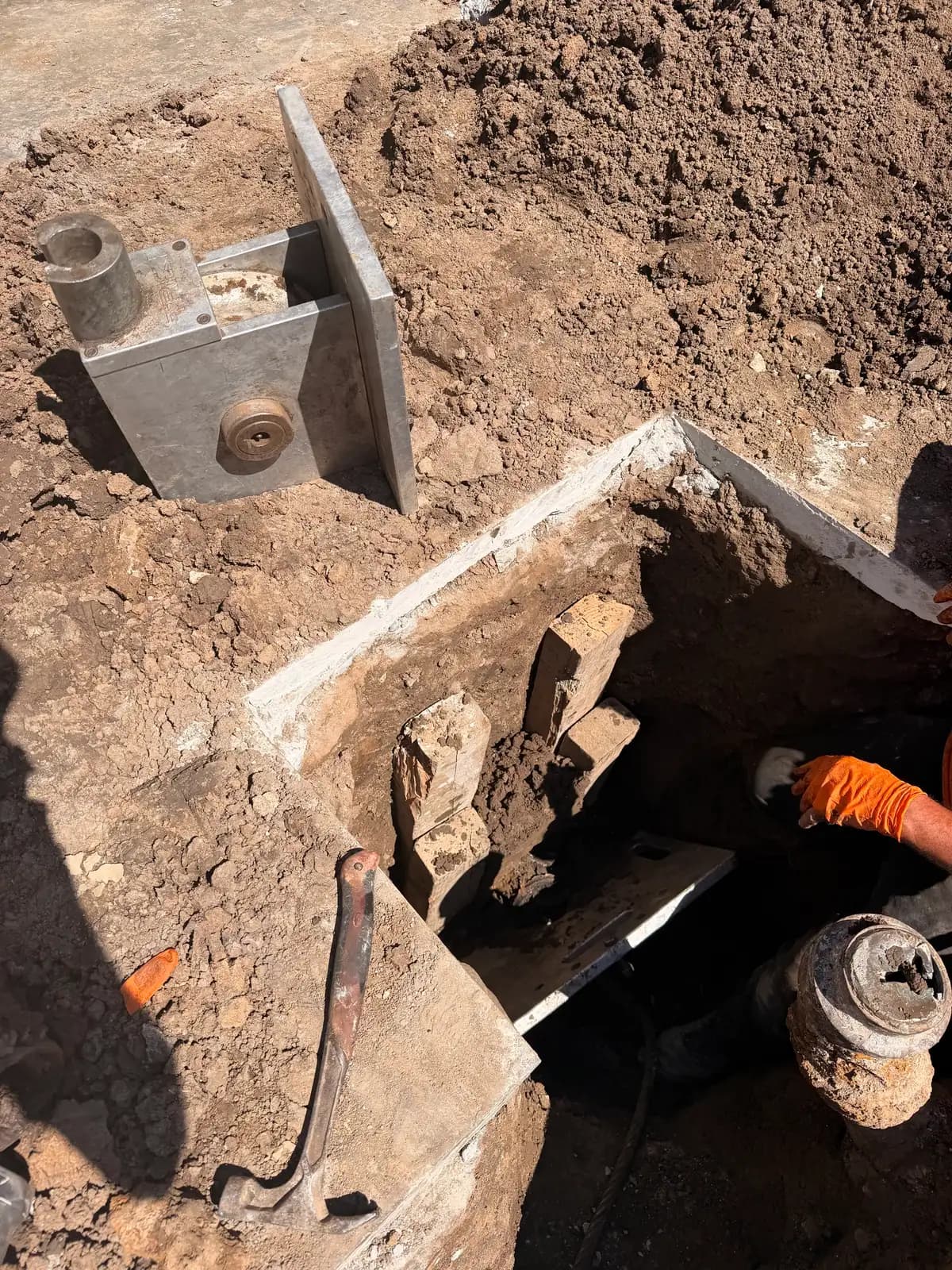
Many RHE properties also have secondary water infrastructure feeding the equestrian side of the property — dedicated lines to wash racks, automatic trough fillers, and irrigation on pasture areas. Before we begin any trenchless work, we conduct a [sewer camera inspection](/services/trenchless) to map the lateral path and identify any crossings with secondary water or irrigation lines. Cutting an irrigation mainline mid-job on a horse property in July is a significant problem for the property owner.
For [trenchless sewer repair in Rolling Hills Estates](/service-areas/rolling-hills-estates/trenchless), the permit path runs through Los Angeles County — not a smaller South Bay municipality — and review timelines reflect that. We factor this into scheduling conversations upfront so property owners aren't surprised when the permit window is longer than they expected based on previous work done in Torrance or Lomita.
Fence panels, paddock gates, and equipment access
Getting a pipe bursting rig onto an RHE property sometimes means moving fence panels to create an equipment corridor. This is standard on any large-lot job. On equestrian properties, it requires coordination with the property owner to ensure that temporary panel removal doesn't create an open line that horses could walk through — before, during, or after the work window.
We plan equipment corridors during the site walk, not the morning of the job. If the optimal path to the lateral access point passes through a paddock perimeter, we document which panels need to move, confirm who is responsible for moving and re-securing them, and establish a sequence that ensures no gap in the fence is open while horses are unattended. This is a five-minute planning conversation that prevents a very bad outcome.
Paddock footing — decomposed granite, rubber matting, packed dirt — can be disturbed by equipment movement. We use ground protection boards on established footing areas when access requires it. On properties in The Terraces or Dapplegray where owners have invested in quality footing material, this is not optional.
What the lateral condition usually looks like on 1960s–1970s estate lots
Most of the original development in Rolling Hills Estates ran from 1957 through the mid-1970s. The sewer laterals from that era are typically vitrified clay tile, occasionally Orangeburg on the older sections of the original estate development. Both materials have a design life that has either been reached or exceeded on most of these properties.
Clay tile joints offset over time as the soil shifts — and on steep terrain with seasonal moisture variation, that movement is ongoing. Offset joints let root systems in, particularly from the eucalyptus and oak trees common on RHE lots. A camera inspection on a 60-year-old clay lateral in Chandler Ranch or Rolling Vista typically shows some combination of offset joints, root intrusion at those offsets, and scale buildup in the lower sections of the run. That profile is a good candidate for pipe bursting — the existing clay fractures cleanly when the bursting head passes through it, and the new HDPE line is continuous, jointless, and root-resistant.
If the camera shows significant collapse or back-pitch anywhere in the run, pipe bursting may not be the right method. A collapsed section can redirect the bursting head off-axis, which creates a more invasive repair than a clean pull would have. We make that assessment during the camera inspection, before any equipment is staged.
What to do next
If you own a horse property in Rolling Hills Estates and you're seeing slow drains, sewage odors near the stable or wash rack, or you've been told by a real estate professional that your lateral needs inspection or replacement, the first step is a camera inspection. It takes about an hour, gives us the pipe condition and path data we need, and lets us give you an honest assessment of what method makes sense — and what scheduling approach works for your horses.
Mainline No-Dig Trenchless Plumbing is a Licensed C-36 #901735 contractor based in Lomita. We've been doing this work for 18-plus years across 16 South Bay cities, and we're familiar with the specific terrain, permit process, and property configurations in Rolling Hills Estates. Call us at (310) 808-7343 to schedule a site visit, or use the contact form on our site to describe your situation and we'll follow up with a call.
Tags