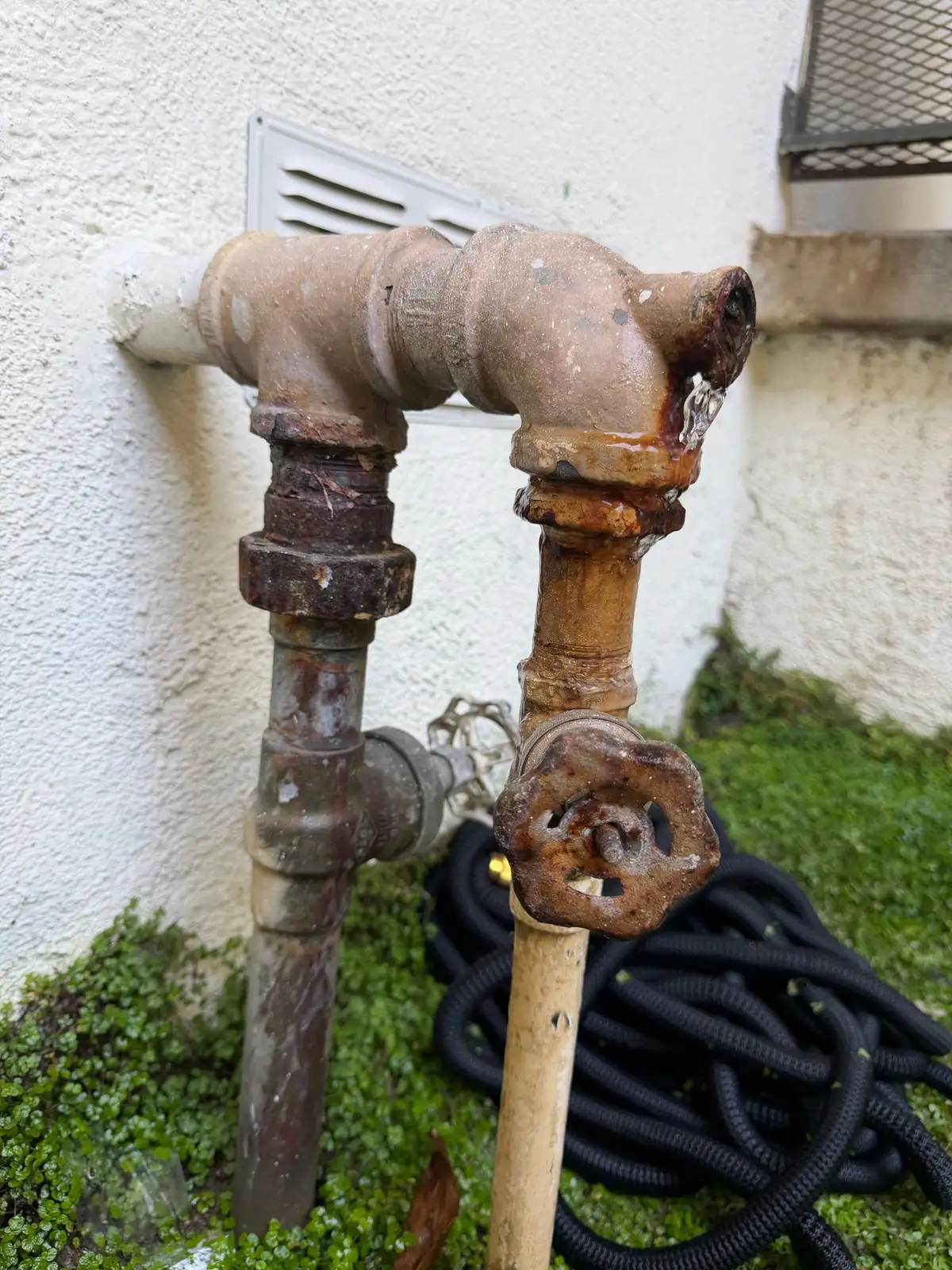
Galvanized pipe is steel pipe coated in zinc, installed in most U.S. homes built before 1960. To identify it: hold a magnet to an exposed supply line — galvanized steel is magnetic, copper and PEX are not. If it sticks, scratch the surface lightly with a key. Silver-gray beneath the scratch with an orange or rust tint underneath confirms galvanized. Threaded joints showing white or gray mineral crust are a secondary tell.
This matters throughout the South Bay because the post-war tract boom of 1948–1965 produced tens of thousands of homes in Gardena, Hawthorne, Lawndale, Carson, and similar cities — most built with galvanized supply lines that are now 60 to 75 years old. If your home was built before 1970 and you haven't verified what's in your walls, the tests below take under five minutes.
The three field tests, step by step
Start at the most accessible exposed pipe you can find — under the kitchen sink, at the water heater, or at the main shutoff. You're looking at supply lines, not drain pipes. Drain pipes are typically plastic ABS (black) or cast iron; supply lines carry pressurized water in and out of fixtures.
**Magnet test**: A refrigerator magnet or any small magnet works. Hold it against the pipe. Copper doesn't attract a magnet. PEX won't either. Galvanized steel will hold the magnet firmly. This is the fastest single indicator.
**Scratch test**: Use a key or a coin on an inconspicuous spot. Copper scratches to a bright orange-pink. Galvanized scratches to a dull silver-gray, sometimes with rust-orange visible underneath where corrosion has started. CPVC is cream or light yellow and scratches easily. PEX is flexible plastic — you'll know immediately.
**Thread and joint color**: Look at the fittings where pipes connect. Galvanized fittings show threaded connections (not solder joints) and accumulate white or brown mineral scale at the threads. Copper joints are soldered and show a greenish patina over time. If every joint in your supply system is threaded and corroded, you almost certainly have galvanized throughout.
What galvanized pipe actually does inside over 60 years
The zinc coating that protects galvanized steel from corrosion dissolves gradually in contact with water — faster in areas with aggressive water chemistry. Once the zinc layer is gone, the underlying steel oxidizes and produces iron oxide scale that builds up on the interior walls of the pipe.
That interior scale does two things. First, it restricts the effective bore of the pipe. A three-quarter-inch galvanized line that starts with a 0.75-inch interior diameter can narrow to under 0.4 inches after decades of scale accumulation — a pressure drop noticeable at every fixture. Second, flakes of rust break loose and enter the water stream, which is why older galvanized systems produce discolored water, especially after any disturbance to the line.
The failure mode isn't always a dramatic burst. More commonly it's pinhole leaks at corroded sections, low pressure that worsens gradually over years, and rust staining in sinks and tubs. By the time the pressure problem is obvious, significant corrosion has typically been in place for years.
Why pre-1960 South Bay neighborhoods carry the highest concentration
The post-war housing build-out in cities like Gardena, Hawthorne, and Lawndale was fast and standardized. Builders used galvanized supply lines because copper was still rationed or price-volatile in the early 1950s. The homes in Moneta and Strawberry Park in Gardena, and in Hollyglen and Bodger Park in Hawthorne, were largely plumbed the same way — and most of that original supply piping was never replaced.
In Carson, the planned single-family development that built out Carson Park and Scottsdale starting in the 1960s was also galvanized-heavy. Homes built in 1962–1970 are now 55 to 63 years old — squarely in the window where galvanized fails. In Lawndale, the '50s and '60s slab tract stock is in the same position.
Older coastal cities add another variable. In Redondo Beach's North Redondo Tract and in parts of San Pedro, salt air accelerates exterior corrosion even on supply lines inside walls, because coastal humidity permeates wood-frame construction. That doesn't change the identification tests, but it does mean corrosion timelines are compressed compared to inland neighborhoods.
Mixed systems: what to do when you find both galvanized and copper
Many South Bay homes were partially repiped at some point — a bathroom renovation in 1985, a water heater replacement that required a short copper stub, a kitchen remodel that updated the under-sink runs. The result is a mixed system with copper at the fixtures and galvanized in the walls or under the slab.
Mixed systems have a specific failure point: the galvanized-to-copper transition fitting. Galvanized steel and copper in direct contact with water create a galvanic cell — the dissimilar metals accelerate corrosion at the joint. If you see a transition fitting (usually a dielectric union or a brass adapter) that looks corroded or has mineral buildup, that fitting is telling you the galvanized section behind it is also degrading.
A [camera inspection](/services/trenchless) of the supply system isn't always practical the way it is for sewer lines, but a visual inspection of every accessible transition fitting gives you a clear picture of where the problem sections are. If every transition fitting you can access is corroded, the galvanized runs behind them warrant serious evaluation.
The repipe decision: what actually drives the timing
There's no single year at which galvanized pipe universally fails. The decision depends on three factors: current water pressure at fixtures, water discoloration frequency, and the number of active leaks or recent pinhole repairs. If pressure has dropped noticeably at showers and washing machines, if the water runs rust-colored for the first minute after the line is disturbed, or if a plumber has patched more than one pinhole in the last two years, a full [repipe](/services/repipes) is almost always more cost-effective than continued patching.
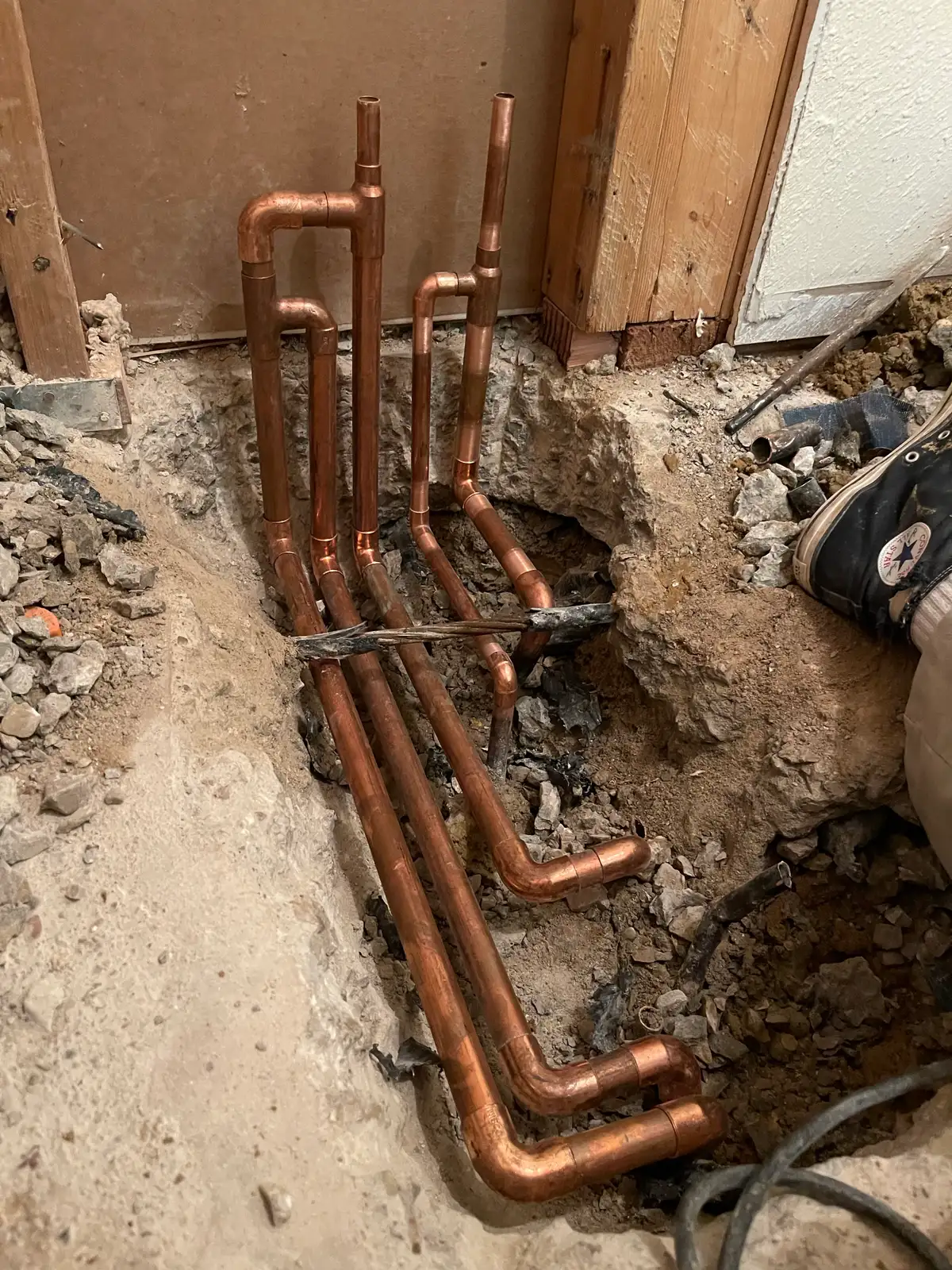
Repipe projects in South Bay tract homes typically run one to three days for a single-family home, depending on the number of fixtures and whether the home is slab or raised foundation. Raised foundations are faster because supply lines are accessible from the crawl space. Slab homes require wall access at each fixture location. The work is done with PEX or copper — PEX is now the standard choice for most residential repipes because of its flexibility, freeze resistance, and lower material cost.
For homeowners in Gardena, Hawthorne, Lawndale, and similar cities evaluating a repipe on a 1950s tract home, our [whole-house repipe](/services/repipes) page covers what the scoping process looks like for that specific housing stock — raised foundation vs. slab, galvanized supply line routing, and what to expect during the project.
South Bay galvanized pipe questions we hear most
**Can galvanized pipe affect water quality enough to be a health concern?** Rust and iron scale from corroding galvanized pipe are not acutely toxic, but they're not something you want to drink long-term. Elevated iron in drinking water has taste and odor effects. If your water runs visibly discolored, running the tap for 30–60 seconds before drinking is a short-term mitigation — replacement is the permanent fix.
**My home was built in 1958 but pressure is still fine. Does that mean the pipe is okay?** Not necessarily. Pressure drop is a late-stage symptom. Interior scale buildup can be significant before pressure is noticeably affected. The magnet and scratch tests confirm pipe material; a pressure gauge at the main tells you current flow. But the absence of obvious pressure loss doesn't rule out substantial interior corrosion.
**Is it possible to reline galvanized supply pipes the way you'd line a sewer?** No practical residential method exists for relining small-diameter supply lines. Epoxy pipe coating systems have been marketed for interior supply lines, but they're not widely used, have mixed track records, and are not a substitute for repiping in a severely corroded system. The standard solution remains full repipe.
**How do I know if my galvanized pipe is the original or was replaced at some point?** If the supply lines throughout your home are all the same dull silver-gray color and all use threaded fittings, they're likely original. If you see sections of copper solder-joined pipe mixed in, those sections were replaced and the galvanized runs the rest of the way. Check permit records at your city's building department — any repipe after roughly 1980 should have a permit on file.
**How do I verify you're a licensed contractor before I hire you?** Mainline No-Dig Trenchless Plumbing holds C-36 plumbing contractor license #901735. You can verify that license directly at the California State License Board website (cslb.ca.gov) using the license number.
**Does a repipe require permits and inspections?** Yes. Any repipe in Los Angeles County requires a plumbing permit and a final inspection by the city building department. We pull the permit as part of the job — it's included in our quoted price, not a separate line item.
What to do next
If the magnet test confirms galvanized and you're seeing pressure loss or discoloration, the next step is a scoping call — not an emergency, but not something to defer for another season. We serve 16 cities across the South Bay from our Lomita headquarters and reach most service areas in 25–35 minutes.
Call us at (310) 808-7343 to schedule a repipe evaluation. We'll confirm pipe material, assess every accessible transition fitting, and give you a straight answer on whether partial replacement addresses the problem or a full repipe is the better move for your specific home.
Frequently Asked Questions
How can I tell if a pipe is galvanized?
Three tests, in order. A magnet sticks to galvanized steel and won't stick to copper or brass. Scratching the surface with a coin or key reveals silver-gray on galvanized, bright orange on copper. And galvanized pipe uses threaded connections with visible screwed fittings, where copper is soldered with smooth joints.
What does galvanized pipe look like?
Dull silver-gray when clean, and chalky white or rust-brown where it's corroding. It's noticeably thicker-walled than copper and always joined with threaded fittings. If you can see threads at the joints and a magnet sticks, it's galvanized steel.
Is galvanized pipe still safe to drink from?
The zinc coating on older galvanized pipe was applied with processes that could contain lead impurities, and decades of corrosion can trap lead from upstream sources in the scale. If your home has original galvanized supply and you have concerns, have the water tested — that's a straight answer, not a sales pitch.
How long does galvanized pipe last?
Between 40 and 70 years depending on water chemistry. In the South Bay, where hardness runs 9 to 12 grains per gallon, we see the shorter end of that range. Any galvanized supply installed before 1960 is past its design life and running on borrowed time.
Can you have both galvanized and copper pipe in one house?
Very commonly, and it's worth understanding why. Partial repipes done in the 1970s and 80s replaced visible runs and left the buried or in-wall galvanized in place. Where copper meets galvanized directly without a dielectric union, the joint corrodes faster than either pipe would alone.
Does galvanized pipe need to be replaced right away?
Not automatically. What drives the timing is pressure loss, discolored water at first draw, and pinhole leaks. One pinhole in a galvanized line usually means the wall thickness is gone throughout, so a spot repair tends to be the first of several rather than a fix.
Tags
Related Services