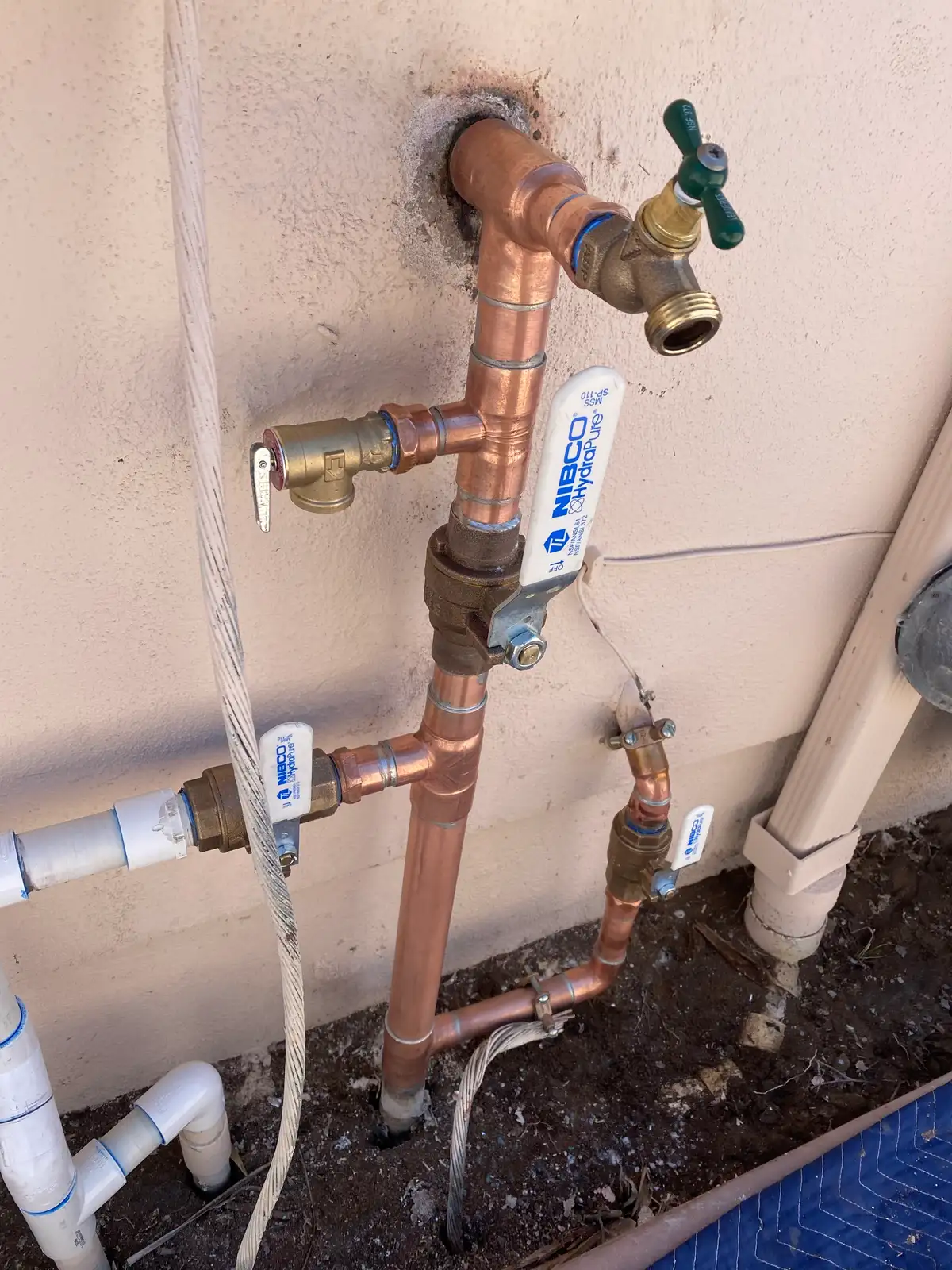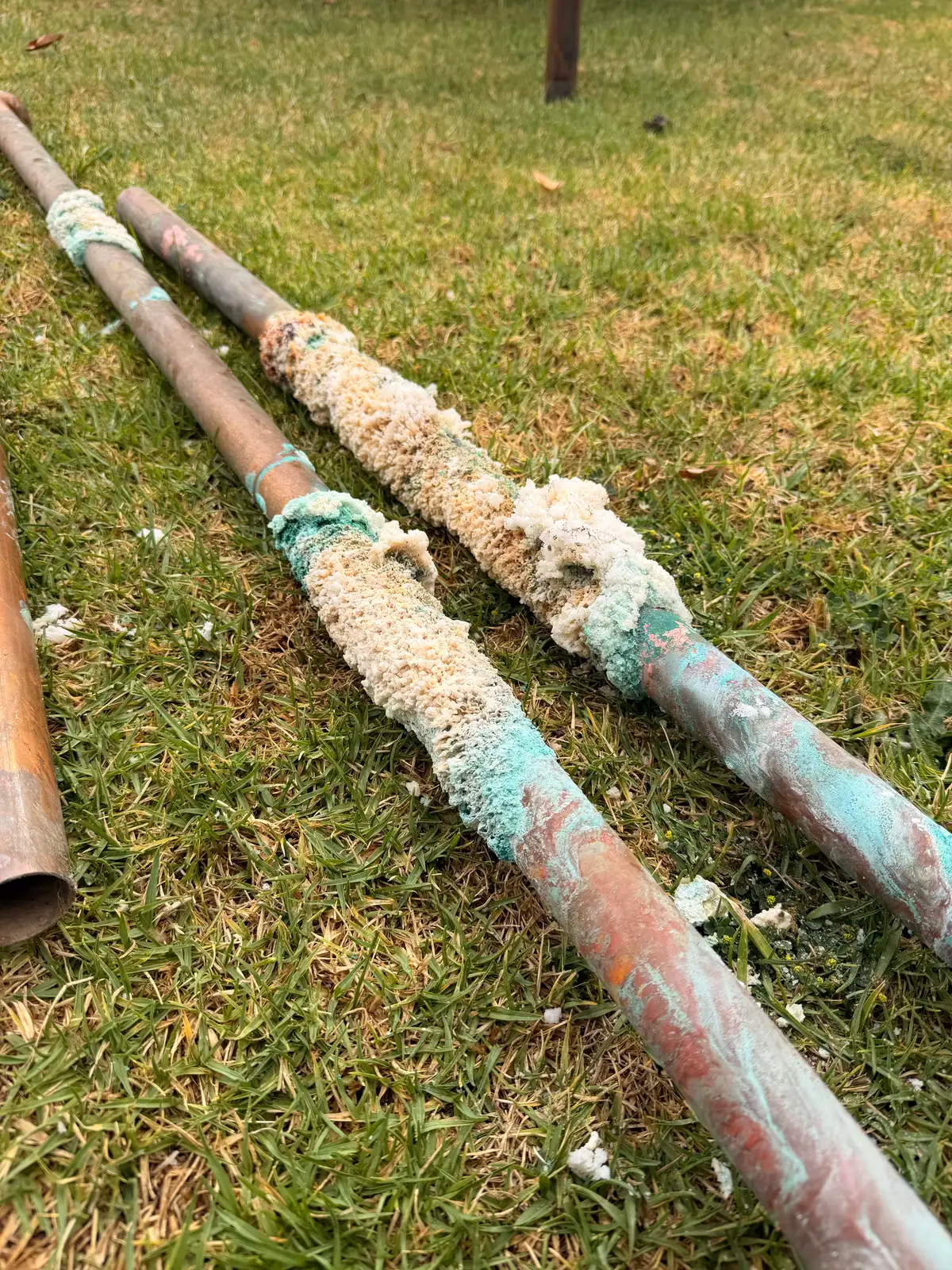
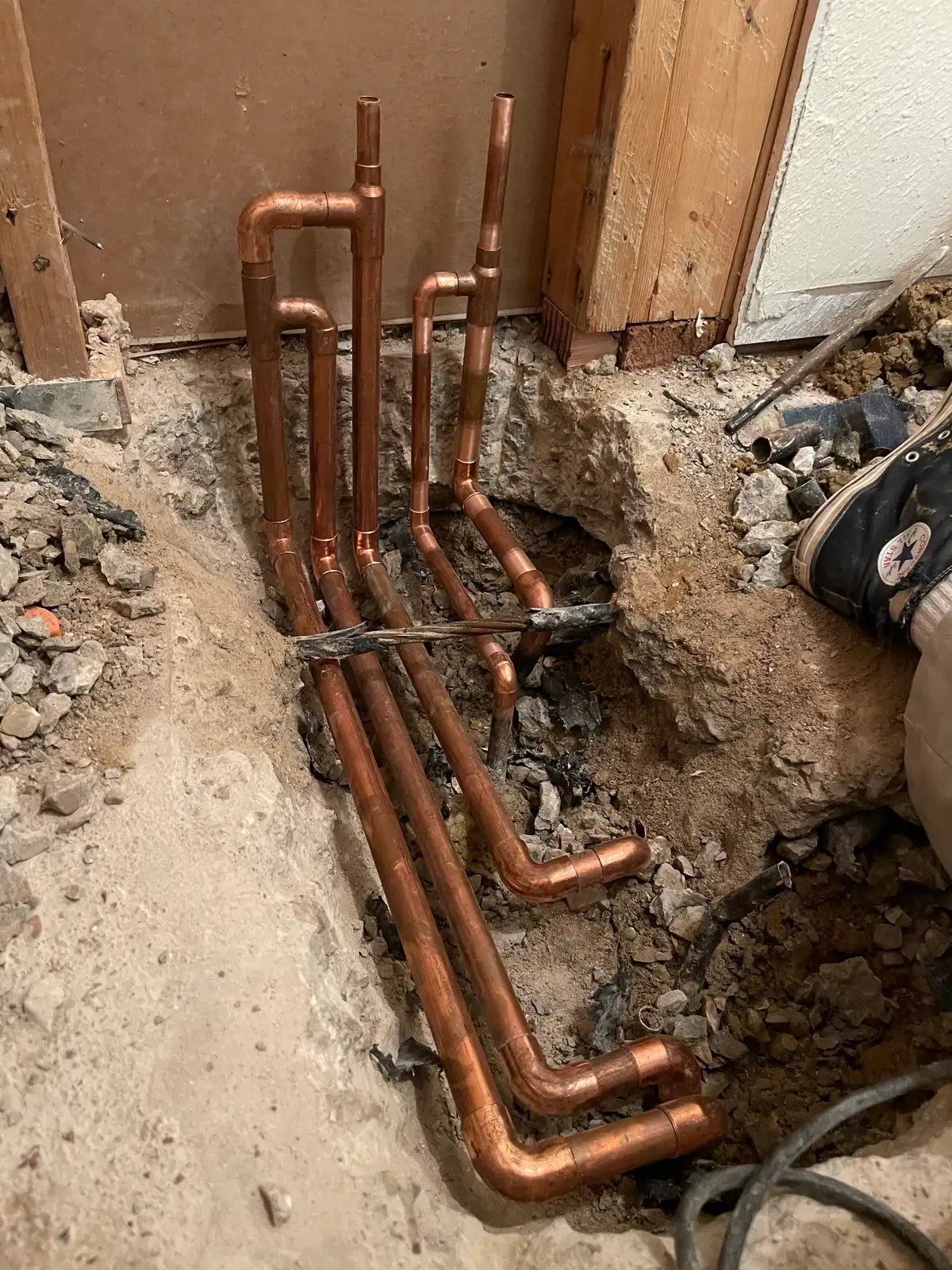
A slab leak is water escaping from a pressurized supply line that runs through or beneath your concrete foundation. The pipe itself may be pinholing from corrosion, cracking from soil shift, or failing at a fitting. The water has nowhere to go except up through the slab — into your flooring, your walls, or pooling under the house. The longer it runs, the more damage accumulates.
The total cost to address a slab leak ranges from $2,150 at the low end (electronic detection plus a straightforward localized repair) to $13,000 or more for a whole-house repipe when multiple pipes are compromised. Where you land on that range depends on four things: how accurately the leak is located, what repair method makes sense given the pipe's age and condition, how accessible the breach point is, and whether it's an isolated failure or a symptom of a system-wide problem.
This breakdown covers the real numbers for each phase — detection, localized repair, reroute, and repipe — and gives you a framework for deciding which scope is appropriate for your house.
Phase 1: Detection ($350–$650)
You can't fix what you haven't located. Detection is not optional — cutting into a slab without precise leak location turns a controlled job into an expensive guess. Electronic leak detection uses acoustic listening equipment and pressure testing to pinpoint the breach to within 6–12 inches before any concrete is touched.
Detection in the South Bay typically costs $350–$650. The variation comes from job complexity, not contractor margin. A single-story Lomita tract home with a straightforward pressure drop and accessible cleanouts is faster to scope than a two-story Rolling Hills Estates estate with manifold-fed distribution and finished hardwood over the slab. Difficult access — finished tile, radiant heat systems, thick concrete — adds time and therefore cost.
Some contractors advertise free detection, then roll the cost into an inflated repair quote. The detection fee is a legitimate line item. If it's missing from the quote, ask where it went.
One note on water bills: a continuously running slab leak of even 1/4 inch can add 10,000–30,000 gallons per month to your consumption. In the South Bay, where LADWP and California Water Service tier rates step up sharply after baseline usage, that translates to $80–$300 in additional charges per month — sometimes more. The meter test (shutting off all fixtures and watching for movement) is free and tells you whether you have active loss before you call anyone.
Phase 2: Localized Repair ($1,800–$3,500)
If the leak is isolated — one breach point, and the surrounding pipe is otherwise in acceptable condition — a localized repair is the right scope. The crew opens the slab at the detected location, removes the damaged section, splices in new copper or PEX, patches the concrete, and pressure-tests the line.
Localized repair in the South Bay runs $1,800–$3,500, including concrete cutting, excavation, pipe repair, and slab patch. The spread reflects two variables: depth of the pipe (deeper means more concrete removal) and flooring above it. Cutting through a tile floor that needs to match existing tile is a different conversation than opening a laundry room with polished concrete. Flooring restoration is typically quoted separately, and costs vary widely depending on material.
Localized repair makes sense when the pipe is copper installed after 1980, the failure is clearly isolated to one fitting or a short run, and the rest of the system pressure-tests clean. It does not make sense when the pipe is original galvanized, when you've had two or more leaks in the past five years, or when inspection reveals pitting corrosion along the full length of the line.
Phase 3: Attic or Wall Reroute ($2,800–$5,200)
A reroute abandons the failed in-slab line entirely and runs new pipe through the attic or interior walls to reach the same fixtures. No concrete is cut. The old pipe stays where it is, capped and inert. The new line runs overhead or through wall cavities in copper or PEX.
Reroutes run $2,800–$5,200 depending on which lines are being replaced and how far they need to travel. A single hot or cold line to a bathroom is on the lower end. Rerouting the entire hot-water distribution from water heater to all fixtures in a larger home is at the top. Attic access matters too — a walkable attic in a single-story Carson ranch home is a half-day job; a cramped hip-roof attic in a Redondo Beach bungalow near The Avenues may require custom runs through wall cavities instead.
The reroute is often the smartest middle-ground decision. It eliminates the failed line permanently, avoids slab demolition, and doesn't require whole-house scope if only one or two lines are compromised. The trade-off is that pipes now run in the attic, where they're exposed to temperature swings. In the South Bay that's a minor concern — attic temps rarely exceed 130°F — but it's worth noting for insulation planning.
We've used reroutes frequently in [Hermosa Beach leak detection](/services/trenchless/leak-detection) jobs where Sand Section lots average 30 feet wide and slab access underneath finished townhome floors would require removing entire rooms of tile or hardwood. Getting above the slab entirely is often the only practical path.
Phase 4: Whole-House Repipe ($7,000–$13,000)
When the slab leak is a symptom rather than an isolated event, a whole-house repipe is the correct scope. Galvanized steel supply lines installed from the 1940s through the 1970s corrode from the inside out. You can repair one leak and another opens six months later. At some point the math on repeated repairs — each one with its own detection fee, concrete work, and flooring disruption — exceeds the cost of eliminating the old system entirely.
A full repipe in the South Bay runs $7,000–$13,000 for a single-family home, depending on square footage, number of fixtures, pipe material (PEX is less expensive than copper to install), and accessibility. A 1,200 sq ft Gardena Moneta tract home with 8 fixtures and an accessible attic is on the lower end. A 2,800 sq ft Old Torrance two-story with 14 fixtures and a full tile finish throughout lands at the top or beyond.
Galvanized supply is essentially a closed-end bet — it will fail, and the only question is timing. Homes in Hawthorne's Hollyglen and Holly Park neighborhoods, Lawndale's mid-century slab tracts, and Gardena's post-war build-out are all concentrated in the 1950s–1965 vintage range. If your home was built in that window and still has original supply lines, a slab leak is a reasonable signal that the system is at end-of-life across the board. A full [whole-house repipe](/services/repipes) stops the cycle of repeated repairs and typically comes with a new-system warranty.
PEX repipes are code-compliant in California and have become the standard for residential repiping in the South Bay. PEX is flexible, corrosion-resistant, and faster to run than rigid copper, which brings labor costs down. Copper remains available and appropriate in certain applications, but most homeowners in this range opt for PEX.
The Decision Tree: Which Scope Fits Your Situation
Start with the pipe age and material. If you have galvanized supply installed before 1975 and this is your first confirmed leak, get detection done and then have the rest of the system pressure-tested before committing to a localized repair. If the system-wide pressure test shows other weak spots, repair is a short-term patch on a long-term problem.
If you have copper installed after 1980 and the system otherwise tests clean, a localized repair or reroute is defensible. One pinhole failure in 40-year-old copper is not necessarily a sign of system-wide failure — it may be isolated to a fitting or a section with unusual soil contact. The detection report will show whether the failure is truly isolated or part of a pattern of corrosion along the run.
If you've had more than one slab leak in three years, the answer is almost always a full repipe. Repeated detection fees, concrete cuts, and flooring restoration add up fast. A third localized repair at $2,500 brings your cumulative spend to $7,500 or more — overlapping with full repipe cost — without the permanence of a new system.
For homes where a sale is anticipated within 24 months, the reroute or repipe has an additional argument: buyers' inspectors will scope the supply system, and a confirmed slab leak history with repeated patch repairs creates negotiating leverage for buyers. A completed repipe with permits pulled and closed is a clean disclosure. A history of patch repairs with no permits behind them is the opposite, and it is the kind of thing a buyer's agent finds by pulling permit history against the seller's disclosure.
What Affects Your Specific Number
Permit costs vary by city. In the South Bay, plumbing permits for slab work or a full repipe typically run $150–$450 depending on the municipality. Torrance, Manhattan Beach, and Redondo Beach each have their own permit fee schedules — your contractor should pull the permit and include it in the quote. If a quote doesn't mention permits, ask.
Flooring restoration is almost always a separate line item, quoted after the slab is opened and the scope of disruption is known. Budget $15–$40 per square foot for tile replacement and matching, or $8–$18 per square foot for basic concrete patch if the floor above is carpet or luxury vinyl. Tile matching in older homes — particularly pre-1970 Saltillo or handmade clay tile common in Old San Pedro and Palos Verdes Estates — can drive restoration costs significantly higher if the tile is discontinued.
Hot-water slab leaks are more common than cold-water leaks. The thermal cycling from constantly heating and cooling the line, combined with slightly acidic condensation in cold-soil environments, accelerates copper corrosion at the bottom of the pipe where it contacts concrete. This is not a South Bay-specific phenomenon, but it means that your hot-water lines statistically represent higher risk than cold — worth factoring into a decision between reroute and full repipe.
Slab leaks in San Pedro and the older hillside blocks
San Pedro generates more slab leak calls per home than anywhere else we work, and the reason is structural rather than bad luck. Much of the housing stock sits on post-war slabs poured over graded hillside fill, and that fill has been settling toward the harbor ever since. Differential settlement puts a bending load on copper supply lines cast into the slab, and copper that's under sustained stress pits from the outside in.
Water chemistry compounds it. South Bay supply runs hard, and decades of scale inside a line narrows the bore, raises velocity, and accelerates erosion corrosion at every elbow. The result is the pattern we see constantly on the older blocks: a first pinhole around year 35 to 45, then a second one within eighteen months, usually somewhere else entirely.
That pattern is the whole argument for the reroute decision. A single localized repair on a first leak is defensible. A second leak in the same slab means the copper is failing as a system, and continuing to chase individual pinholes through a concrete floor costs more over three years than rerouting the line overhead once. Our [slab leak detection](/services/trenchless/leak-detection) work in San Pedro starts with locating the active leak, but the conversation that matters is which of the four scopes above your slab actually needs.
What to do next
If you're seeing warm spots on your floor, unexplained spikes on your water bill, or hearing running water when every fixture is off, the first step is a professional [slab leak detection](/services/slab-leak-repair) — not a repair quote. You need an accurate location before you can make any of the repair decisions described above. Detection without accurate location is money spent twice.
Mainline No-Dig Trenchless Plumbing is a Licensed C-36 #901735 contractor serving 16 South Bay cities, headquartered in Lomita. We carry electronic detection equipment on service vehicles, handle the full scope from detection through repipe, and pull permits in every city we work in. No overtime fees on dispatch — the rate is the same at 9 PM as it is at 9 AM.
Call us at (310) 808-7343 to schedule detection or to talk through what scope makes sense for your house before any work is committed.
Frequently Asked Questions
How much does slab leak repair cost?
Detection runs $350–$650. A localized repair through the slab is $1,800–$3,500. Rerouting the affected line overhead is $2,800–$5,200. A whole-house repipe runs $7,000–$13,000. Which one you need depends less on the leak in front of you than on whether it's the first one.
How do I know if I have a slab leak?
The clearest signs are a hot spot on the floor, the sound of running water with every fixture closed, an unexplained jump in the water bill, and a water meter that creeps with the whole house shut off. Warm floors point at the hot line, which is where most slab leaks happen.
Should I repair the slab leak or reroute the line?
Repair the first one; reroute after the second. A single pinhole can be an isolated defect. A second pinhole in the same slab means the copper is failing throughout, and each subsequent repair means opening the floor again. Rerouting abandons the slab run and puts new pipe where it can be serviced.
Does homeowners insurance cover a slab leak?
Most policies cover the resulting water damage and the cost of accessing the leak, but not the pipe repair itself, and never the slab-breaking as a standalone. Coverage varies enough that the only reliable answer comes from reading your specific policy's water damage section before work starts.
How long does slab leak detection take?
Usually 60 to 90 minutes. We isolate the system by pressure, then narrow the location acoustically and with thermal imaging before anyone opens concrete. Locating precisely is what keeps a repair to one small opening instead of exploratory demolition.
Why does San Pedro have so many slab leaks?
Post-war slabs poured over graded hillside fill that has been settling toward the harbor ever since. Settlement bends copper supply lines cast into the slab, and hard water scale accelerates erosion corrosion at the elbows. First pinholes typically show up between years 35 and 45.
Tags
Related Services