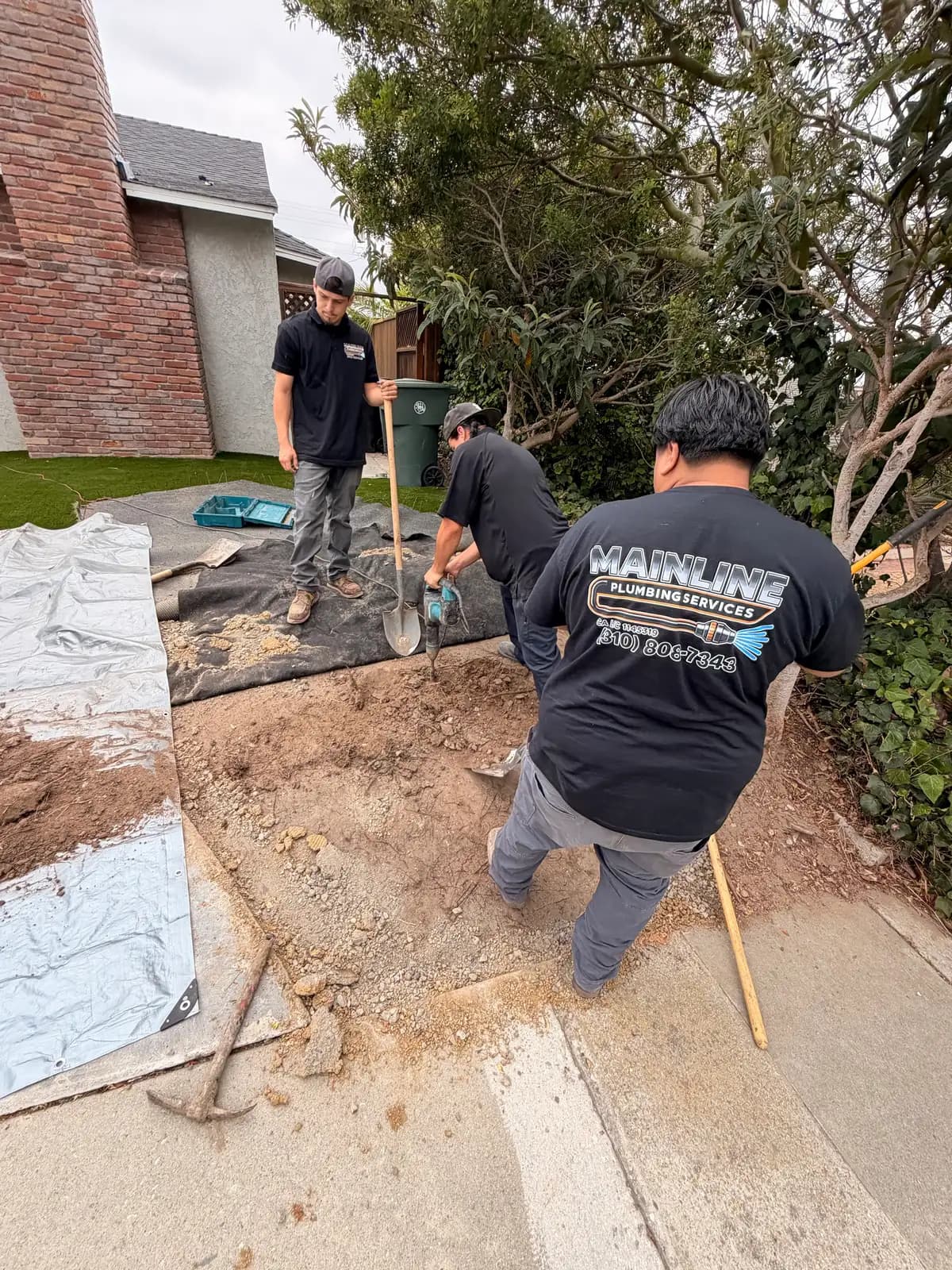
In Torrance the property owner is responsible for the entire sewer lateral, including the connection to the public sewer main in the street. The city defines that lateral as the horizontal piping beginning twelve inches from the exterior wall of the building and running to its connection with the public sewer. There is no cost-sharing at the property line, and there is no point-of-sale inspection requirement.
That last point is worth stating plainly because the opposite is widely repeated. Torrance has no ordinance requiring a sewer lateral inspection when a property changes hands, no designated compliance districts, and no city-issued compliance certificate tied to a sale. The confusion is understandable, because programs of that kind do exist elsewhere in California and the assumption travels across city limits. Torrance has never adopted one.
What Torrance does have is a detailed set of real requirements in Division 7, Chapter 2 of its municipal code — when a permit is triggered, what diameter the pipe has to be, where cleanouts go, when a city inspector must be physically present, and what you are never allowed to connect to a sewer. Most of it is unknown to homeowners and skipped by contractors who work here occasionally. This is what it actually says.
Where Torrance draws the ownership line
Most homeowners assume the handoff happens at the property line — your pipe on your side, the city's past the sidewalk. In Torrance that is wrong, and it is the single most expensive misunderstanding on this job. The city's sewer lateral policy states that owners are responsible for maintaining and repairing the lateral including the connection point to the City sewer. Not up to it. Including it.
The practical consequence lands in the estimate. A lateral that fails at the tie-in — a common failure point, since that is where the pipe transitions and where decades of differential settlement concentrate stress — is a right-of-way excavation on the owner's dime. That means a deeper dig, traffic control, and a second permit. Homeowners who budgeted for a property-line repair get a number that looks like it came from a different job.
It also changes the math on partial repairs. If your lateral has a bad section at thirty feet and questionable pipe from there to the main, spot-repairing the thirty-foot mark leaves you owning everything downstream of it. On a 1950s clay lateral through Walteria or Madrona, that is usually the argument for replacing the full run in one pass rather than paying mobilization twice.
Past the city main, responsibility shifts to a third party most residents never hear about. Torrance is a member of the South Bay Cities Sanitation District, one of the Los Angeles County Sanitation Districts, formed in December 1923. Flow from the city system reaches the A.K. Warren Water Resource Facility in Carson — the plant formerly known as the Joint Water Pollution Control Plant, with a design capacity of 400 million gallons a day serving more than 4.8 million people. The municipal code recognizes that split directly: the city permit requirement does not extend to sanitary sewers used by the County Sanitation Districts.
When you need a permit — and when you genuinely don't
The code draws a line here that saves people money, and almost nobody knows about it. Section 72.2.2 says the permit requirement does not apply to removing stoppages or repairing leaks in a house connection sewer — except when it becomes necessary to replace any part or all of that sewer with other or different materials. Clearing a blockage is not permitted work. Replacing pipe is.
Once you are into replacement, Section 72.2.3 makes it unlawful to construct, alter, or use a house connection sewer without a permit first. The code defines "alterations" as any change or addition and "repairs" as the reconstruction or renewal of any existing part, so the trigger is broader than a full replacement — relining and spot replacement are inside it.
Which permit depends on where the pipe is. The city issues a plumbing permit listed as "Alter Building Sewer" for work on private property between the building and the property line, and a Construction and Excavation permit for work in the public right-of-way from the property line out to the main. Because Torrance holds you responsible clear to the main, a full lateral replacement here frequently needs both. That is two departments reviewing two scopes, not a contractor padding an invoice.
Permits go through Torrance Community Development at (310) 618-5910, at the One-Stop-Shop counter on Torrance Boulevard. The city also expects the work to be done by a licensed plumber who holds a City of Torrance business license — a separate credential from the state contractor license. We carry both, under C-36 #901735, and pull the permits as part of our [Torrance trenchless sewer repair](/service-areas/torrance/trenchless) jobs.
What the code requires of the pipe itself
Section 72.2.10 is unusually specific, and the numbers are worth knowing before you approve a bid. From the street sewer to the property line, the pipe must be at least six inches in internal diameter. From the property line to the building, a house connection sewer serving twenty people or fewer must be at least four inches; anything serving more than twenty must be six inches for its entire length. That last threshold catches a lot of Torrance duplexes, triplexes, and ADU conversions where the original four-inch line is no longer code-compliant for the occupancy it now serves.
Cleanouts are not optional and their placement is specified. The code requires a cleanout in every house connection sewer at the junction of the soil pipe at the building, and at all changes in alignment and grade. A lateral with a bend and no cleanout at that bend is not compliant, and it is also the reason so many older Torrance homes can only be scoped from one direction.
Grade is specified too: the run from the property line to the public sewer must be straight, with a fall of not less than one foot in fifty feet — a two percent slope, which matches the quarter-inch-per-foot rule most plumbers work to. Too flat and solids drop out; too steep and liquid outruns them. Bellies in a Torrance lateral usually trace back to settlement rather than original installation, but the standard is what a camera inspection gets measured against.
One requirement catches contractors out. Under Section 72.2.11, when a lateral has to be connected to a public sewer at a point where no Y or T branch already exists, the connection must be made in the presence of a city inspector. On mains twelve inches or smaller and ten feet deep or less, it has to be done by removing a section of the existing sewer and inserting a Y branch. A saddle is only permitted on mains eight to twelve inches deeper than ten feet, or fourteen inches and larger at any depth. Scheduling that inspector is part of the job, not an afterthought.
What your replacement lateral is allowed to be made of
The materials language in the sewers chapter is a period piece — it describes vitrified clay laid on an unyielding foundation with oakum and cement mortar joints, and cast iron caulked with pig lead. That text is still on the books, but it is not what governs a replacement today. Torrance amended the plumbing code to set the current list.
Section 83.2.4 of the municipal code rewrites California Plumbing Code Section 715.1 to read that the building sewer, beginning two feet from any building or structure, shall be cast iron, vitrified clay, asbestos cement sewer pipe, Schedule 40 ABS, Schedule 40 PVC, or PVC SDR35 — or as approved by the administrative authority. In practice on Torrance residential work that means Schedule 40 ABS or PVC, or SDR35 for the buried run.
That last clause matters more than it looks, and it is the part worth asking any trenchless contractor about. The HDPE used in pipe bursting and the resin liners used in CIPP are not on the named list. They are permitted here under the administrative authority approval route, which means the method and product have to be accepted by the city rather than simply assumed. A contractor who has not done that before will find out at plan check. We handle that approval as part of our [pipe bursting](/services/trenchless/pipe-bursting) and lining work.
One more amendment catches commercial buildings: Section 83.2.3 adds language limiting above-ground ABS and PVC DWV installations to residential construction. If you own a Torrance commercial property and someone is proposing above-ground plastic drainage, that is a code problem before it is a quality problem.
Three things that quietly put a Torrance property out of compliance
Downspouts and yard drains tied into the sewer. Section 72.2.14 makes it unlawful to connect any roof conductor, yard drain, or other conduit carrying rain or surface water to a sanitary sewer or the house connection sewer leading to it. This is extremely common on older Torrance properties, usually added by a previous owner solving a drainage problem, and it is why some laterals surcharge only during storms. It also loads the treatment system with clean water, which is the reason the prohibition exists.
Restaurants without correctly sized grease interceptors. Section 72.2.17 requires any establishment serving one hundred or more meals per day — and any private or public automobile or carriage wash rack — to pass kitchen sink and wash rack waste through approved grease traps. Capacity is set by volume: twenty pounds of grease capacity for establishments serving one hundred to three hundred meals a day, sixty pounds above three hundred. Undersized interceptors are a recurring finding on South Bay commercial kitchens.
Below-grade fixtures with no backwater valve. Torrance adopted the California Plumbing Code, 2025 Edition, and its local amendments do not touch Section 710 — so the state rule applies here word for word. CPC 710.1 requires that drainage piping serving fixtures on a floor located below the elevation of the next upstream manhole cover of the public sewer be protected from backflow of sewage by an approved backwater valve. The reference point is not your property line or the street surface. It is the manhole cover immediately uphill of where your lateral ties in.
The installation detail people get wrong is what goes through the valve. Fixtures above that manhole elevation must connect downstream of the backwater valve, not through it — otherwise the upstairs bathroom is trying to drain through a closed flap every time the main surcharges. If you have a basement bathroom, a below-grade laundry, or a sunken addition, this is the difference between a main-line backup staying in the street and coming up through your floor drain. A plumbing permit is required to install one.
What a camera inspection is actually measuring against
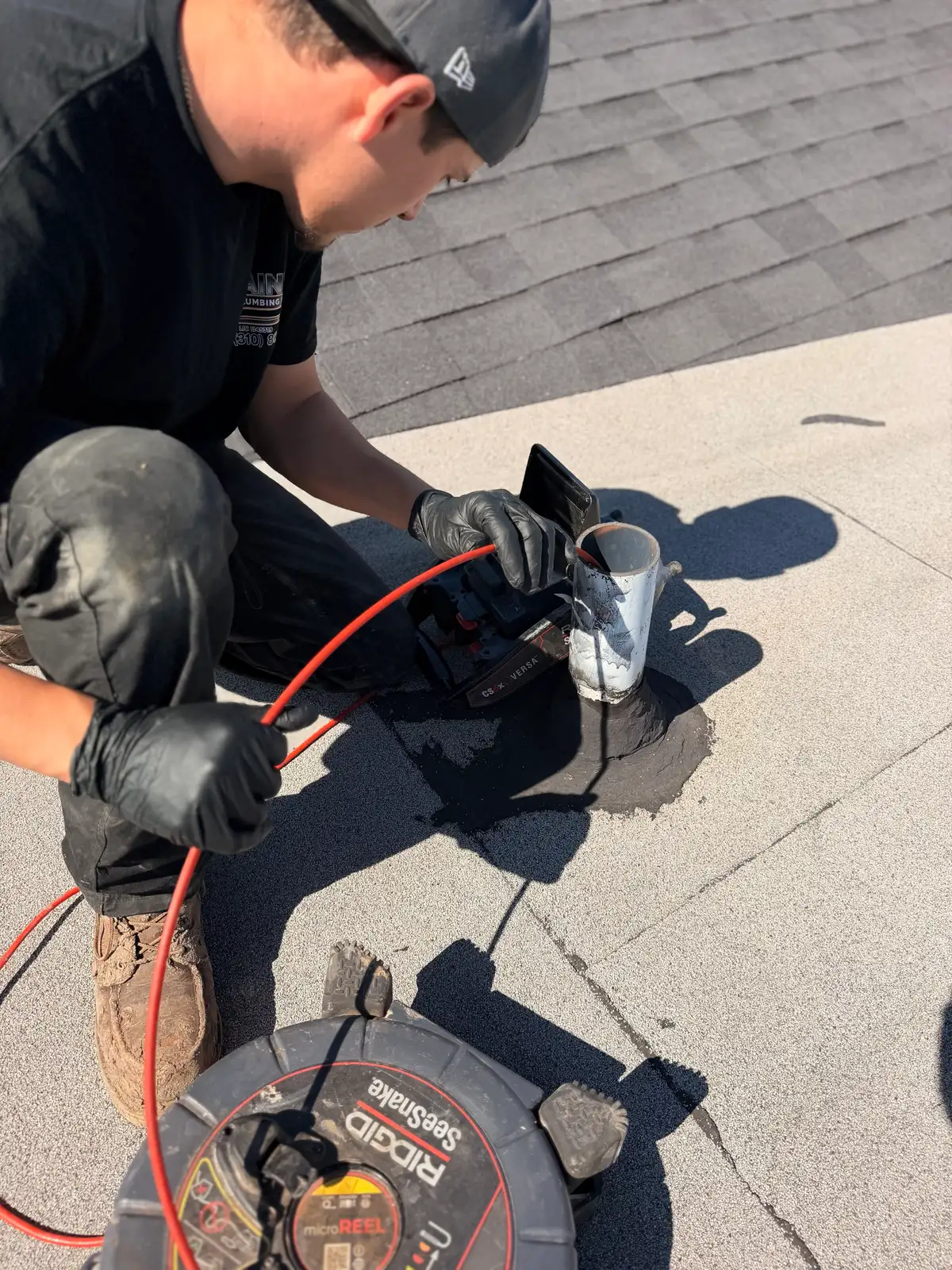
The city's own guidance for a sewer problem is a four-step sequence: contact a licensed plumber holding a Torrance business license, request a camera inspection of the lateral, repair any damage or blockages found, and obtain the required permits before performing repairs. The inspection comes before the repair for a reason — it determines which repair is viable and which permits the job will need.
Torrance also lists what it sees causing lateral failures: aging and deteriorating pipe, cracks and pipe separation, tree root intrusion, soil movement, and improper maintenance. That list maps cleanly onto the city's housing stock. Old Torrance runs 1920s and early-1930s bungalows on short original clay laterals, now approaching a century. The post-war tract belt through Walteria, Madrona, West Torrance, El Nido, Anza, and Southwood went up almost entirely between 1948 and 1965, with clay laterals of fifty to ninety feet through fill that has been settling ever since. A clay joint flush in 1955 is offset by an inch today, and that ledge catches solids and admits roots.
When work is done, Section 72.2.7 requires that it be left uncovered and accessible for the inspector, with written notice given when it is ready. If pipe gets buried before inspection, the code allows the city to require it be uncovered again. Section 72.2.8 then provides for a certificate of final inspection once the work meets the code and the fees are paid — worth being precise about, because this is a post-construction sign-off on permitted work, not the point-of-sale compliance certificate that doesn't exist.
Torrance sewer lateral questions we hear most
Does Torrance require a sewer inspection before I sell my house? No. Torrance has no point-of-sale sewer lateral requirement, no compliance districts, and no certificate program tied to a sale. A pre-listing scope is voluntary — and on pre-1970 pipe still usually worth doing, because the buyer's inspector will scope it regardless and you would rather see the footage first.
Who pays if the lateral fails under the street? The property owner. Torrance assigns responsibility for the entire lateral including the connection to the public main, so a failure past the property line is still your repair. This differs from cities that take ownership at the property line, which is where most of the confusion originates.
Do I need a permit just to clear a blockage? No. The code exempts removing stoppages and repairing leaks from the permit requirement — unless the fix requires replacing part or all of the sewer with other or different materials. Snaking and hydro-jetting are not permitted work; relining and replacement are.
What size does my sewer lateral have to be? At least six inches from the street sewer to the property line, and at least four inches from the property line to the building for laterals serving twenty people or fewer. Anything serving more than twenty people must be six inches throughout — which is what catches converted duplexes and added units running on an original four-inch line.
Can my downspouts drain into the sewer line? No, and this is a real code violation rather than a technicality. Torrance makes it unlawful to connect a roof conductor, yard drain, or any rain or surface water conduit to the sanitary sewer or the lateral serving it. If your lateral only backs up during heavy rain, this is the first thing to look for.
How do I verify a plumber is licensed to do this work in Torrance? Check the state license number against the California State License Board at cslb.ca.gov — ours is C-36 #901735. Then confirm the contractor also holds a City of Torrance business license, which the city expects for this work and which is separate from the state license.
What to do next
If you own a Torrance property built before 1970 and the lateral has never been scoped, its condition is genuinely unknown to you — and under the city's ownership rule, all of it is your financial exposure, including the portion under the street. That is the case for scoping it on an ordinary Tuesday rather than during an inspection contingency or at 9pm with a backed-up bathtub.
If you are selling, scope before you list. If you are buying, scope before your contingency expires. If you have had two or more backups in the past eighteen months, the problem is the pipe, and a camera run will tell you which repair the code actually permits instead of paying for another snaking that buys three months. Our [trenchless sewer repair](/services/trenchless) page covers how lining and pipe bursting differ and when each one is viable.
Call the Mainline crew at (310) 808-7343. Licensed C-36 #901735, headquartered in Lomita, 18+ years in the South Bay, with a 25-minute target response into Torrance. We will tell you what the camera showed, which repair method the pipe condition supports, and exactly which permits your job needs — including whether it crosses into the right-of-way and triggers the second one.
Frequently Asked Questions
Is there a Torrance sewer lateral ordinance requiring inspection before a sale?
No. Torrance has no point-of-sale sewer lateral inspection requirement, no designated compliance districts, and no city compliance certificate tied to a property transfer. Torrance Municipal Code Division 7, Chapter 2 governs sewers and contains no transfer trigger. Some other California cities do run such programs, which is the usual source of the confusion.
Who is responsible for the sewer lateral in Torrance?
The property owner, for the entire lateral. The city's sewer lateral policy assigns the owner the full run — defined as the horizontal piping beginning twelve inches from the building's exterior wall — out to and including the connection with the public sewer main. A failure past the property line is still the owner's repair.
Do I need a permit to unclog a sewer line in Torrance?
No. Torrance Municipal Code section 72.2.2 exempts removing stoppages and repairing leaks from the permit requirement, unless the work requires replacing part or all of the sewer with other or different materials. Snaking and jetting are exempt; relining and pipe replacement require a permit.
What permits does sewer lateral replacement in Torrance require?
An "Alter Building Sewer" plumbing permit covers work on private property between the building and the property line. A Construction and Excavation permit covers work in the public right-of-way out to the main. Jobs spanning both need both. Permits are issued through Torrance Community Development at (310) 618-5910.
What size does a sewer lateral have to be in Torrance?
At least six inches internal diameter from the street sewer to the property line, and at least four inches from the property line to the building for laterals serving twenty people or fewer. Laterals serving more than twenty people must be six inches throughout — which catches many converted duplexes and added units still running an original four-inch line.
Can rain gutters or yard drains connect to the sewer in Torrance?
No. Section 72.2.14 makes it unlawful to connect any roof conductor, yard drain, or other rain or surface water conduit to a sanitary sewer or the house connection sewer leading to it. If a lateral surcharges only during storms, an illegal storm connection is the first thing to check.
Does a city inspector have to be present when my lateral is tied into the main?
Yes, when no Y or T branch already exists at the connection point. Section 72.2.11 requires the connection be made in the presence of an inspector, by removing a section of the existing sewer and inserting a Y branch on mains twelve inches or smaller and ten feet deep or less. Saddles are only permitted on larger or deeper mains.
Do I need a backwater valve in Torrance?
You do if any fixture sits on a floor below the elevation of the next upstream manhole cover on the public sewer. Torrance adopted the California Plumbing Code, 2025 Edition, and did not amend Section 710, so CPC 710.1 applies as written. Fixtures above that elevation must connect downstream of the valve rather than through it. Installing one requires a plumbing permit.
What pipe material is approved for a sewer lateral in Torrance?
Municipal code section 83.2.4 amends CPC 715.1 to allow cast iron, vitrified clay, asbestos cement sewer pipe, Schedule 40 ABS, Schedule 40 PVC, or PVC SDR35, beginning two feet from the building — or other materials as approved by the administrative authority. The HDPE used in pipe bursting and CIPP liners fall under that approval route rather than the named list.
Where does Torrance wastewater actually go?
Torrance collects it, then it enters the regional system. Torrance is a member of the South Bay Cities Sanitation District, part of the Los Angeles County Sanitation Districts, and flow is treated at the A.K. Warren Water Resource Facility in Carson — formerly the Joint Water Pollution Control Plant — which has a 400 million gallon per day design capacity.
Tags