Most homeowners assume water heaters take the hardest hits in winter — cold mornings, longer showers, higher demand. The data tells a different story. Across our service calls over 18+ years in the South Bay, August and September are when tank failures cluster. Not January.
The mechanism is counterintuitive, but it's not complicated. Southern California's municipal water supply runs warmer in summer. That sounds like less work for your water heater, and in a narrow sense it is — the burner cycles less often. But that reduced cycling is exactly what lets sediment settle hard, lets scale accumulate unchecked, and lets the conditions for a blown thermostat or failed anode rod develop quietly over three months before the unit fails at the worst possible time.
This guide explains the actual physics behind summer water heater failure, what the pre-summer flush accomplishes and when it's too late to bother, and how to read the warning signs specific to the coastal and inland neighborhoods of the South Bay.
The cold-water inlet temperature problem
In winter, groundwater temperatures in the Los Angeles Basin drop. Cold water entering the tank requires the burner to fire more frequently to maintain the setpoint — typically 120°F for residential units. More burner cycles means more convective movement inside the tank, which keeps sediment suspended rather than settled.
In summer, inlet water temperatures rise — often 10°F to 15°F warmer than their January lows. The burner fires less. Water sits more static inside the tank between heating cycles. Sediment that would have been agitated and flushed in winter has time to pack down at the bottom of the tank. Over a 90-day summer, a moderate sediment layer becomes a dense, insulating crust.
That crust forces the burner to work harder to transfer heat through it. You'll hear this as a rumbling or kettling sound — water trapped beneath the sediment layer superheating and releasing. The burner runs hotter and longer to compensate, which accelerates wear on the thermostat, the tank lining, and any components downstream.
Hard water scaling is a year-round problem, but summer makes it worse
South Bay municipal water is hard — typically in the 300–400 ppm total dissolved solids range depending on your water district and the time of year. Calcium and magnesium carbonate precipitate out of solution when water is heated, forming scale on the tank interior, the heating element (electric units), or the bottom glass lining (gas units).
Scale formation is temperature-dependent. Warmer inlet water plus less frequent agitation from burner cycling means scale has ideal conditions to accumulate in summer. An electric water heater in a Gardena home on the Moneta grid or a gas unit in a Hawthorne Hollyglen bungalow is laying down scale at a higher rate between June and September than it does the rest of the year.
On tankless units, the problem presents differently. The heat exchanger — the component most vulnerable to scale — sees higher mineral loads in summer because incoming water already carries more dissolved solids from warmer distribution pipes. Tankless units without a descaling schedule every 12 months in hard-water areas are accumulating efficiency losses at a measurable rate each summer.
The anode rod factor that compounds over summer
Anode rods — sacrificial magnesium or aluminum rods suspended inside the tank — are what prevent the tank lining from corroding. They deplete over time as they do their job. The rate of depletion scales with water temperature and the mineral content of the water.
Coastal South Bay cities have an additional variable: salt air. In Redondo Beach neighborhoods like The Avenues and Golden Hills, and in homes along the Hermosa Beach Sand Section, atmospheric salt accelerates corrosion of any exposed metal — including water heater components. We inspect anode rods in coastal locations on a 3-year cycle, not the 5-year default that applies inland. By August, a rod installed three years ago in a coastal home may be consumed enough that the tank itself has started corroding.
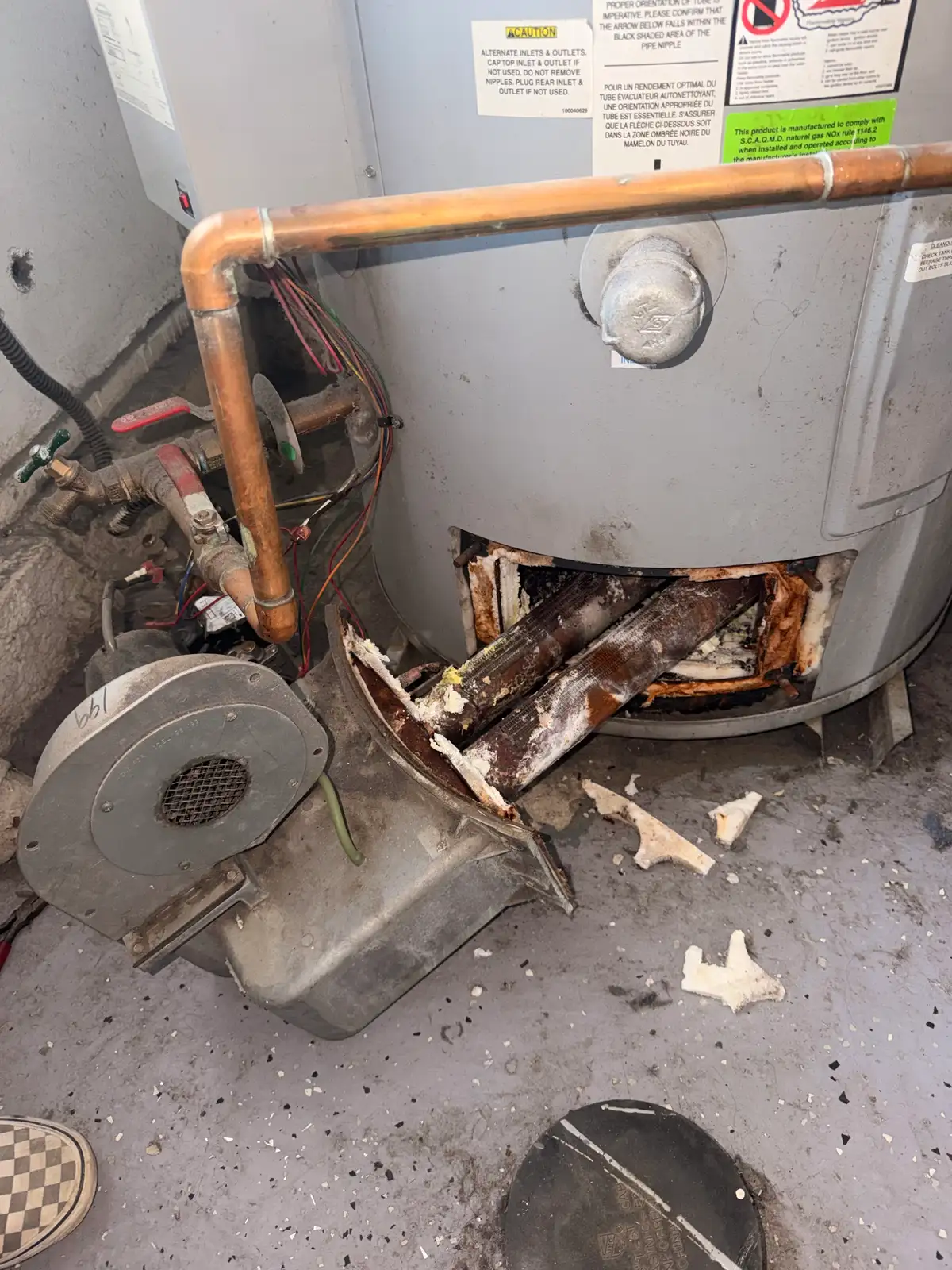
A depleted anode rod in summer isn't just an isolated problem. The combination of static water, elevated temperatures, hard-water scale, and a consumed anode creates a failure environment. The tank doesn't fail because of one thing — it fails because several compounding factors all peak simultaneously in late summer.
What the pre-summer flush actually does
Flushing a water heater before summer — April or May for South Bay timing — serves one primary function: removing the sediment layer before summer conditions allow it to harden further. The process involves connecting a hose to the drain valve at the tank's base, partially or fully draining the tank, and allowing the agitated water to carry sediment out. On a tank with a significant buildup, this can take 20–30 minutes of intermittent flushing cycles to run clear.
What flushing doesn't do: it doesn't remove scale that has already bonded to the tank lining or element. That requires either a descaling chemical flush (more applicable to tankless units) or, if the tank is a standard storage unit, replacement if the scale layer is thick enough to have caused internal hot spots. On [standard water heater service](/services/water-heaters) calls, we often see tanks where flushing would have helped two or three years ago but is no longer sufficient.
For tankless units, the pre-summer maintenance step is a descaling flush — circulating a mild acid solution through the heat exchanger to dissolve calcium deposits. This is particularly important in Carson Park and Scottsdale neighborhoods of Carson, where water chemistry from the West Basin Municipal Water District runs on the harder end of the South Bay range. If you've never had a tankless unit descaled and it's been in service more than two years, this is the season to schedule it.
Warning signs that summer failure is already underway
Rumbling or popping sounds during heating cycles are the clearest indicator of a sediment layer at the tank bottom. The sound is produced when water trapped under the crust superheats and bursts through — not dangerous on its own, but a reliable signal that the tank is working harder than it should. If this is new behavior heading into summer, the tank needs to be flushed before the sediment hardens further.
Water that takes longer than usual to reheat after a draw-down points to the same insulation effect. If your 50-gallon tank used to recover in 60–70 minutes and it's now taking 90 minutes or more, scale or sediment has degraded thermal transfer. This is not a minor efficiency issue — it means the burner is running longer per cycle, increasing wear.
Discolored hot water — rust or tan tint — usually means the anode rod is gone and the tank lining has started oxidizing. At that point, you're past maintenance and into [water heater replacement](/services/water-heaters). Homeowners in Old San Pedro and Vinegar Hill, where pre-1940 supply plumbing is still common, sometimes mistake this for pipe-origin discoloration. A simple test: run cold water only for two minutes. If that runs clear but hot water is discolored, the source is the tank.
Tank age and the August replacement scramble
A standard gas tank water heater in the South Bay has a realistic service life of 8–12 years depending on water chemistry, maintenance history, and coastal exposure. Tankless units run 15–20 years under the same conditions. Most homeowners don't know their unit's installation date without checking the serial number — the manufacture date is encoded in the first four digits on most major brands.
What we see every August: a cluster of calls from homeowners whose units are 10–14 years old, hadn't been serviced in years, and failed during the first serious heat event of late summer. At that point, same-day or next-day installation becomes necessary, which means less time to evaluate options, less flexibility on equipment selection, and sometimes supply constraints on specific models.
The alternative is a pre-summer assessment in April or May. For units under 8 years old with no warning signs, a flush and anode inspection is usually sufficient. For units 8–10 years old, we evaluate the anode condition, sediment level, and the thermostat before recommending flush-and-monitor versus proactive replacement. For units over 10 years in coastal areas, or over 12 years inland, the math usually favors replacement before failure rather than after. Homeowners in the [Redondo Beach service area](/service-areas/redondo-beach/water-heaters) dealing with salt-air corrosion often find 10 years is the realistic ceiling for tank units near the coast.
What to do before June
Check your water heater's age. If the manufacture date isn't visible on the unit's label, the serial number will contain it — most manufacturers encode it in the first two digits (year) or first four digits (year and week). If the unit is over 8 years old and hasn't been serviced in the last two years, schedule a flush and inspection before the summer cycling pattern sets in.
For tankless units, the priority is descaling. If you're in a hard-water zone — most of the South Bay qualifies — annual descaling is the correct interval. Two years without it means the heat exchanger has measurable scale accumulation and reduced efficiency. Three or more years means potential flow restriction and possible error codes during high-demand periods.
If you want the Mainline crew to assess your unit before summer, call (310) 808-7343. We're a Licensed C-36 #901735 contractor serving 16 South Bay cities out of our Lomita headquarters, with 18+ years on water heater maintenance, replacement, and trenchless drain work. We don't charge overtime fees, and our 24/7 dispatch operates if something fails before you get to the pre-season call. Early is easier and less expensive than the August scramble.
Tags