A water heater makes noise when something physical is happening inside the tank or flue. That might be sediment fracturing under heat, metal expanding against metal, a gas valve partially restricting flow, or a heating element arcing through scale. Each sound has a distinct signature and a distinct cause — and lumping them all under 'my water heater is making a weird noise' leads to either unnecessary panic or ignoring a problem that's quietly destroying your tank.
The sounds covered here — rumbling, popping, ticking, and whistling — are the four most common complaints we diagnose across South Bay homes. Some are cosmetic. Some indicate imminent failure. A few require you to act before the tank does the deciding for you. What follows is a straightforward breakdown of each one, what's physically causing it, and what the correct response actually is.
The rumble: sediment buildup and why it gets worse fast
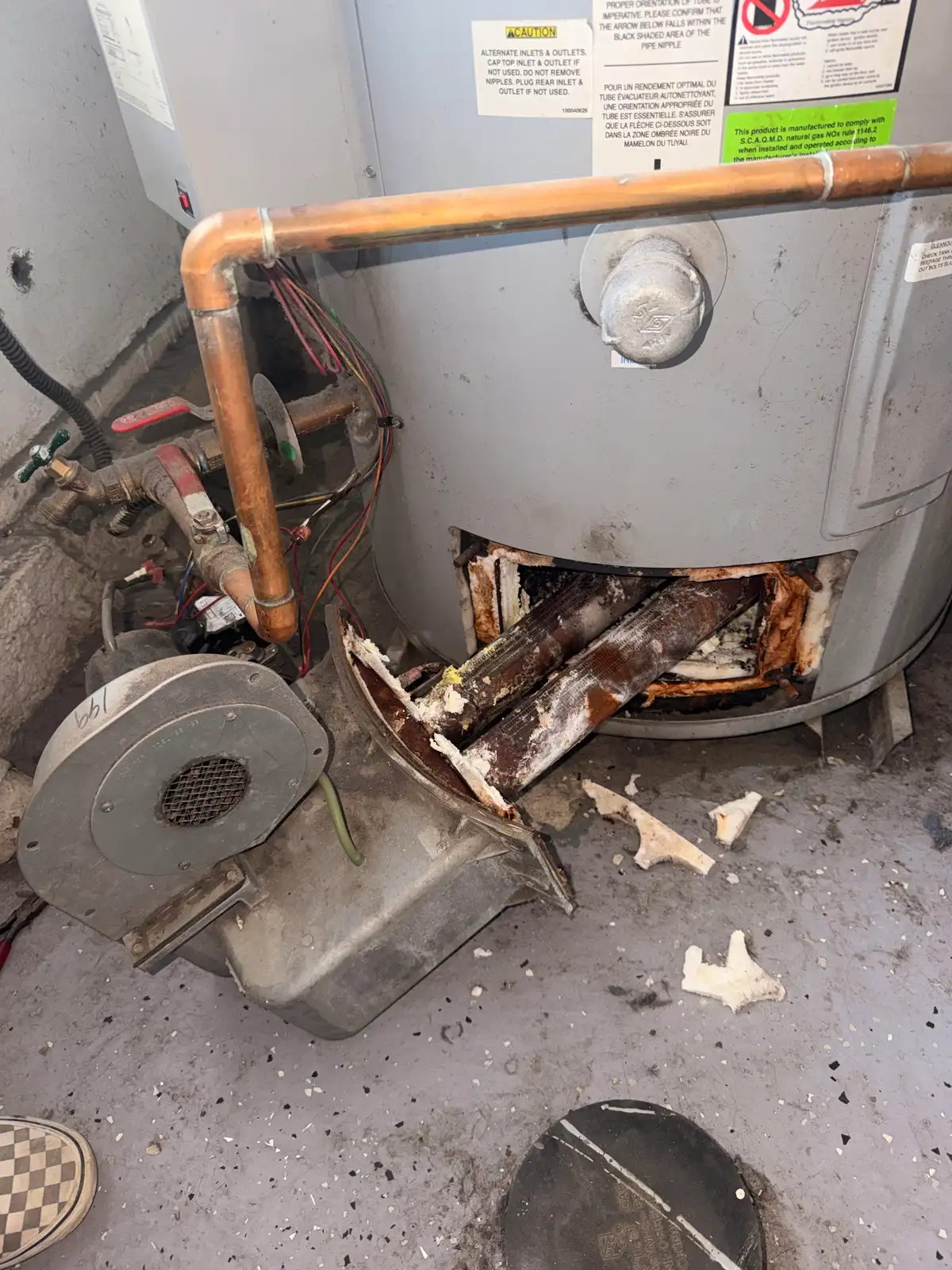
A low, rolling rumble — often described as boiling or gravel churning — is sediment fracturing at the bottom of the tank. Over years of heating and cooling, dissolved minerals in tap water (primarily calcium carbonate and magnesium) precipitate out and accumulate as a hardened layer on the tank floor. When the burner fires, water trapped beneath that sediment layer superheats and forces its way through, creating the rumbling sound.
South Bay water is moderately hard — roughly 200–300 ppm depending on your city's supply mix. That's enough to produce significant scale accumulation in 4–6 years on an unserviced tank. In Gardena and Hawthorne, where mid-century tract homes have been running the same water heater for 15+ years, we frequently find sediment layers 1–2 inches thick. At that depth, the tank floor is under thermal stress every time the burner cycles, and the efficiency loss is measurable — tanks with heavy sediment can run 15–25% less efficiently than a clean unit.
If the rumble is new and moderate, a full tank flush may recover some efficiency and buy time. If the rumble is loud, constant, or accompanied by visible discoloration at the pressure relief valve, the sediment layer has likely bonded to the tank floor. At that stage, flushing pushes sediment through your system and rarely removes the compacted base layer. A camera-assisted drain inspection will tell you what's actually in there. For tanks over 10 years old with a confirmed sediment rumble, replacement is usually more cost-effective than repeated service attempts.
The pop: heating elements and scale on electric units
Popping or cracking sounds — sharp, intermittent, sometimes rhythmic — are almost always an electric water heater problem. The lower heating element gets buried in sediment over time. As scale bonds directly to the element, the resistance changes and you start hearing a popping or crackling noise as the element heats and the scale fractures slightly around it.
This is functionally the same root cause as the rumble in gas units, but the location and failure mode are different. A gas tank's sediment sits on the floor. An electric tank's sediment attacks the element itself. A severely scaled element will eventually fail entirely, leaving you with lukewarm water or no hot water at all from the lower zone of the tank.
If you catch the popping early, an element replacement combined with a full flush is a reasonable repair — typically in the $200–$400 range depending on tank access. If the element has already failed or the tank is past 10–12 years, the math on repair versus replacement shifts quickly. Electric tanks in coastal zip codes like those in Redondo Beach and Hermosa Beach face accelerated scale formation because the anode rod — which protects the tank lining — corrodes faster in salt-adjacent environments and stops protecting the tank sooner than the 5-year inspection interval most owners assume.
The tick: thermal expansion on metal supply lines
A rhythmic ticking or clicking — most audible right after a hot water draw — is almost always thermal expansion. Cold water enters the tank, the burner or element fires to recover temperature, and the metal supply pipe expands slightly against a bracket, a framing stud, or a neighboring pipe. As it contracts again, it ticks back. This is a physical property of metal, not a failure.
Ticking that occurs only at startup or recovery and stops within a few minutes is generally not a problem you need to fix. It's annoying, and you can sometimes eliminate it by adding a foam pipe insulation sleeve at the point where the pipe contacts a hard surface. What you're listening for is ticking that's changed — faster, louder, or happening at a different point in the cycle than it used to. That can indicate a pressure fluctuation upstream, a failing expansion tank on a closed plumbing system, or a bracket that's broken and allowing more pipe movement than before.
Homes in Rolling Hills Estates and Palos Verdes Estates with steep site topography sometimes see higher static water pressure than expected — municipal pressure entering the home can exceed 80 psi in certain elevation situations — which amplifies thermal expansion sounds and stresses fittings over time. If your ticking is new and you haven't had your supply pressure tested recently, that's worth a pressure gauge check before attributing the sound to normal expansion.
The whistle or whine: gas valve, inlet, and combustion issues
A high-pitched whistle, whine, or singing sound on a gas water heater usually points to one of three places: the cold water inlet valve (if it's partially closed or failing), the temperature and pressure relief valve (if it's seeping), or the gas burner assembly itself. Each has a different urgency level.
A whistling inlet valve is a cheap fix — the valve seat is worn or the valve was accidentally left partially closed. A seeping T&P valve is more serious: the valve is either releasing pressure as designed (meaning your tank pressure is too high) or the valve seat has failed and it can no longer hold a proper seal. A T&P valve that drips persistently onto the discharge pipe needs to be replaced, and the cause of elevated pressure needs to be investigated. Do not cap a T&P discharge to stop the dripping — that valve is your last line of defense against a catastrophic tank failure.
Whistling or a high-pitched hum from the burner area on a gas unit can indicate a partially restricted orifice, combustion air issues, or a gas valve that's starting to fail. If the sound is accompanied by a yellow or orange flame visible at the burner viewing port (instead of a clean blue flame), shut the unit down and call a licensed plumber. A properly burning gas water heater produces a quiet, blue flame. Anything else warrants a burner inspection before you run it further. You can review our [water heater services](/services/water-heaters) for the full scope of what a burner diagnostic covers.
Which sounds can wait and which ones can't
Mild thermal ticking on metal supply lines during recovery: monitor it, no immediate action needed. Moderate sediment rumble on a tank under 8 years old: schedule a flush within the next 60 days. Loud rumble on a tank 10+ years old: get a diagnostic and start budgeting for replacement — don't wait for a leak to force the decision.
Popping on an electric unit with an element that's still heating water adequately: schedule element service within 30 days. A T&P valve that's dripping or hissing: do not defer this. Shut off the cold water supply to the tank, connect a hose to the drain valve to relieve pressure slightly, and call for same-day service. A failed T&P valve on an over-pressurized tank is not a slow failure — it's a rapid one.
A gas burner whistling with a discolored flame: shut the unit off at the gas valve and call immediately. Combustion problems on gas appliances are outside the range of normal wear-and-tear diagnostics and need hands-on inspection before the unit is run again. Our [Lomita water heater team](/service-areas/lomita/water-heaters) responds to gas-related water heater calls 24/7 with no overtime fees for evening or weekend dispatch.
When the sound tells you the tank is done
There's a combination of signals that collectively indicate a tank has crossed from 'repairable' to 'replace now': age over 12 years, an audible sediment rumble, rust-colored water at the hot side only, moisture or corrosion visible at the base of the tank, and a T&P valve that's been dripping. Any three of those together means the tank is living on borrowed time. All five means you're scheduling replacement, not repair.
Standard tank water heaters have a realistic service life of 10–14 years with routine maintenance, and 8–10 years without it. Tanks in coastal cities — Hermosa Beach, Manhattan Beach, Redondo Beach — toward the lower end of that range because the anode rod sacrifices itself faster in salt-adjacent air. When a tank fails from the inside out (usually a pinhole in the glass-lined steel caused by a fully depleted anode), the first visible sign is often a slow weep from the base. By that point, the interior lining is compromised and the tank cannot be repaired.
If you're hearing sounds you didn't hear six months ago and the tank is over 10 years old, the diagnostic call pays for itself. Understanding what you're actually looking at — sediment depth, anode condition, element status, burner operation — lets you make a replacement decision on your schedule rather than the tank's.
What to do next
If the sound you're hearing matches one of the urgent categories above — dripping T&P valve, discolored flame, loud rumble on an old tank — call (310) 808-7343 now. We dispatch 24/7 with a 60-minute target response for emergency calls, and we don't charge overtime for evenings or weekends. Licensed C-36 #901735.
If it's a non-emergency diagnostic — you want to know what the noise actually is before committing to a repair or replacement — schedule a water heater inspection. We'll check sediment accumulation, anode rod condition, element or burner operation, pressure, and T&P valve function and give you a straight answer on where the unit stands. For sediment-related [tank water heater service](/services/water-heaters/standard), a flush combined with a full system check runs in the range of $150–$250 depending on tank size and access. That's a reasonable way to get a clear picture of how much life the tank has left.
Tags
Related Services