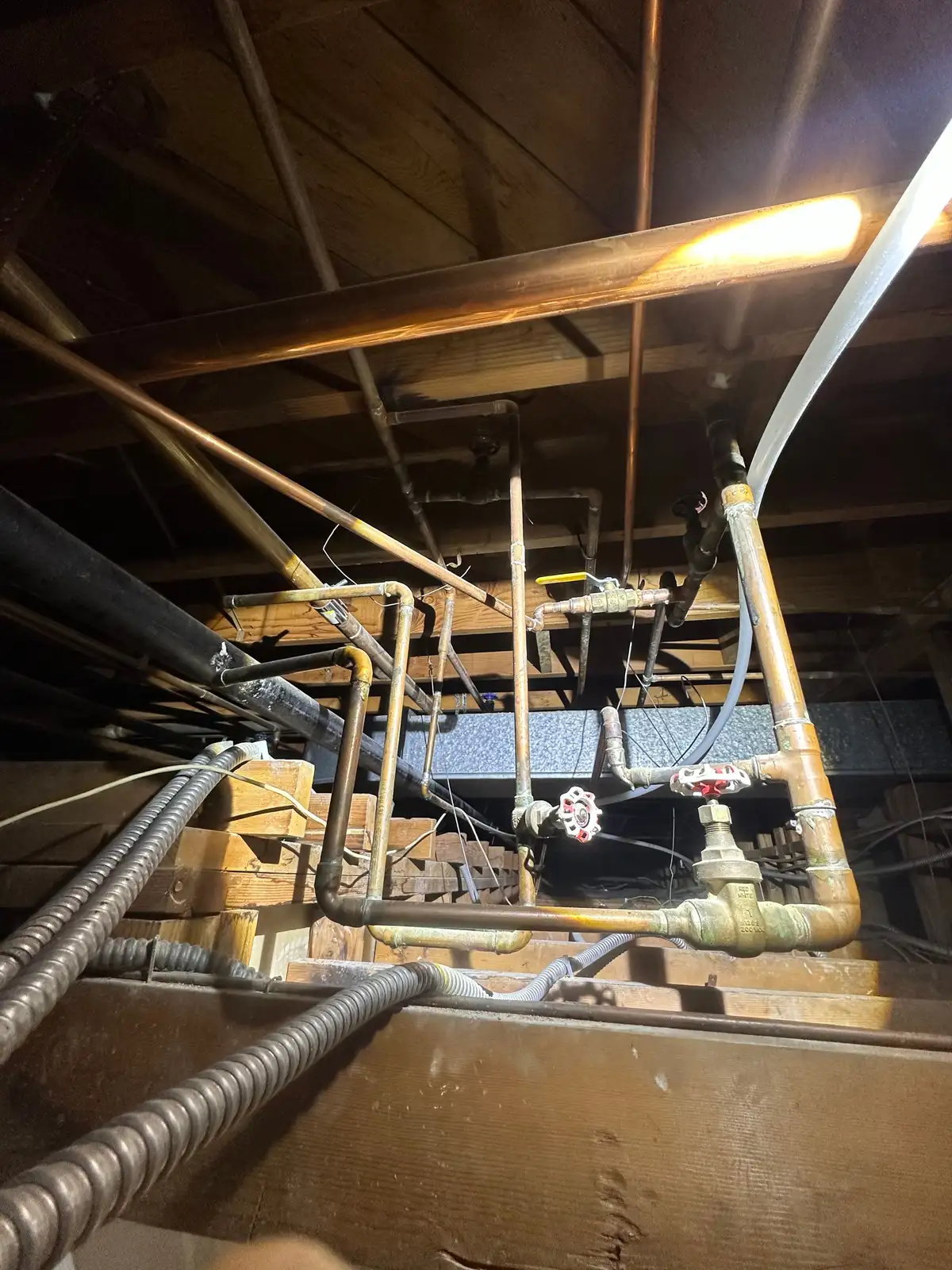
Lawndale's post-war tract housing stock — the 1,200 to 1,600 square foot slab homes built between 1948 and 1965 along the Hawthorne Boulevard Corridor and Marine Avenue — was constructed with galvanized steel supply pipe. That pipe had a useful life of roughly 50 to 70 years. Most of it is now 60 to 75 years old. The math isn't complicated.
When galvanized corrodes from the inside out, water pressure drops, orange-tinted water appears at fixtures, and pinhole leaks start showing up in walls. At that point, patching individual sections doesn't solve the problem — it just relocates it. A full repipe addresses the root cause once, on a defined schedule, at a cost that doesn't compound over years of band-aid repairs.
This guide walks through what a whole-home repipe actually looks like on a standard 1,400 square foot Lawndale slab tract: what happens each day, what decisions get made before work starts, and why the structural predictability of these homes makes scoping — and pricing — more reliable than on custom builds or two-story wood-frame houses.
Why Lawndale slab tracts are well-suited to repipe work
The homes built across Lawndale's post-war grid were designed for efficiency, not complexity. Supply lines run in relatively short horizontal paths between the water main entry and two or three wet walls. There's no basement. Pipe runs don't have to navigate around attic framing or multi-story chases. Once you've opened the wall sections identified in the pre-job mapping, the path from manifold to fixture is usually straightforward.
The slab construction does create one constraint: any lines that were originally run under the slab itself — common in older tract homes — need to be rerouted through interior walls rather than accessed through the concrete. That's standard practice. It avoids slab penetration and actually results in more accessible pipe going forward.
Homes on the Manhattan Beach Boulevard Corridor tend to have had some improvement work done over the decades, which means partial copper replaces in one or two wet walls are common. The pre-job camera scan and pressure test identifies exactly which sections are original galvanized and which have already been updated — so the crew isn't tearing into walls that don't need it.
Before day one: the opening map
No repipe crew should show up on day one without a clear opening map. On a 1,400 square foot slab home, that map identifies the water main entry point, the proposed manifold location, every fixture connection point, the wall sections that need to be opened, and any under-slab lines that will require above-slab rerouting. The map is built from a walk-through with the homeowner and, where necessary, a pressure test and camera scan.
This pre-work step is what allows a fixed-scope quote. If a crew is quoting a Lawndale repipe without having walked the home and mapped the opens, they're estimating — and estimates have a way of expanding once the walls come open. A properly scoped job doesn't have that problem.
The permit is pulled before any work starts. In Lawndale, the repipe permit triggers an inspection at rough-in and a final inspection before wall closure. That's factored into the schedule. Trying to move faster than the inspection schedule is how jobs end up with buried work that fails later.
Day one: manifold install and main line runs
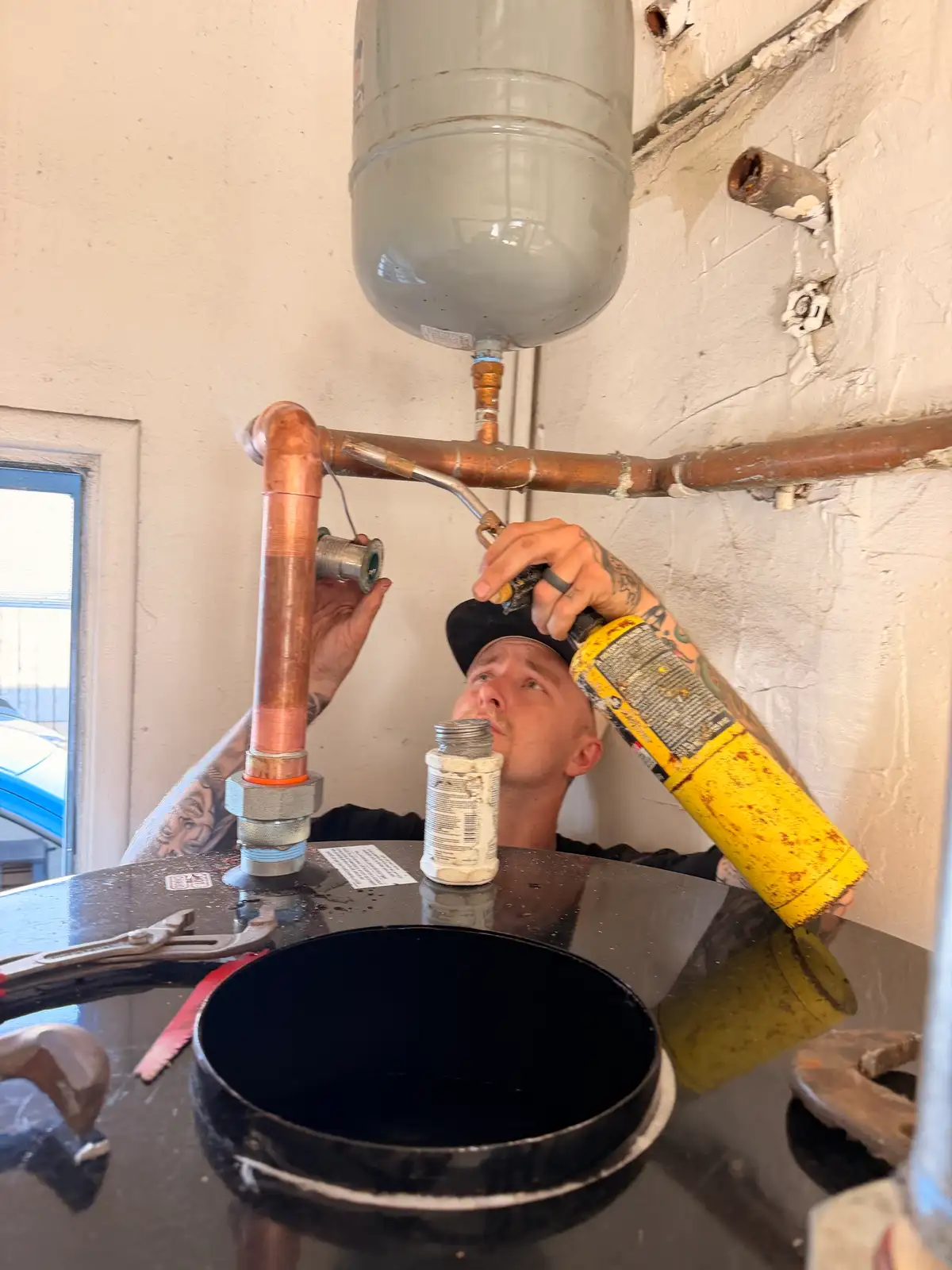
Work starts at the water main entry. The existing galvanized main shutoff is replaced, and the new manifold — typically PEX with individual shutoff valves per circuit — is installed at a location accessible for future service. On a standard Lawndale slab tract, that's usually a utility area near the water heater or in a closet adjacent to the main wet wall.
From the manifold, the crew runs the primary hot and cold trunk lines to the kitchen and bathroom wet walls. These are the longest runs on the job, and getting them right on day one sets the pace for everything that follows. Drywall cuts are made to the minimum size needed to run pipe and secure hangers — not larger.
By end of day one on a standard 1,400 square foot home, the manifold is in, the main runs are roughed, and the bathroom and kitchen wet walls are open and staged for the fixture connections that happen on day two. The water is off during active work but restored at the end of each day so the homeowner isn't without service overnight.
Day two: fixture connections and secondary runs
Day two covers the fixture drops — the individual hot and cold connections at each sink, tub, shower, toilet supply, dishwasher, washing machine, and ice maker. On a two-bathroom, one-kitchen slab home, that's typically 14 to 18 connection points depending on fixture count. Each connection is made at the stub-out, pressure-tested, and tagged on the map before the crew moves to the next one.
Any under-slab line reroutes happen on day two as well. The above-slab path is determined during the opening map phase, so there's no improvising — the reroute path is already marked, the wall sections are already open, and the new pipe follows the agreed route through interior wall cavities to reach the fixture location.
By end of day two, all supply lines are run and connected. The system goes through a full static pressure test before any walls are closed. If there's a failure anywhere in the system, it shows up now — not after drywall is back in place. On jobs where rough-in inspection falls on day two or three, the inspector reviews the open work at this stage.
Day three: inspection, closure, and primer-ready handoff
Once rough-in inspection passes, wall closure begins. On a 1,400 square foot home with a clean opening map, this typically means 12 to 20 individual drywall patches of varying sizes. Patches are cut, fitted, taped, and mudded to a finish that's ready for primer and paint. The crew doesn't paint — that's the homeowner's scope — but every patch is sanded flat and primed where the mud is fully cured.
The final inspection covers the completed system: pressure, connections, manifold labeling, and permit documentation. Once final inspection passes, the permit closes and the homeowner has a documented record of the repipe for insurance and resale purposes. For a [Lawndale repipe](/services/repipes), that documentation has value — buyers and their inspectors increasingly ask for it.
The three-day timeline assumes a single-story slab home with no unusual complications — no previous partial repipes that left conflicting pipe materials in the walls, no asbestos drywall texture that requires abatement before cuts, no permit delays. If any of those factors are present, they're identified before the job starts and the schedule is adjusted accordingly. The point of the opening map is to eliminate surprises, not ignore them.
Why scope predictability drives price predictability
Lawndale's tract homes are, by design, repetitive. The same floor plans appear dozens of times across the same streets. A 1,200 square foot two-bedroom on Marine Avenue and a 1,400 square foot three-bedroom off Inglewood Avenue share the same basic wet wall layout, the same slab construction, and the same original pipe material. That repetition means the crew has seen the exact job before — sometimes dozens of times.
That familiarity translates directly into pricing reliability. When the scope is clear before day one, there's no reason for change orders driven by discoveries inside the walls. The [whole-home repipe process](/services/repipes) on these homes has been refined across enough jobs that the opening map accounts for the variables that actually matter: partial prior replaces, fixture count, and whether under-slab reroutes are needed.
Homeowners in Hollyglen and Bodger Park who get multiple repipe quotes sometimes see wide price variation. That variation usually reflects scope differences, not contractor margin differences. A quote that doesn't include drywall closure, permit fees, or under-slab reroutes will look lower — until it doesn't. Ask what's included before comparing numbers.
What to do next
If your Lawndale home was built before 1965 and still has original galvanized supply, the question isn't whether to repipe — it's when. Waiting for a pinhole leak to force the issue means doing the job on a compressed timeline, often with water damage in the walls as a complicating factor.
The Mainline crew, Licensed C-36 #901735, has completed whole-home repipes across Lawndale's tract housing stock. We pull the permit, map the opens before day one, and hand off walls that are ready for primer. Call (310) 808-7343 to schedule a walk-through and get a fixed-scope quote — not an estimate.
Tags
Related Services