A dripping outdoor faucet gets ignored longer than almost any other plumbing problem. It's outside, it's not flooding anything, and it feels minor. But a hose bib leaking at the spout or at the wall can waste hundreds of gallons a month, and in some cases it signals a supply line issue that compounds quietly behind your stucco. The good news: most of the time, the problem is the bib itself — and a straight replacement takes a competent plumber about 45 minutes.
What stretches that 45-minute job into a 4-hour wall-opening is a misdiagnosis. If a homeowner or an under-equipped technician can't isolate whether the leak is at the bib body, the packing nut, or behind the wall at the supply connection, the default move is often to open the wall. That's sometimes necessary. It's also frequently not. Understanding what you're looking at before anyone touches a wrench saves you time, drywall, and money.
This guide covers how frost-free and standard hose bibs differ, where leaks actually originate, and how the diagnostic should drive the repair scope — not the other way around.
Frost-free vs. standard hose bibs: what's actually different
A standard hose bib has its valve seat right at the exterior wall. When you turn the handle, the washer compresses against the seat an inch or two behind the spout. Simple, cheap, and adequate in climates where freezing isn't a concern — which describes most of the South Bay most of the year.
A frost-free hose bib (also called an anti-siphon or freezeless bib) has a longer stem — typically 6 to 12 inches — that pushes the valve seat deep inside the wall, where temperatures stay above freezing. When you shut it off, any water left in the exterior pipe section drains out, so there's nothing to freeze and expand. In coastal South Bay neighborhoods like the Sand Section in Manhattan Beach or the Esplanade in Redondo Beach, where overnight temps rarely drop below 40°F, this isn't a freeze-protection issue. But frost-free bibs also carry a built-in anti-siphon vacuum breaker that prevents contaminated outdoor water from back-flowing into your supply — which is a plumbing code requirement in California regardless of freeze risk.
Most post-1990 construction in the South Bay uses frost-free bibs by code. Pre-1970 homes in neighborhoods like Old Torrance, Old Gardena, or Moneta are more likely to have standard bibs — and those are the ones most likely to be past their service life.
Where the leak is actually coming from
Not all outdoor faucet leaks are the same, and the location of the drip tells you almost everything about the fix. There are four distinct leak points: the spout, the packing nut (the collar just behind the handle), the vacuum breaker cap on top of the bib, and the wall connection where the bib threads or solders onto the supply line.
A spout drip that only occurs when the bib is open usually means a worn washer or O-ring inside the valve — a repair, not a replacement. A spout drip when the bib is fully off is more likely a failed valve seat or a worn stem, and at that point replacement is often cheaper than repair labor. A leak at the packing nut can sometimes be fixed by tightening the nut a quarter turn, or by repacking it with plumber's grease and new packing string — but only if the bib body itself isn't corroded.
A leak at the vacuum breaker cap — the small plastic or brass fitting on top of the bib — is its own problem. The vacuum breaker has a spring-loaded check that can fail, especially on older bibs that get heavy use. Sometimes the cap just needs to be tightened; often the vacuum breaker assembly needs to be replaced separately. It's a $12 part.
The one that requires the most care to diagnose is a leak at the wall — where the bib meets the supply. If water is weeping from behind the escutcheon plate (the trim ring against the siding), or if you see staining on the exterior wall below the bib, the connection itself may be failing. On a soldered copper connection, that means the solder joint has cracked — often from years of thermal cycling or someone overtightening the bib body. On threaded galvanized connections, it's usually thread corrosion. Either can be fixed without opening the wall if the leak is at the very end of the supply stub-out. If the failure is 6 or more inches back into the wall cavity, that's when selective wall access makes sense.
The 45-minute replacement — what it actually involves
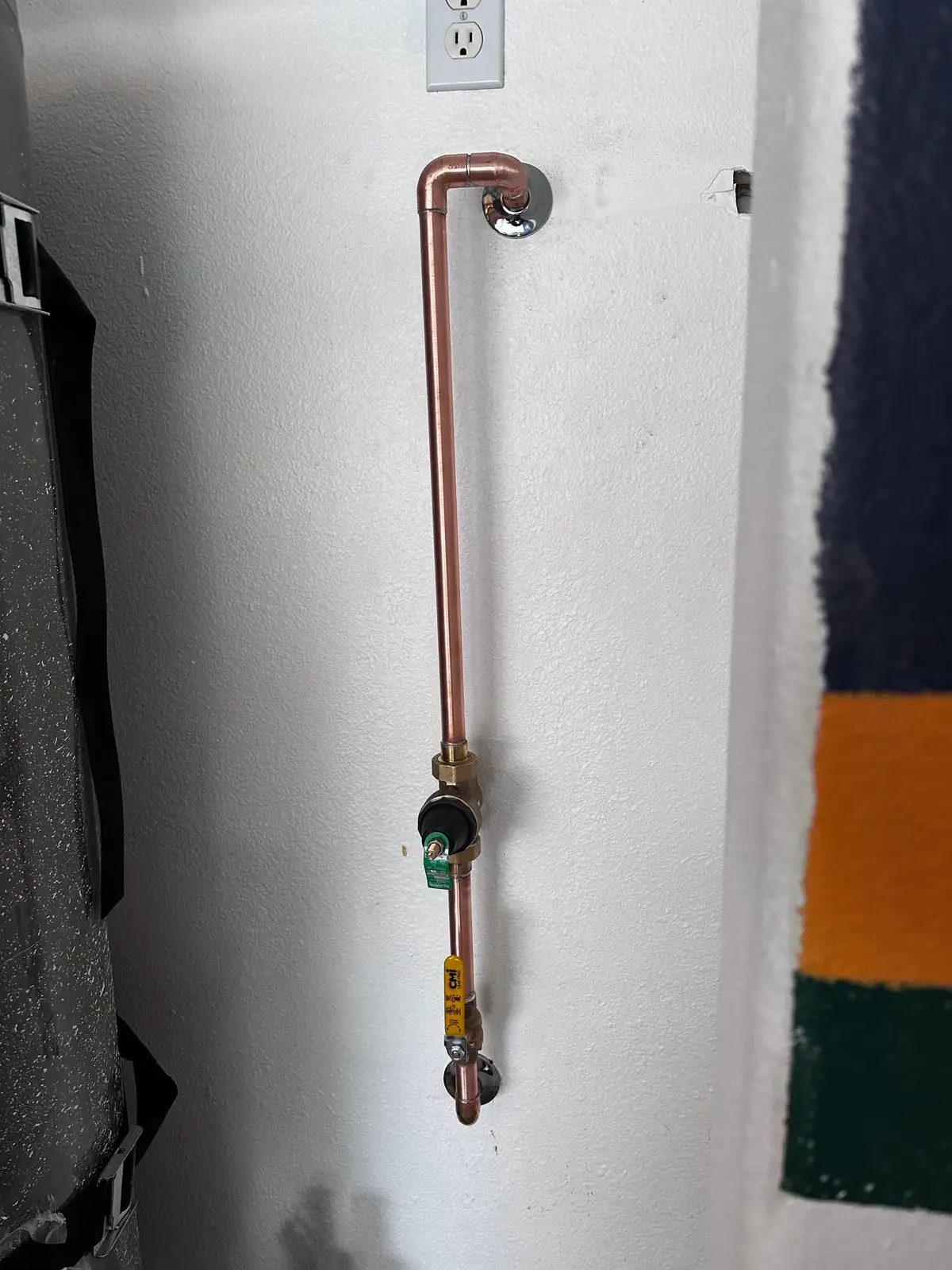
A straightforward hose bib replacement on a copper supply line runs like this: shut off the water at the main or at a dedicated shutoff if one exists close to the bib, drain the line, cut or unsweat the old bib, prep the stub-out, and solder on a new frost-free bib of the correct stem length. The stem length matters — it has to match the wall thickness so the valve seat lands inside the conditioned or insulated wall cavity, not in the middle of a stud bay.
On homes in areas like Hollyglen in Hawthorne or Carlson Park in Culver City — 1950s and 1960s tract construction with standard 2×4 framing — the stem length is typically 6 inches. Homes with added exterior insulation or thicker walls may need 8 or 10 inches. Getting this wrong means the vacuum breaker and valve seat end up in the wrong position relative to the wall face, which causes the exact drainage issues frost-free bibs are designed to prevent.
The whole job, done correctly by someone who has done it before, takes 30 to 45 minutes including pressure testing. The parts cost $15 to $40 depending on bib quality and whether you use a standard big-box unit or a solid brass body. The job only becomes complicated if the supply stub-out is corroded galvanized, if the wall access behind the bib is blocked by insulation or fire blocking, or if the shutoff upstream doesn't hold — which is its own diagnostic flag.
When wall access is actually necessary
Wall opening is warranted in three scenarios: the leak is confirmed to be at a supply connection deeper than the stub-out, the stub-out itself is galvanized and corroded back several inches, or a frost-free bib replacement requires extending the copper stub-out to the correct depth and there's no access from the exterior.
What it is not warranted for: exploratory fishing because the technician isn't sure where the leak is. A visual inspection of the bib, a dry cloth test to isolate exactly where water is appearing, and if needed a 20-minute [camera inspection or leak detection](/services/trenchless/leak-detection) pass near the supply connection will tell you whether you're opening a wall before any drywall gets cut. That diagnostic step costs less than the wall patch.
If a homeowner is told the wall needs to open before anyone has done a proper isolation test, that's worth questioning. Ask specifically: what evidence, visible right now, tells you the leak is behind the wall rather than at the bib or stub-out connection? The answer should be concrete.
Galvanized supply and older South Bay homes
The most common complication in hose bib replacement across South Bay cities isn't the bib itself — it's what the bib is attached to. A significant portion of pre-1970 housing stock in Gardena, Lawndale, and older sections of Carson has galvanized steel supply lines. Galvanized corrodes from the inside out over decades, and the stub-out feeding the hose bib is often the first place exterior corrosion becomes visible because it's exposed to weather cycling.
When we unscrew a standard hose bib from a galvanized stub-out and the threads crumble, the job changes. At minimum, we're replacing the stub-out back to the next fitting. If that fitting is also corroded — which it usually is at the same rate — we're tracing back further. At some point the math favors a targeted section repipe rather than chasing a 55-year-old galvanized supply joint by joint. If you're already dealing with low pressure or rust-tinted water from other fixtures, a hose bib replacement is a reasonable prompt to scope the broader supply condition. Our [general plumbing services in Gardena](/service-areas/gardena) include exactly this kind of supply assessment as part of the job, not as an add-on.
On copper supply — which is standard in most post-1970 South Bay construction — the stub-out is almost always reusable. The bib swaps in and out without drama unless someone previously used a pipe wrench on the bib body and cracked the copper at the fitting. That's a $50 copper repair before the replacement proceeds.
Anti-siphon compliance and permit requirements
California's plumbing code requires outdoor hose bibs to have backflow prevention — either an integral vacuum breaker built into the bib body, or a separate hose bib vacuum breaker screwed onto the spout. Frost-free bibs manufactured after roughly 2000 have the vacuum breaker built in. Older standard bibs often don't, and a screw-on vacuum breaker added to the spout is acceptable for code compliance in most jurisdictions.
Replacing a like-for-like hose bib in most South Bay cities doesn't require a permit — it's considered a repair of an existing fixture. Installing a new bib where one didn't previously exist, or adding a second hose bib connection to the supply, typically does require a permit. If you're running a new supply line for an outdoor kitchen, a separate garden bib, or a drip irrigation connection, that's permit territory. For [general plumbing](/services) work at that scope, permitting is part of the job.
What to do next
If your outdoor faucet is dripping at the spout when closed, weeping at the wall collar, or the handle spins without fully stopping flow, it's worth getting a proper diagnosis before assuming you need wall access. Most hose bib replacements in the South Bay are same-day jobs — the part is on our truck, the shutoff is usually accessible, and the job is done in under an hour.
Mainline No-Dig Trenchless Plumbing is a Licensed C-36 #901735 contractor serving 16 South Bay cities from our Lomita headquarters. We carry frost-free bibs in multiple stem lengths and can assess whether a failing stub-out changes the scope before we commit to a repair path. Call us at (310) 808-7343 to schedule or get a same-day assessment. Dispatch runs 24/7.
Tags
Related Services