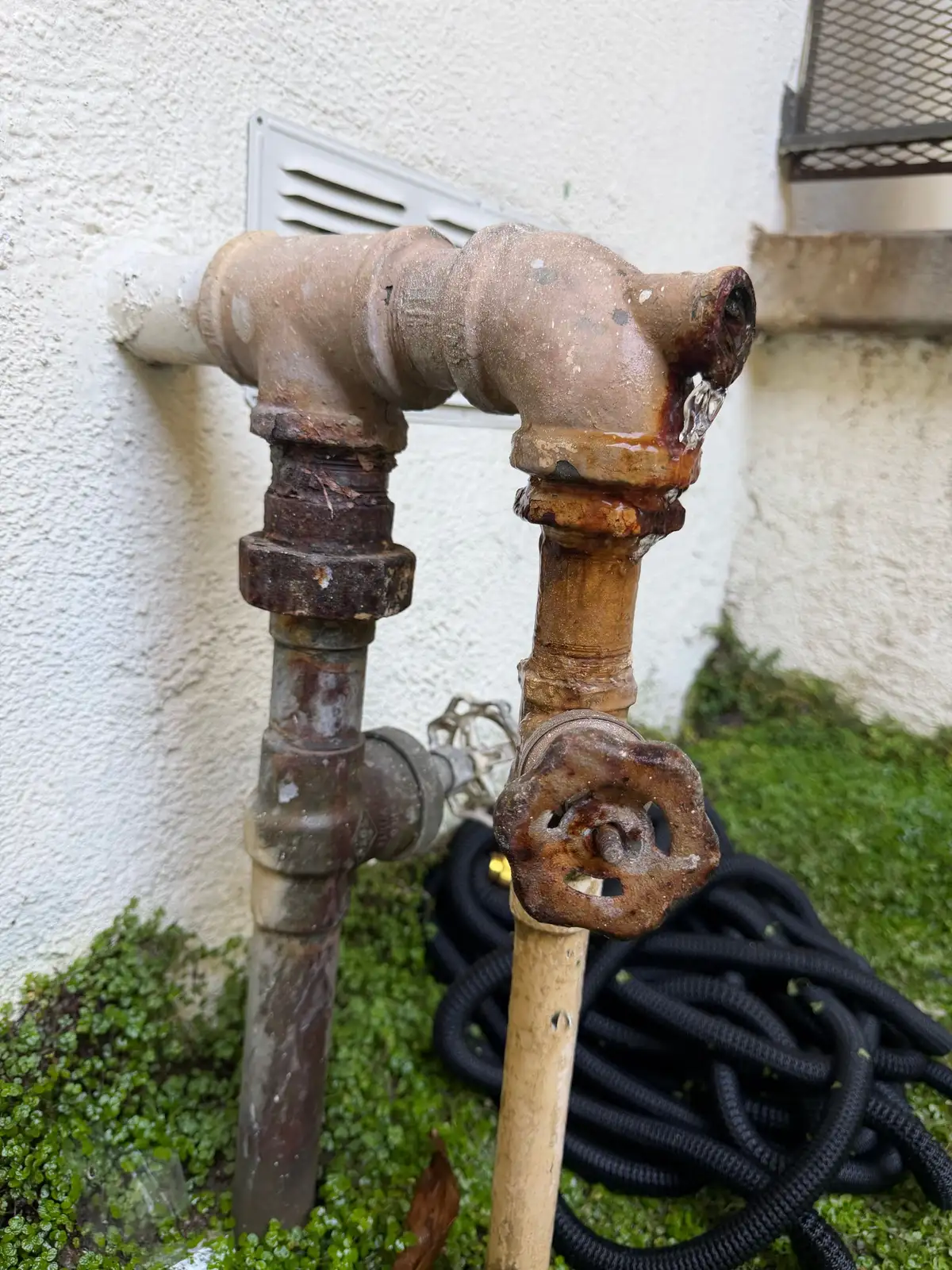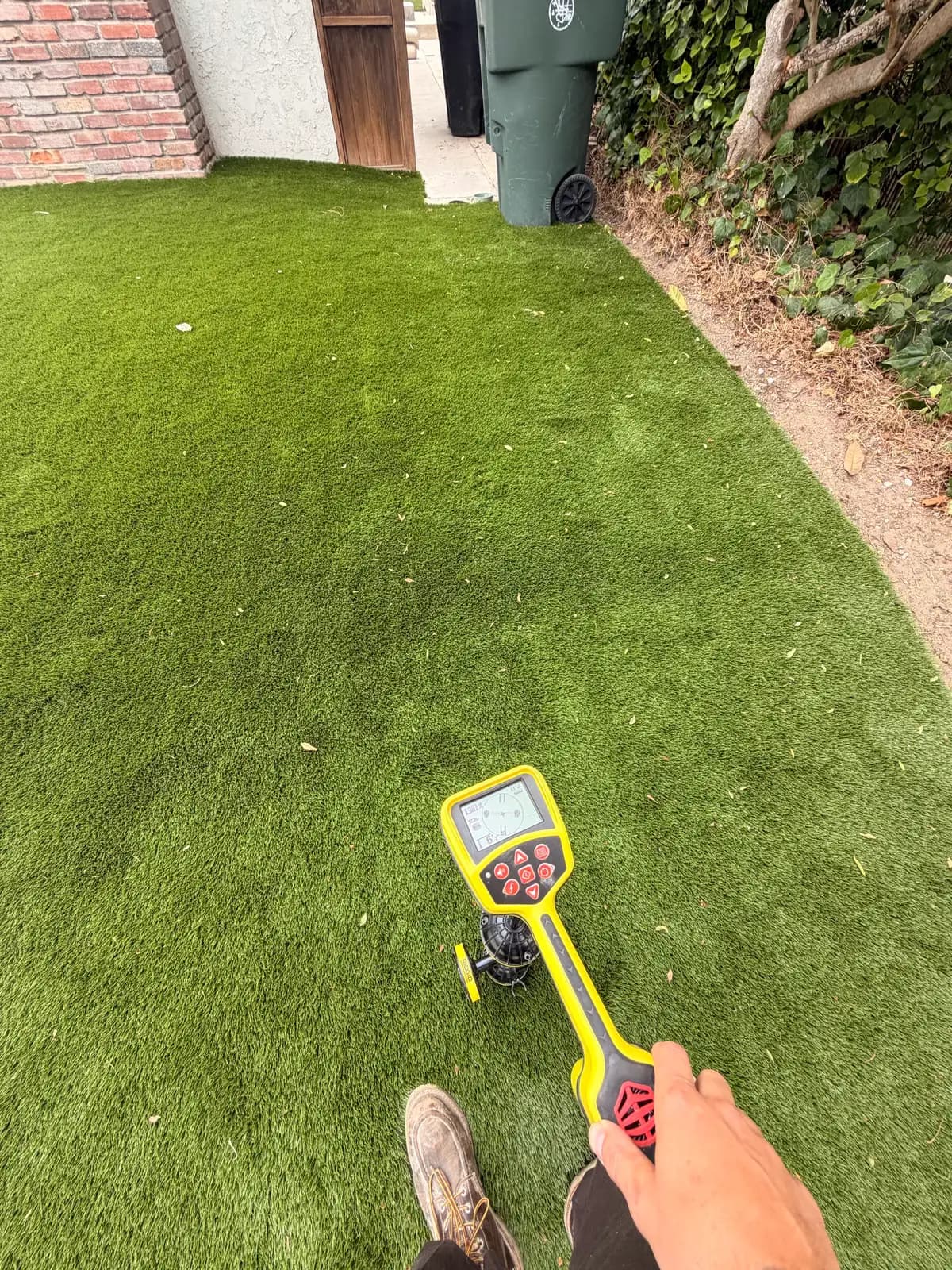
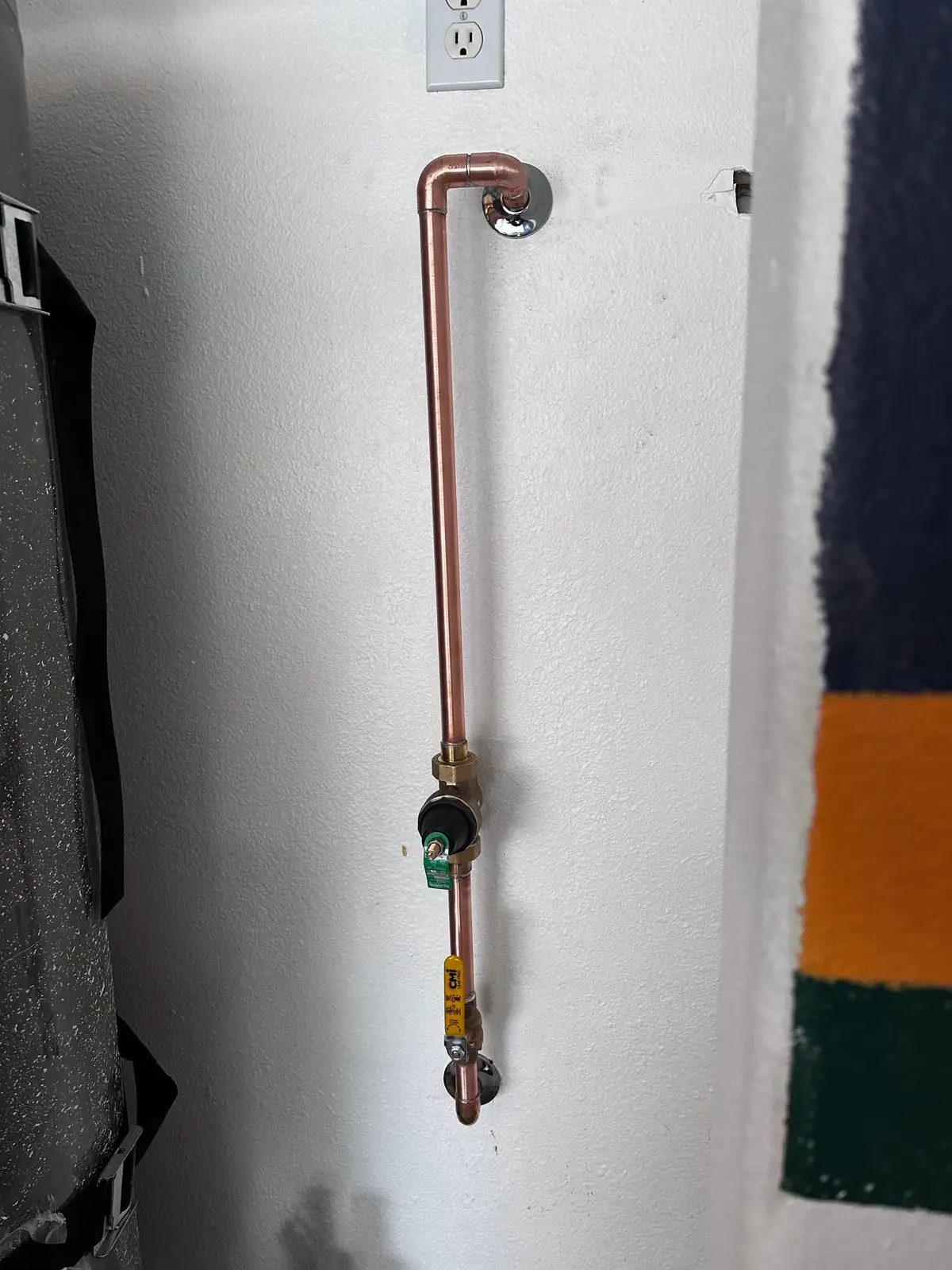
Most South Bay homeowners never think about the [pressure regulator valve](/services/water-pressure-regulator) — the bell-shaped brass fitting bolted to the supply line near where it enters the house, usually within a few feet of the meter. It's out of sight, it doesn't make noise when it's working correctly, and it doesn't show up on any maintenance reminder list. It also silently prevents the municipal water main from destroying everything downstream of it.
The water main pressure delivered to South Bay homes routinely runs between 90 and 110 psi. In some stretches of Gardena and Carson, it peaks higher during off-peak hours. The fixtures, valves, washing machine hoses, and water heater fittings in your home are rated for 80 psi — most manufacturers specify 60–80 psi as their acceptable operating range. A functioning PRV keeps your house pressure in that range. A failed one doesn't.
This post covers how to test whether your PRV is doing its job, what the failure modes actually look like, and why a $250 part-and-labor repair is worth prioritizing before a burst washing machine hose floods a kitchen or a water heater relief valve starts weeping under chronic overpressure.
What a PRV actually does — and doesn't do
A pressure regulating valve is a spring-loaded diaphragm device. Water from the main enters at high pressure, the diaphragm compresses against the spring, and the valve throttles flow to maintain a set downstream pressure — typically 50–75 psi out of the box. Most manufacturers set them to around 60 psi at the factory. You can adjust the set point with a screw on top of the dome.
A PRV is not a shutoff valve and it's not a pressure relief valve. It doesn't stop flow — it modulates it. When the diaphragm or seat wears out, it can fail in two directions: it can stick closed (very low or no pressure downstream), or more commonly, it can fail open (unregulated main pressure passes straight through). The second failure mode is the one that causes damage, and it can happen gradually over months before anyone notices.
PRVs have a service life of roughly 10–15 years under normal conditions. South Bay coastal corrosion, sediment from aging mains, and thermal cycling in homes near the coast — Redondo Beach, Hermosa Beach, El Porto in Manhattan Beach — shorten that window. If your PRV was installed with the original plumbing and the house was built in the 1970s or 1980s, it's been due for replacement for some time.
Testing your pressure in 10 minutes
A hose bib pressure gauge costs $10–$15 at any hardware store. Thread it onto an outdoor hose bib, open the bib fully, and read the static pressure. Do it twice — once in the morning during peak demand, and once late at night or early morning when demand is low. The overnight reading is the one that matters most, because that's when street pressure climbs and a failed PRV passes the full load to your supply lines.
Pressure above 80 psi at the hose bib means your PRV is either not installed, set too high, or failing. Above 90 psi is a repair-now situation. If you're seeing pressure fluctuate widely between the two tests — say, 65 psi at noon and 105 psi at 2 a.m. — that's a clear sign the PRV is losing its ability to regulate consistently.
One more useful test: close all fixtures and check whether pressure climbs slowly over time while everything is off. Thermal expansion in a closed system will cause minor pressure rise naturally, but if your pressure gauge shows an uninterrupted climb past 80 psi with no fixtures running, the PRV is not holding set point. That test also helps distinguish a failing PRV from an unrelated supply line issue.
What high pressure is actually doing to your house
The most immediate casualties are rubber-seated components: washing machine hoses, toilet fill valves, the flexible supply lines under sinks and behind toilets, and dishwasher inlet valves. These parts are designed for consistent pressure in the 60–80 psi range. Running them at 100+ psi continuously is the rough equivalent of overinflating a car tire by 40% and leaving it in the sun. The failure isn't always visible until a hose lets go.
Water heaters take the punishment differently. Most tank water heaters are rated to 150 psi working pressure, but the temperature and pressure relief valve is typically set at 150 psi and 210°F. What chronic high pressure does is cause the T&P valve to weep — small, repeated discharges that signal the valve is working as intended, but the root cause is uncontrolled supply pressure. We see T&P valves and their discharge pipes replaced as a symptom fix in Torrance and Hawthorne homes routinely, when the actual fix is the PRV upstream. On [general plumbing service calls](/services) that involve unexplained T&P valve discharge, checking supply pressure is step one.
Tankless water heaters are more sensitive still. Most units have maximum inlet pressure ratings between 150 and 200 psi, but the internal heat exchangers, check valves, and flow sensors are calibrated for steady-state pressure in the 60–80 psi range. Chronic overpressure accelerates wear on those components — and unlike a tank heater, a tankless repair isn't a $30 anode rod swap. It's a $400–$900 service call at minimum.
Neighborhoods and housing stock where PRV failure is more common
Older housing stock that hasn't had a full plumbing update is the highest-risk category. That puts Pre-WWII blocks in Old Gardena and Moneta near the top of the list — homes that were plumbed in the 1940s and 1950s may have original PRVs that have never been replaced, or no PRV at all if it predates widespread municipal pressure regulation. Similarly, the Post-War tract neighborhoods in Hawthorne — Hollyglen, Holly Park — saw enormous build-outs through the 1950s and 1960s, and a PRV from that era is well past its reliable service window.
Hillside properties in Rolling Hills Estates and Palos Verdes face a different problem. Elevation changes mean pressure varies significantly between the street and the house depending on whether you're uphill or downhill of the main. On downhill runs, gravity adds to street pressure — you can have 90 psi at the street and 110 psi at the hose bib without any PRV failure at all, simply because of head pressure differential. Those homes need PRVs set conservatively and inspected more often.
Coastal areas — the Strand-adjacent blocks in Hermosa Beach, the Esplanade properties in Redondo Beach — see accelerated PRV diaphragm degradation from salt-air humidity. The brass body resists corrosion reasonably well, but the internal rubber components degrade faster in those environments. A 10-year replacement cycle is more realistic than 15 years for homes within a quarter mile of the water. For Redondo Beach homeowners specifically, our [Redondo Beach general plumbing](/service-areas/redondo-beach) work regularly turns up PRV failures that have been running undetected for years.
What PRV replacement actually involves
The typical replacement is a 1–2 hour job for a licensed plumber. The main supply line needs to be shut off at the meter, the old valve is cut out, the new valve is sweated or threaded in (depending on the connection type), and pressure is set and verified before the job is closed. On most South Bay homes, the PRV is accessible at the front exterior wall, in a crawlspace, or inside a utility closet — none of those require significant demolition.
Parts cost runs $80–$150 for a quality valve from Watts, Wilkins, or Cash-Acme. Labor on a straightforward replacement runs $150–$250 in the South Bay, making the all-in cost $250–$400 for a standard single-family home. That number goes up if the existing valve is in a difficult location, if the surrounding pipe is corroded and needs replacement in the same scope, or if the shutoff at the meter is itself failed and needs to be pulled at the same time.
A new PRV should be set between 60 and 75 psi for most residential applications. Some homeowners with large lots or multi-story homes request a slightly higher set point for upper-floor pressure — 70–75 psi downstream of the PRV is usually a reasonable compromise that protects fixtures without starving the upper floors. That set point should be verified with a gauge at the hose bib after installation, not assumed based on the adjustment screw position alone.
When PRV replacement is part of a larger scope
If your pressure test reveals a failed PRV and you've been running unregulated 100+ psi supply for an extended period, don't assume replacing the PRV closes the issue. A thorough check of the flexible supply lines under every fixture — kitchen and bathrooms — is worth doing at the same time. Braided stainless lines that have been pressurized well above their rated range for years are time bombs. Replacing them during the same service call adds minimal cost and eliminates the risk of a line failing months later.
Water heater T&P valves that have been weeping under chronic overpressure should be replaced if they've been discharging. A T&P valve that has opened and reseated multiple times under thermal-expansion events doesn't always reseat cleanly — a partial seal is worse than a full discharge because it allows slow, continuous water loss that's easy to miss until the relief pipe is running constantly. This is a $30–$60 part and a 30-minute repair, and it's worth doing as part of the same visit. For homes with [general plumbing service needs](/service-areas/carson) that span multiple systems, addressing the pressure root cause and the downstream component damage in one scope avoids a second service call six months later.
In homes with galvanized supply — Gardena, Lawndale, older Hawthorne stock — high-pressure operation accelerates the interior scaling and pin-hole failure rate that galvanized pipe already trends toward at end of life. If you're replacing the PRV in a home with original galvanized supply and you're already seeing pressure-related symptoms, that's the right moment to have a repiping conversation. The PRV repair is not a substitute for addressing pipe condition, but it stops the pressure from accelerating the deterioration further while you plan the larger scope.
Why San Pedro sees more pressure complaints than the flat cities
San Pedro generates a disproportionate share of the pressure calls we take, and elevation is the reason. The city climbs from the harbor to well over 400 feet, and municipal systems serving that kind of grade have to hold enough head pressure at the top of the zone to deliver adequate flow. Homes near the bottom of a pressure zone receive the surplus.
The practical result is that a house on the lower slopes can be sitting at 100 psi or more at the meter, where 40 to 60 psi is the target at the fixture. A working PRV absorbs that difference invisibly for years, which is precisely why its failure is so often misdiagnosed as something else — a bad fill valve, a noisy line, a water heater problem.
The tell is that the symptoms cluster. Multiple toilets running on, several faucets dripping, water hammer that appeared recently, a water heater relief valve weeping, and a jump in the bill are not five separate problems. They're one regulator that stopped regulating. If you're seeing more than two of those at once, test the static pressure before replacing any fixture.
What to do next
If you haven't tested your house pressure recently — or ever — get a $10 gauge on the hose bib this week. An overnight reading above 80 psi warrants a service call. A reading above 90 psi warrants one this week. A reading above 100 psi is a same-day repair situation if you have flexible supply lines or an aging water heater on that system.
Mainline No-Dig Trenchless Plumbing is a Licensed C-36 #901735 contractor serving 16 South Bay cities out of our Lomita headquarters. We carry PRV stock on the truck, verify set pressure with a gauge before closing, and check the downstream components — supply lines, T&P valve, shutoff condition — as part of the same visit. 24/7 dispatch, 25–45-minute target response for emergency calls. Call (310) 808-7343 to schedule a pressure check or PRV replacement.
Frequently Asked Questions
Can a water pressure regulator go bad?
Yes, routinely. PRVs are wear parts with a typical service life of 10 to 15 years. They fail in two directions — stuck open, passing full municipal pressure to the house, or stuck closed, choking flow. Stuck open is the more damaging and the more common.
What are the symptoms of a failing pressure regulator?
Toilets that run on after filling, faucets dripping at multiple fixtures, water hammer that recently appeared, a water heater relief valve weeping, and an unexplained rise in the water bill. The signature is several of these at once rather than one isolated fixture problem.
How do I test my water pressure?
Thread a pressure gauge onto an exterior hose bib and open it fully with no water running inside. Anything above 80 psi is over the code limit and needs correction. South Bay municipal pressure commonly arrives at 90 to 110 psi at the meter, so a healthy reading means your PRV is doing its job.
How much does it cost to replace a water pressure regulator?
The valve itself is a modest part; most of the cost is access and labor, and the total typically lands in the several-hundred-dollar range for a straightforward replacement at the main. Cost rises when the PRV is buried in a box, behind hardscape, or paired with a corroded shutoff that needs replacing at the same time.
What damage does high water pressure actually cause?
It shortens the life of every valve, supply hose, and appliance connection in the house simultaneously. Washing machine and dishwasher inlet valves fail early, toilet fill valves wear out, and braided supply lines burst. High pressure doesn't cause one failure — it accelerates all of them.
Do I need a pressure regulator if my pressure seems fine?
If static pressure at the hose bib is under 80 psi you're within code and don't need one. Test before assuming. Many South Bay homes already have a PRV installed at the main and the owner has never known it was there until it failed.
Tags