South Bay tap water isn't dangerous. The Metropolitan Water District tests it continuously, and it meets federal safe drinking water standards. But 'safe' and 'good for your plumbing' are different questions. The water coming into most South Bay homes carries three problems that cost real money over time: hardness that scales your water heater and fixtures, chloramine that wears on rubber seals and affects taste, and sediment that accelerates appliance wear. Understanding which problem you actually have is the only way to choose filtration that pays back.
Most homeowners get sold a whole-home system without a clear picture of what it's treating. A water softener installed without a sediment pre-filter will foul its resin bed within a few years. A carbon filter installed where hardness is the primary problem won't stop scale. This guide maps each of the three South Bay water-quality issues to the equipment that addresses it, and explains where combinations make sense versus where they're just added cost.
South Bay water quality: the actual numbers
Most South Bay cities draw water from a blend of local groundwater and MWD imported supply from the Colorado River and State Water Project. The Colorado River blend is notably hard — typically 275–400 mg/L as calcium carbonate, which puts it well into the 'very hard' classification. The State Water Project supply runs softer, around 100–180 mg/L, but the blend shifts seasonally. What comes out of your tap in Torrance in August may be measurably harder than what came out in February.
Chloramine has replaced free chlorine as the primary disinfectant in most MWD-supplied South Bay water since the early 2000s. Chloramine is more stable than chlorine, which is why the utility prefers it — it persists through the distribution system without dissipating. That stability is also why carbon filtration takes longer to reduce it compared to free chlorine. Standard activated carbon works, but it requires longer contact time or catalytic carbon media to be effective at the whole-home scale.
Sediment is most relevant in older distribution areas. Neighborhoods like Old Torrance, Old Gardena, and portions of San Pedro with aging water mains occasionally push fine particulates into supply lines during pressure changes. Even new construction can see sediment during the early months after a meter set. A baseline sediment test at your tap costs under $50 and tells you whether a pre-filter belongs at the head of your system.
The hardness problem: what it actually does to your plumbing
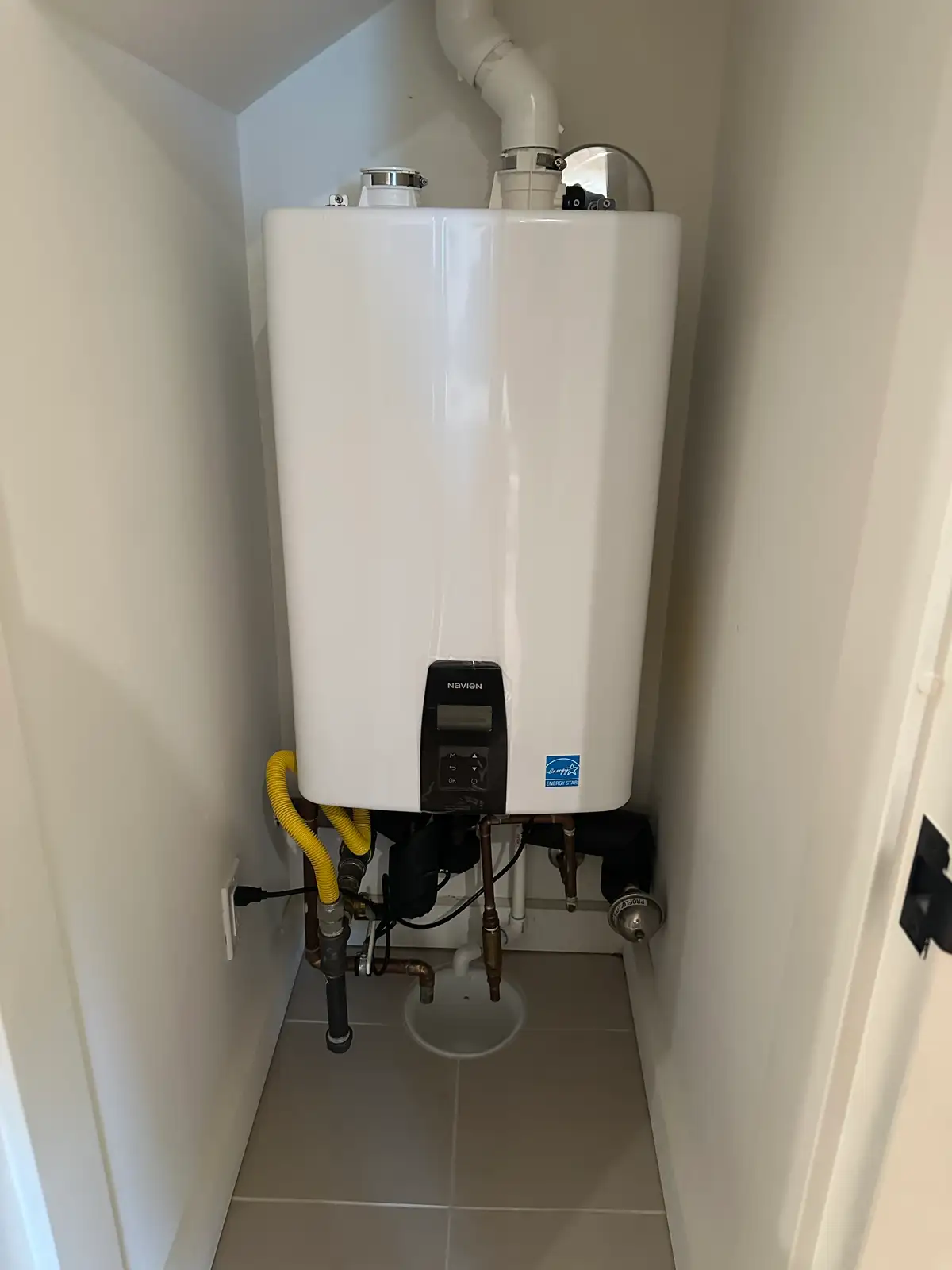
Scale is calcium and magnesium carbonate precipitating out of solution when water is heated. The hotter the water and the longer it sits, the more scale forms. A tank water heater operating at 120°F with very hard water will develop a scale layer on its heat exchanger that measurably reduces efficiency within 2–3 years. Tankless units are more sensitive — a Navien or Rinnai unit with no softening installed in a Redondo Beach home drawing hard Colorado River blend can require descaling within 18–24 months of installation.
Beyond water heaters, scale affects shower valves, dishwasher heating elements, ice makers, and washing machine fill valves. The cumulative cost is less visible than a single burst pipe, but it's real. A water softener rated for your household's daily gallonage and grain count addresses this at the source. Properly sized and maintained, it extends the service life of every hot-water appliance in the house.
Salt-based ion exchange softeners remain the most cost-effective hardness solution for whole-home treatment. Salt-free 'conditioners' using template-assisted crystallization (TAC) technology reduce scale formation but don't actually remove hardness minerals — they alter the mineral's behavior so it's less likely to adhere to surfaces. TAC is worth considering if you want to avoid salt handling or have a small lot without room for a brine tank. But don't expect identical results to a true ion exchange unit — they're different technologies with different mechanisms.
The chloramine problem: what carbon filtration actually does
Chloramine affects taste and odor, and it gradually degrades certain rubber compounds — specifically elastomers used in older faucet washers, toilet fill-valve seals, and water heater flexible connectors. In homes built before the shift to chloramine in the early 2000s, the original rubber seals were formulated for free chlorine, not chloramine. If you're replacing faucet washers or fill valves more often than you'd expect, chloramine degradation is a plausible contributor.
Whole-home carbon filtration targets chloramine effectively when the system uses the right media and is properly sized. Catalytic activated carbon — most commonly in the form of a large-format tank filter installed at the main line — provides enough contact time to reduce chloramine to near-zero at typical residential flow rates. Standard granular activated carbon (GAC) in a smaller housing can reduce chloramine but requires slower flow or more frequent media replacement to maintain performance.
Media replacement is the part most homeowners underestimate. Carbon becomes saturated and must be replaced — typically every 3–5 years for a whole-home catalytic carbon tank, or annually for a smaller cartridge-style system. A system that hasn't had its media replaced is no longer filtering. If you have an existing whole-home carbon filter and can't recall the last time the media was serviced, assume it needs replacement.
The sediment problem: when a pre-filter earns its cost
Sediment filters are the simplest and cheapest filtration component — a 10-inch cartridge housing with a 5-micron or 10-micron polypropylene filter element installed at the main line. They don't address chemistry. They catch particles. For most South Bay homes on city water, a sediment pre-filter is useful insurance rather than a critical necessity. For homes in neighborhoods with older distribution infrastructure, or after any main-line work in your street, they become more important.
The primary reason to install a sediment pre-filter in a multi-stage whole-home system is equipment protection. Fine sediment loads accelerate wear on a water softener's control valve and resin bed. It can clog the small orifices in tankless water heater heat exchangers. A $20–$30 cartridge changed twice a year protects components that cost hundreds or thousands to replace or repair. In a properly designed whole-home system, the sediment pre-filter goes first, before softening or carbon treatment.
Which combinations make sense — and which don't
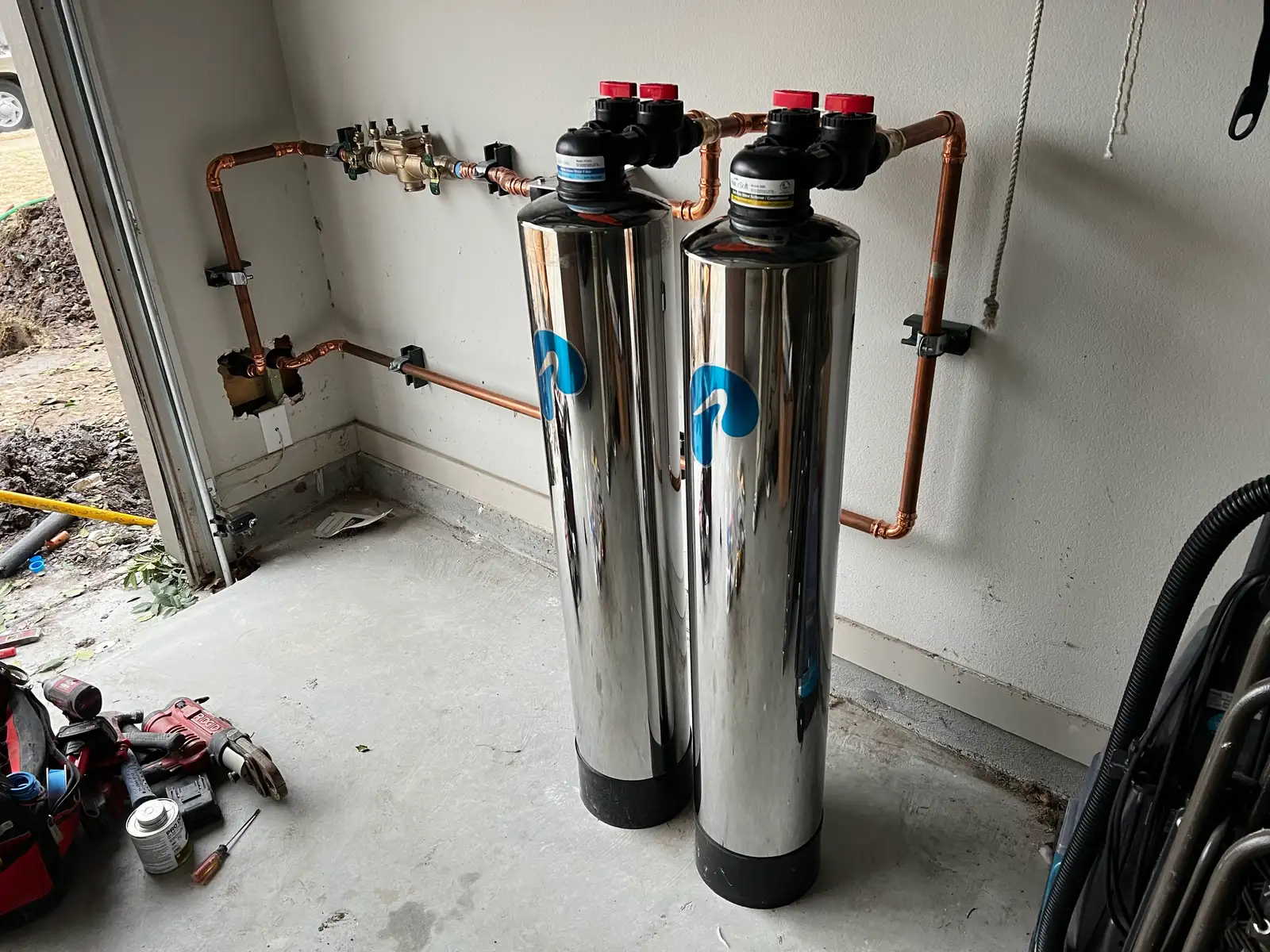
The most practical whole-home configuration for a South Bay home on hard city water with chloramine is a three-stage approach: sediment pre-filter, then ion exchange softener, then catalytic carbon tank. This sequence matters. Carbon media is sensitive to high hardness — operating a carbon filter on unsoftened hard water can cause calcium precipitation inside the media bed. The softener goes before the carbon, not after.
Homeowners who want filtered drinking water at the kitchen tap but don't want to soften the whole house sometimes pair a point-of-entry sediment filter with a point-of-use reverse osmosis system under the kitchen sink. An RO unit removes hardness, chloramine, nitrates, and most other dissolved solids from drinking and cooking water. It doesn't protect the rest of the plumbing or appliances, but it addresses the health and taste concerns directly and at lower upfront cost.
Where combinations become wasteful is when equipment is stacked without a clear target. A softener plus a whole-home carbon filter plus an RO at the tap is three layers of treatment. That may be warranted in some cases, but in most South Bay homes on city water, two of those three systems will do the job. Start with a water test. A basic hardness, pH, and TDS test costs under $60 at most hardware stores or through a lab. The results tell you what problem you're actually solving before you spend money on equipment.
One scenario where the full stack makes sense: homes in areas like the Hollywood Riviera straddling Redondo Beach and Torrance, where salt-air corrosion is already stressing copper and brass fixtures, and where hard scale adds another layer of wear. In that context, softening plus carbon plus a sediment pre-filter is a defensible investment because every appliance and fitting is already under accelerated stress from the coastal environment. For a similar scenario in your area, our team covers [Redondo Beach general plumbing](/service-areas/redondo-beach) and can assess what makes sense for your specific conditions.
Installation: where it goes and what it requires
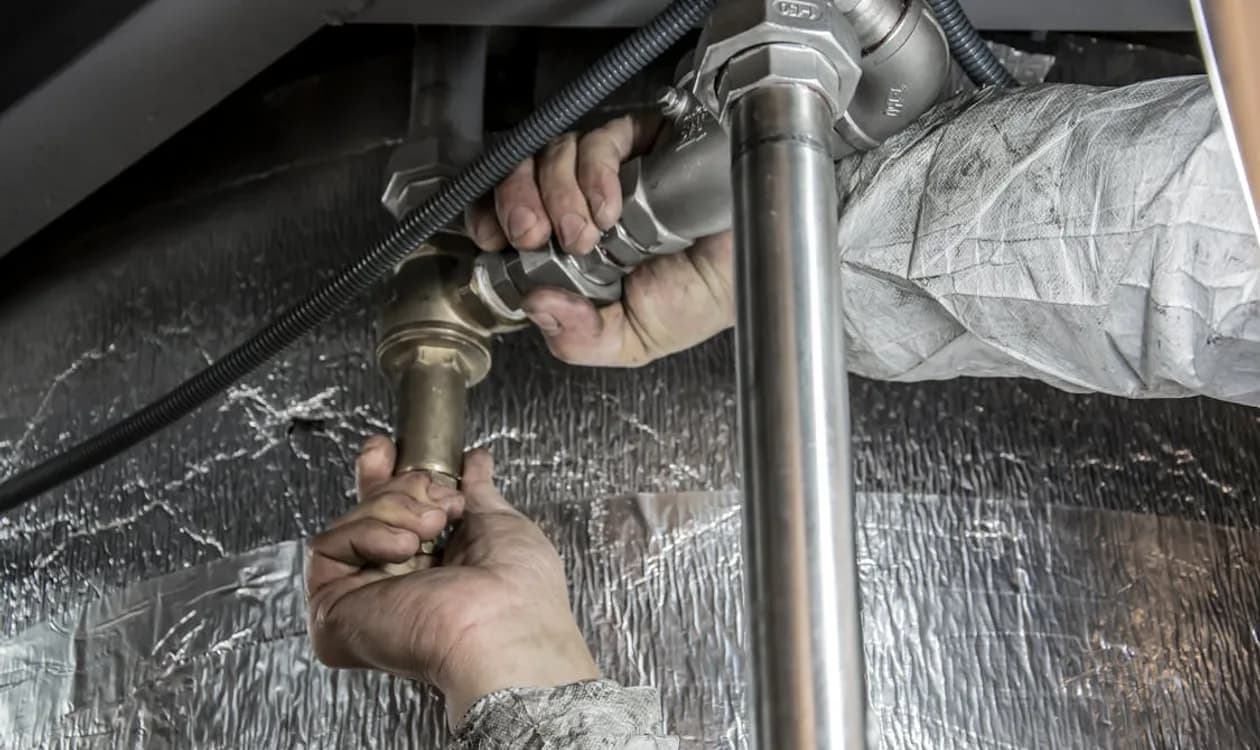
A whole-home filtration system installs on the main supply line before it branches to any fixture — typically in the garage or utility area near the main shutoff. The plumbing work involves cutting into the main supply, installing bypass valves, and connecting the treatment equipment in sequence. This is not a DIY project if it involves a water softener with a brine tank drain line, or a carbon tank that requires a drain connection for backwash cycles. Both need proper drain connections and, in most South Bay jurisdictions, a permit.
Space is a practical constraint that varies by city. In Old Lomita and older Gardena tract homes, the garage utility corner is usually workable — enough wall space and floor area for a softener tank and brine tank side by side. In a Hill Section Manhattan Beach townhome or a Valley Drive Hermosa Beach property with a utility closet instead of a garage, equipment sizing becomes a real constraint. Compact cabinet softeners exist for tight installations, but they have smaller resin volumes and regenerate more frequently, which affects salt use.
Our Licensed C-36 #901735 crew handles the full installation — cutting in, bypass valves, drain connections, and the startup programming on any automated softener or backwash carbon system. For homeowners evaluating options across our service area, our [water filtration services page](/services/water-filtration) covers the equipment we install and the typical scope of work.
What to do next
If you're starting from zero, get a water test before calling anyone. Hardness, TDS, and pH are the three numbers that matter most. If your hardness comes back above 200 mg/L, a softener is worth serious consideration. If you have chloramine odor or taste issues, catalytic carbon is the right layer. If you see visible particulates or have older mains in your neighborhood, add the sediment pre-filter.
If you already have a system installed and aren't sure when the media was last serviced, that's the first question to answer. A carbon tank on exhausted media is just a housing. A softener with a fouled resin bed is putting hardness back into your supply in some configurations.
To schedule a site visit or talk through your water quality situation, call Mainline No-Dig Trenchless Plumbing at (310) 808-7343. We're available 24/7 for dispatch, and there are no overtime fees for after-hours calls. We serve 16 South Bay cities from our Lomita headquarters, with no additional travel charges within our service area.
Tags